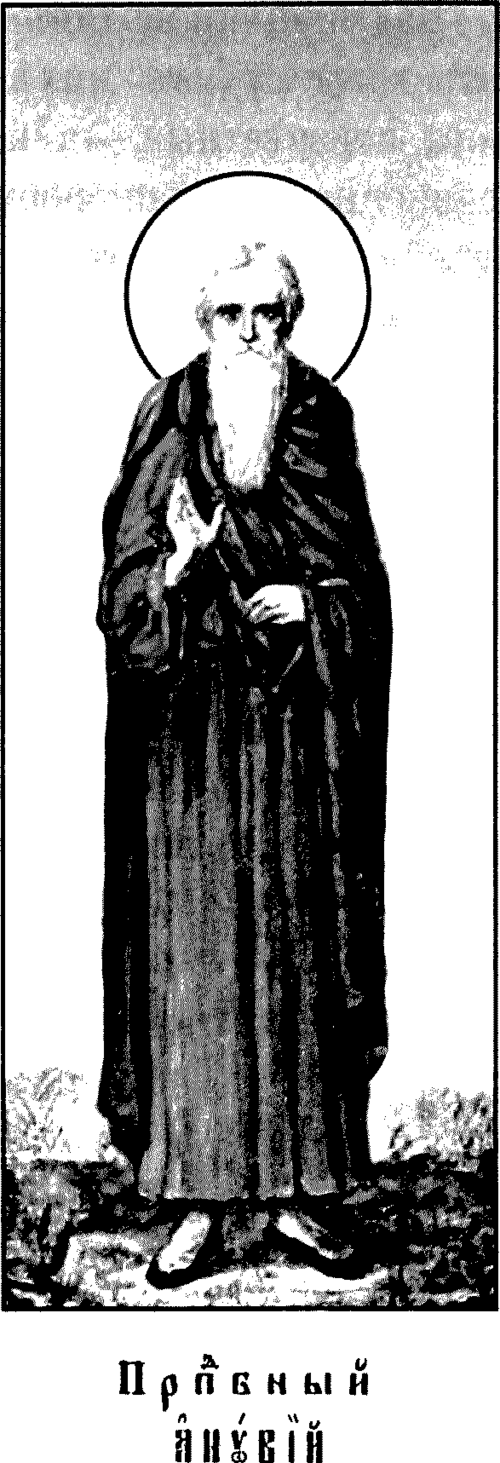
Venerable
Anoub of Scetis
Desert Father of Scetis
Egyptian ascetic of Scetis in the 4th and 5th centuries, mentioned in the Sayings of the Desert Fathers.
- Feast
- June 5old style June 18
- Reposed
- 4004th century
- Order
- Venerables
Life
Venerable Abba Anoub (Anubius), also called the Signbearer, was an Egyptian desert father, an ascetic of Scetis in Lower Egypt (today Wadi Natrun), in the fourth and fifth centuries. He is mentioned in the Sayings of the Desert Fathers. Saint Nikolaj Velimirović calls him one of the great Egyptian monks. He is commemorated on 5 June by the old calendar, which is 18 June by the new, in the Serbian Church, while the Greek and Slavonic verse synaxaria have him on 6 June.
Life
He was one of the seven blood brothers of Abba Poemen, together with Paësius. Poemen was their spiritual father, though Anoub was the eldest by age. It is said that before becoming a monk he was persecuted as a Christian and suffered much for the true faith. After the first attack of the Mazices barbarians on Scetis, in 407-408, which dispersed the monks, the seven brothers moved to the ancient city of Terenuthis in the western Delta, and Anoub took the leadership of the new monastic settlement. They formed a community of common life, occupying for a time an abandoned pagan temple. They kept a strict ascesis in which they spent all their time in prayer or in work, leaving only four hours a night for sleep. He fell asleep in peace in the second half of the fifth century.
It is told that when the brothers lived in the pagan temple, every morning Anoub threw stones at a statue and in the evening asked it to forgive him. Abba Poemen asked why he did so, and he answered that he did it for their sake: the statue did not become angry when struck and did not say it would not forgive when he bowed in repentance. He told them that if they wished to live together they must be like the statue, which is not moved whether beaten or praised, and otherwise there were four doors in the temple and each could go where he wished. The seven brothers decided to remain together.
Another time his brother Paësius told him that Abba Poemen spoke too harshly and showed him a small chest of gold, with which to start a monastery elsewhere. Anoub saw that his brother's greed could ruin him, but instead of rebuking him harshly he pretended to agree and took the chest on the way. At the crossing of a river he feigned losing his balance and let the gold fall into the water. Paësius said not to be distressed, since the coins were lost they could return to their brother, and they lived in peace. So Anoub hid the sins of others and saved them. Before his death three aged hermits visited him and, being gifted with insight, he revealed to them the secrets of their hearts.
His sayings
From the Sayings are preserved words such as: since the day when the name of Christ was invoked upon me, no lie has come out of my mouth. Abba Poemen said of him after his death: we lived together in complete unity and unbroken peace till death broke up our association. He who reproaches himself justifies his neighbour and covers his neighbour's sins.
Another Anoub
A Ukrainian source says that Anoub struggled in Upper Egypt and was a confessor in time of persecution, perhaps under Julian the Apostate, that he was fed by angels and died three days after a visit from the monks Syrus, Isaiah and Paul, told in the History of the Monks. The same source says it is not certain that he is the same as the one in the frescoes of the Bawit monastery.
Commemorated the same day June 5
 Boniface of MainzHieromartyr · Apostle of the GermansJun 5
 Dorotheus of GazaVenerable · Abbot near GazaJun 5
 Igor of ChernigovPassion-Bearer · Grand Prince of KievJun 5
 Luke of SimferopolSaint · Archbishop of CrimeaJun 5
 Dorotheus of TyreHieromartyr · Bishop of TyreJun 5
 Constantine I of KievSaint · Metropolitan of KievJun 5
- EobanHieromartyr · Bishop, companion of Saint BonifaceJun 5
 John of ValaamVenerable · Schema-abbot at New ValamoJun 5
 Jonah and VassianHoly VenerablesJun 5
 Theodore YaroslavichRight-Believing · Prince of NovgorodJun 5
 Peter of KorišaVenerable · HermitJun 5
- Theodore of the JordanVenerable · HermitJun 5