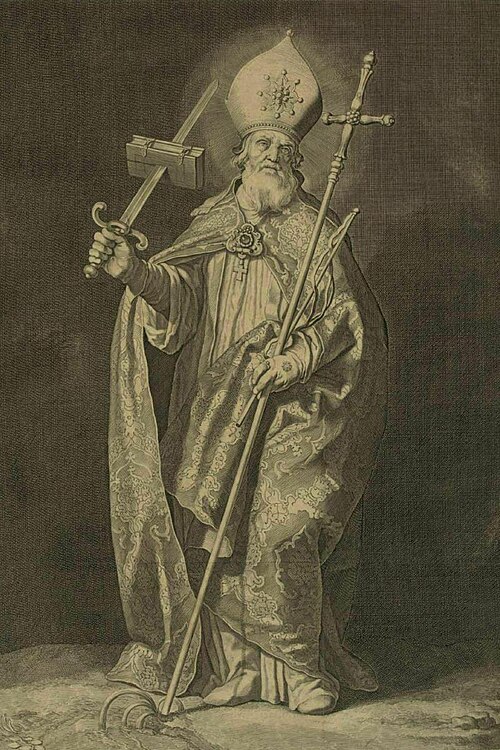
Hieromartyr
Boniface of Mainz
Apostle of the Germans
English monk and missionary bishop in the Germanic lands, killed by pagans in Frisia in 754.
Life
The Holy Hieromartyr Boniface of Mainz, born Wynfreth or Winfrid, was an English Benedictine monk, missionary and archbishop, called the Apostle of the Germans. He laid the foundations of the Church in Germany, organized the Church of the Franks and received the crown of martyrdom in Frisia, on 5 June 754, together with fifty-two companions. The Orthodox Church commemorates him on 5 June, as a saint of the time of the undivided Church, and his relics are kept at Fulda.
Beginnings
His oldest life, written by Willibald, does not say where he was born. Later tradition speaks of Crediton, and the year is placed around 675 (the Greek synaxarion says 672). Wynfreth came of a prosperous and respected family and, against his father's wishes, devoted himself to the monastic life from youth. He studied in the monastery at Exeter, then in the one at Nursling, near Southampton, under Abbot Winberht, a centre of learning. He taught in the monastery school, wrote the first Latin grammar produced in England, the Ars Grammatica, and at thirty was ordained priest.
First attempts in Frisia
In 716 he set out as a missionary to the Frisians, on the North Sea, but the war between Charles Martel and the Frisian king Radbod ruined the work. With Willibrord, the Apostle of the Frisians, he spent a year at Utrecht, then returned to Nursling. When Abbot Winberht fell asleep, the brethren wished to choose him, but Wynfreth refused the abbacy in order to give himself to the mission.
To Rome and Germany
In 718 or 719 he went to Rome, where Pope Gregory II named him a missionary bishop for the Germanic lands and gave him the name Boniface, after a martyr of the early centuries. He never saw England again, but kept in touch with his own people by letter to the end. He laboured in Thuringia, Hesse and Bavaria, baptized multitudes of pagans and brought back to the right faith Christians who had gone astray.
According to Willibald, at a place near Fritzlar in Hesse, Boniface began to cut down the oak sacred to the god Donar, which the biographer calls the oak of Jupiter. A strong wind overthrew the tree, and the pagans, seeing that the god took no vengeance, marvelled and believed. From its wood Boniface raised a church, the beginning of the monastery at Fritzlar. Scholars today observe that the event was most likely well prepared beforehand, near a Frankish fortress, and that the life presents it as the deed of one man alone.
Archbishop and reformer
In 732 Pope Gregory III gave him the pallium of an archbishop. On his third visit to Rome, in 737 or 738, he was named papal legate for Germany. With the support of Duke Odilo he established four dioceses in Bavaria, at Salzburg, Regensburg, Freising and Passau, and arranged others in Thuringia, Hesse and Franconia, among them Würzburg. In 745 the see of Mainz was given to him.
With the support of Carloman he gathered the Germanic Council in 743, which adopted stricter rules for the clergy. Boniface struggled for a Frankish Church bound more closely to Rome, but could not stop the seizure of Church property by the nobles. In 742 his disciple Sturm founded at Fulda the monastery that was to become a great centre of learning. The Greek synaxarion tells that Pepin the Short was crowned by him at Soissons in 751, but historians today consider this report uncertain.
His disciples
Boniface called from England devout men and women, who laboured with great effort for the conversion of the Germans and the organizing of the Church. Among them are the Saints Wigbert, Burchard, Lull, Thecla, Bertigita, Conrude and Lioba, who was his niece and came with thirty more nuns from the convent at Wimborne. He founded monasteries, among them Fulda and Ohrdruf. Many of his letters are preserved. In one, to Archbishop Cuthbert of Canterbury, he writes that we must not be dumb dogs, sleeping watchmen or hirelings who flee when they see the wolf, but watchful shepherds, preaching the Gospel to small and great, rich and poor, in every place and season.
Martyrdom
In 754, with the approval of Pope Stephen II, Boniface ordained Lull as his successor in Germany and, in old age, set out for eastern Frisia with a group of companions. That year he baptized thousands of pagans. He summoned the new Christians to a place not far from Dokkum, on the bank of a river, to receive Chrismation. In their place armed men came and attacked the missionary camp.
The lives say that Boniface restrained his companions who wished to defend themselves, with the words of Scripture about not repaying evil with evil but overcoming evil with good. He was killed on 5 June 754, together with fifty-two people, among them Bishop Eoban, three priests, three deacons, four monks and forty laymen. The attackers looked for treasure and found in the chests only books. One of them, the Ragyndrudis Codex, kept at Fulda, bears cuts that could have been made by a sword or an axe. According to his second life, a witness saw that the saint at the moment of death held a Gospel raised over his head, as a spiritual shield.
Relics and veneration
His body was taken from Frisia to Utrecht, then to Mainz, and finally to Fulda, where the sources tell differently the part played by Bishop Lull. The relics lie in a sarcophagus beneath the high altar of Fulda Cathedral, a place of Christian pilgrimage. His veneration at Fulda began right after his death. About ten years later the grave received an ornamented tomb. After the basilica of Ratgar was built, consecrated in 791, the relics were moved, and in 819 laid in a new apse. At Dokkum, according to Willibald, a spring burst forth where a passing rider's horse stuck its hoof in the mire, and by the ninth century there was a church there.
Saint Boniface is venerated in the West, above all in Germany, as patron of the Germanic lands. The Orthodox Church commemorates him on 5 June. The Doxologia portal of the Romanian Orthodox Church lists him on 5 June, as Saint Bonifatie, Apostle of Germany, and the Greek Synaxarion also has his life. Since he lived centuries before the division of the Churches, he is venerated by Orthodox as a saint of the undivided Church. In 2019 Devon County Council recognised him as patron saint of the county, with the support of local leaders of the Anglican, Catholic, Orthodox and other Churches.
Commemorated the same day June 5
 Dorotheus of GazaVenerable · Abbot near GazaJun 5
 Igor of ChernigovPassion-Bearer · Grand Prince of KievJun 5
 Luke of SimferopolSaint · Archbishop of CrimeaJun 5
 Dorotheus of TyreHieromartyr · Bishop of TyreJun 5
 Constantine I of KievSaint · Metropolitan of KievJun 5
- EobanHieromartyr · Bishop, companion of Saint BonifaceJun 5
 John of ValaamVenerable · Schema-abbot at New ValamoJun 5
 Jonah and VassianHoly VenerablesJun 5
 Anoub of ScetisVenerable · Desert Father of ScetisJun 5
 Theodore YaroslavichRight-Believing · Prince of NovgorodJun 5
 Peter of KorišaVenerable · HermitJun 5
- Theodore of the JordanVenerable · HermitJun 5