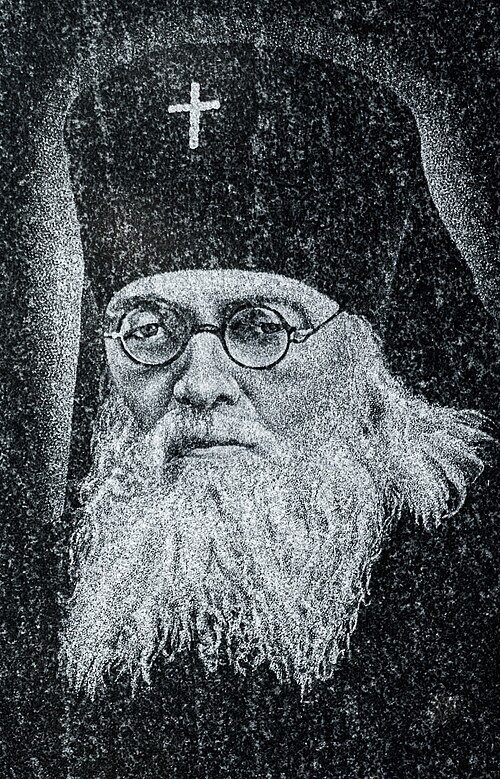
Saint
Luke of Simferopol
Archbishop of Crimea
Renowned surgeon and archbishop, author of medical and spiritual works, who died in 1961 in Simferopol.
Life
Saint Luke of Crimea, born Valentin Felixovich Voyno-Yasenetsky, was a distinguished surgeon, a spiritual writer and the archbishop of Simferopol and Crimea. He was born on 27 April 1877 at Kerch and fell asleep on 11 June 1961 at Simferopol, after long years of persecution in the Soviet Union. The Church honours him as a confessor and as a protector of the sick, and he is known as Luke the Blessed Surgeon.
Youth and the call to medicine
His father, Felix, was a pharmacist of Polish origin and a Roman Catholic, while his mother, Maria Dmitrievna, was Orthodox; she ran the household and was active in works of mercy. In 1889 the family moved to Kiev, where Valentin finished the gymnasium and an art school. For a long time he hesitated between painting and medicine and chose medicine because he wanted to serve simple and poor people. According to his memoirs he received no religious upbringing at home, and when he left school the principal gave him a New Testament, by careful study of which he came to know the teaching of Christ.
Among the attractions of his youth was a short closeness to the ideas of Leo Tolstoy, from which he turned away after reading Tolstoy's book on faith. From 1898 he studied medicine at Kiev University and stood out in anatomy, where his skill in drawing served him well. In 1904 he went as a doctor to the Russo-Japanese War and headed the surgical department of a hospital at Chita. There he saw how often wounds became infected and began to think about purulent surgery. At the end of that year he married Anna Vasilievna Lanskaya, a nurse known for her kindness and faith, who was a help to him in his work.
The surgeon
For many years he worked as a district doctor in country hospitals, then at Kiev, at Petrograd and, from 1916, at Tashkent, where he hoped the warm climate would help his wife, who was ill with tuberculosis. Anna died in October 1919, and he never married again. He became professor of anatomy and surgery at the new university of Tashkent and headed one of the best-known surgical clinics of Central Asia.
He made a close study of regional anaesthesia, described the treatment of trigeminal neuralgia by local anaesthesia and earned the doctorate in medicine. His chief work, Essays on Purulent Surgery, published in 1934, remained a standard manual; in the years when antibiotics were lacking it was of great importance. He prayed to the Mother of God before every operation, kept an icon in the operating room and gave his lectures in clerical dress, with a cross around his neck.
Priest and bishop
In February 1921, in the midst of persecution, he was ordained deacon and a week later priest. In 1923 he was tonsured a monk with the name Luke, after the Evangelist Luke, who was both physician and painter, and was consecrated bishop of Tashkent and Turkestan. He did not give up surgery. In the same year he was arrested on a charge of anti-Soviet activity and sent to Siberia.
In all he spent eleven years in exile and prison. He later served as bishop of Yelets, as archbishop of Krasnoyarsk during the war years, when he worked in the military hospitals, and then as archbishop of Tambov. In April 1946 he was appointed archbishop of Simferopol and Crimea. For his work on purulent surgery he received the Stalin Prize that same year, and for his wartime labour a medal. From 1955 he was totally blind. In 1958 he wrote how hard it had been to swim against the stormy current of antireligious propaganda, how much suffering it had caused him and still caused him. He fell asleep in the Lord on 11 June 1961.
Veneration
In 1995 the Synod of the Ukrainian Orthodox Church recognised his local veneration, and the Russian Orthodox Church canonised him as a confessor in 2000. On 17 March 1996, before many thousands of people, his relics were uncovered; it is said that an indescribable fragrance rose from them, and his heart was found incorrupt. Three days later they were placed in the Cathedral of the Holy Trinity at Simferopol. On 13 June 2019 the Ecumenical Patriarchate also numbered him among the saints.
Parts of his relics are in Greece, at the Sagmata Monastery in Boeotia and elsewhere, in the Antiochian Orthodox church at Raleigh, and in the cathedral of Saint Marina at Plovdiv in Bulgaria. At Belgrade the chapel of the Military Medical Academy bears his name. His feast is kept on 11 June, and on 18 March the finding of his relics is remembered.
Commemorated the same day June 5
 Boniface of MainzHieromartyr · Apostle of the GermansJun 5
 Dorotheus of GazaVenerable · Abbot near GazaJun 5
 Igor of ChernigovPassion-Bearer · Grand Prince of KievJun 5
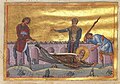 Dorotheus of TyreHieromartyr · Bishop of TyreJun 5
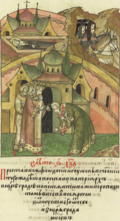 Constantine I of KievSaint · Metropolitan of KievJun 5
- EobanHieromartyr · Bishop, companion of Saint BonifaceJun 5
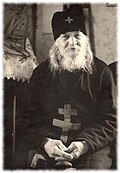 John of ValaamVenerable · Schema-abbot at New ValamoJun 5
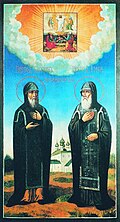 Jonah and VassianHoly VenerablesJun 5
 Anoub of ScetisVenerable · Desert Father of ScetisJun 5
 Theodore YaroslavichRight-Believing · Prince of NovgorodJun 5
 Peter of KorišaVenerable · HermitJun 5
- Theodore of the JordanVenerable · HermitJun 5