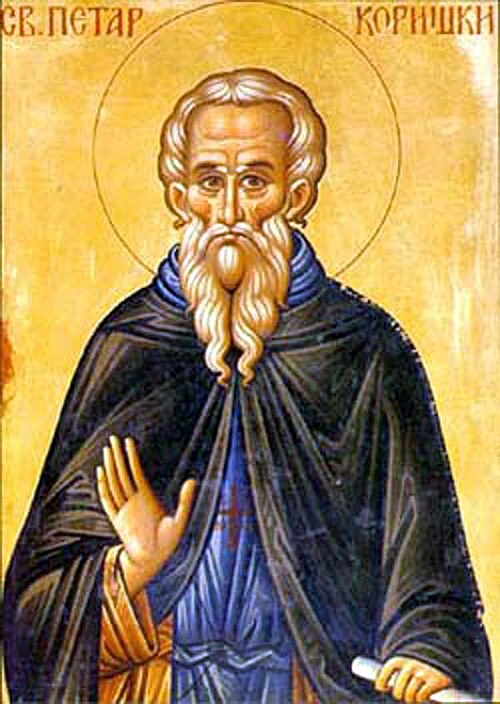
Venerable
Peter of Koriša
Hermit
The first hermit saint of medieval Serbia, who lived in a cave in the Šar Mountains and worked wonders.
- Feast
- June 5old style June 18
- Era
- unknown
- Place
- Serbia
- Order
- Venerables
Life
Venerable Peter of Koriša (Petar Koriški) was the first hermit saint of medieval Serbia, who lived in caves in the Šar Mountains and became known as an ascetic and wonderworker. He lived in the thirteenth century and died toward the end of it, in an unknown year, on 5 June (or, according to one source, 29 June). The Serbian Orthodox Church commemorates him on 5 June (18 June in the new calendar). Another source says he was the only saint who was neither a ruler of the state nor head of the Church; this would be an exception made by the Serbian Church.
His life
His birthplace is not certain: according to the English source he was born at Ujmir, a village south-west of Peć, while according to the Serbian one he came from the village of Koriša, near the Monastery of Saint Mark close to Prizren, where his uncle Mark of Koriša had struggled; tradition also names Hvosno of Dioclea, and the Bulgarian source gives Koriša or Ujmir. He died at Koriša. In youth he toiled in poverty, ploughing the land with a one-eyed ox, and was unusually meek and free of anger. After the death of his parents he and his sister Elena withdrew from the world. The English source says both joined a monastic community and then became hermits; the Serbian source that he struggled very hard and persistently in solitude, in one of the high, hard-to-reach caves of Altina (around Đakovica). The Bulgarian source says he left his sister secretly and, according to Theodosius, became a monk in the monastery of Saints Peter and Paul near Ujmir, while according to another version he went to the mountain of Koriša, where he chose a cave as his place of quiet and fasting.
Christian tradition says he came out victorious from the hard struggle with demonic temptations. When he had grown calm and reached a higher spiritual stage, he moved to a small cave of irregular shape near the village of Koriša, which he used as a place of prayer. The cave had frescoes which he had paid for. It was hidden, hard to reach, on a steep cliff in the canyon of the river Koriša. Opposite it is another, the cell of his sister Elena, with a church of the Mother of God. A multitude of monks gathered around him and he was their teacher; so Peter formed a small Holy Mountain of Koriša around the monastery that bears his name. Fleeing human glory, which began to trouble him there too, he withdrew for a time to Crna Reka, where Saint Joanikije of Devič struggled later. A legend of a dragon is also told of him; of it, of his sister the hermit Elena, and of the transfer of the relics from the stone tomb in the cave to the Monastery of Crna Reka in 1840, Konstantin Jireček wrote. He died in deep old age in his cave at Koriša. The faithful believe that on the night of his death the light of many candles was seen in the cave and angelic singing was heard.
Veneration and relics
Tsar Dušan came in 1355 with his family to venerate the saint's relics (between 1346 and 1355 according to the Bulgarian source, which also says that Dušan, hunting, found the relics by chance and then brought there his wife Helena and son Stefan Uroš). Over the relics he built a church, a metochion of Hilandar, built by the Hilandar elder Gregory beside the cave cell. The village of Koriša is mentioned as a metochion of Hilandar in Dušan's charter of 1343. Later the remains of the relics were moved secretly to Crna Reka, where they are now. Peter's church had a single nave, leaning against the cliff, and in it was the saint's tomb; a small door led from the church into the cave. When the church he had built above the village of Koriša was torn down in 1760, the relics were hurriedly hidden; in 1763 peasants of the village of Brnjak moved them to the nearby Monastery of the Holy Archangel, Saint Janićije's foundation. The book that the saint always carried with him was buried in his shrine.
In an old church in Veles, the Holy Saviour, the relics of the saint (Saint Peter the Serb) were discovered in February 1926, together with those of Saint Eustathius, in a wooden shrine covered in silver and red velvet. On the silver was engraved: "Relics of the holy venerable Peter of Serbia, on the day of 29 June." According to a third inscription, they were deposited by Patriarch Joanikije of Serbia on 30 August 1752. The shrine had been strictly guarded against the Turks and the Bulgarian Exarchists. His Service and Life were written by the Hilandar monk Theodosius between 1309 and 1310 at the urging of Bishop Gregory of Raška-Prizren; it was his last work. His narrative has features of a novel. The English source says that Theodosius popularized Peter "in the next century", which does not fit the dates in the Serbian source.
On his origin the sources differ as follows: Golubinsky counted him among the Bulgarian saints, on the basis of Theodosius, who wrote his life at the Rila Monastery; according to Ivan Yastrebov, he lived and withdrew at the monastery of Saints Peter and Paul in Altina, then wished to retreat across the Has mountains to the Prizren mountains. The Bulgarian source nevertheless regards him as canonically and traditionally venerated also as a Serbian saint, together with John of Devič. In 2025 the Albanian authorities in Kosovo carried out construction work near the Hermitage of Saint Peter of Koriša without the approval of the Serbian Orthodox Church, which provoked a protest from the Serbian Church.
Commemorated the same day June 5
 Boniface of MainzHieromartyr · Apostle of the GermansJun 5
 Dorotheus of GazaVenerable · Abbot near GazaJun 5
 Igor of ChernigovPassion-Bearer · Grand Prince of KievJun 5
 Luke of SimferopolSaint · Archbishop of CrimeaJun 5
 Dorotheus of TyreHieromartyr · Bishop of TyreJun 5
 Constantine I of KievSaint · Metropolitan of KievJun 5
- EobanHieromartyr · Bishop, companion of Saint BonifaceJun 5
 John of ValaamVenerable · Schema-abbot at New ValamoJun 5
 Jonah and VassianHoly VenerablesJun 5
 Anoub of ScetisVenerable · Desert Father of ScetisJun 5
 Theodore YaroslavichRight-Believing · Prince of NovgorodJun 5
- Theodore of the JordanVenerable · HermitJun 5