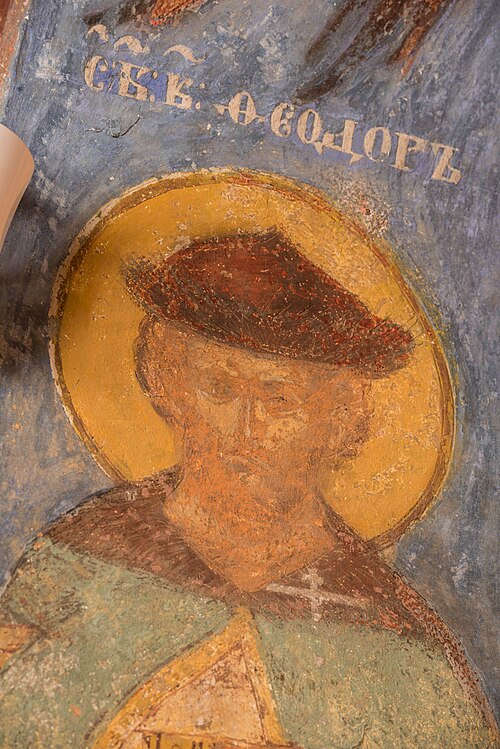
Right-Believing
Theodore Yaroslavich
Prince of Novgorod
Son of Grand Prince Yaroslav Vsevolodovich, Prince of Novgorod in 1228-1229 and 1230-1233, who died in 1233.
- Feast
- June 5old style June 18
- Reposed
- 123313th century
- Place
- Veliky Novgorod
Life
The right-believing Prince Theodore Yaroslavich was prince of Novgorod in the years 1228 to 1229 and 1230 to 1233, son of the grand prince Yaroslav Vsevolodovich and elder brother of Alexander Nevsky. He was born in 1219 (by other reports, in February 1220) and died unexpectedly on 5 June 1233, at only thirteen. The Russian Church honours him among the right-believing princes on 5 June. The place of his relics is in doubt.
Childhood
He was the son of the grand prince of Kyiv and Vladimir, Yaroslav Vsevolodovich, by his second marriage, to Rostislava-Theodosia Mstislavna, in monastic life Euphrosyne, daughter of Prince Mstislav the Bold of Novgorod and Galicia. He was born at Pereyaslavl. His name was unusual in the history of the Rurikids in two ways: he received at baptism the same name as his father, Yaroslav-Theodore Vsevolodovich, and, most probably, no Slavic "princely" name was given to him, or to his brother Alexander, for all the sources call them only by Christian names. In 1225 Yaroslav performed for his sons the "princely tonsure", the rite of initiation as warriors, carried out by Bishop Simon of Suzdal, after which the boyar voivode Fyodor Danilovich began to teach them the craft of arms.
At Novgorod
In 1228 Theodore, aged eight, and his younger brother Alexander (Nevsky), seven, were left by their father at Novgorod, under the care of Fyodor Danilovich and the tiun Yakim, while their father, with the army of Pereyaslavl, was preparing to set out on a campaign against Riga. In winter, in time of famine, without waiting for the father's answer to the Novgorodians' request to abolish the levy called zabozhnichye, in the night of 20 February 1229 Fyodor Danilovich and the tiun Yakim fled secretly from the city with the princes Theodore and Alexander, fearing reprisals from the rebellious Novgorodians. In 1230, when the Novgorodians called Yaroslav again, he, after two weeks at Novgorod, set Theodore on the throne in the land of Novgorod, together with Alexander. In 1232, by order of his uncle, the grand prince Yury Vsevolodovich, he took part in a campaign against the Mordvins. He died unexpectedly, aged thirteen, before the planned marriage to the daughter of Michael of Chernigov, Euphrosyne, also canonized later, at Novgorod, on 5 June 1233. He was buried in the cathedral of Saint George of the Yuriev monastery, beside the south entrance.
The relics
In the early 1930s M. K. Karger opened the sarcophagus and found the bones of an adolescent of thirteen to fifteen, thrown about in disorder. The remains taken out at the excavations were displayed in the cathedral of the Yuriev monastery and were destroyed during the Fascist occupation of Novgorod. After the Time of Troubles the army of the Swedish commander Jacob De la Gardie was in the land of Novgorod, called to defend against the Poles. In 1616 (or 1614) Swedish marauders plundered the burials of the cathedral of Saint George. From the Roll of the shrines of Novgorod of 1634 it appears that his body, probably the one displayed by the church wall, was judged incorrupt and moved as holy relics to the Nativity of the Mother of God chapel of the Saint Sophia cathedral in Novgorod.
In 1987 the archaeological expedition of V. L. Yanin opened the burial of "Prince Fyodor Yaroslavich" and a forensic examination of the mummified remains was made. It was established that they belonged to a man of forty-five to fifty, who could not be the adolescent Theodore Yaroslavich. The excavations at both the cathedral of Saint George and Saint Sophia proved that this mummy was that of Prince Dmitry Shemyaka. The second version of the place of the saint prince's relics is the city of Vladimir. According to the tradition inscribed on the walls of the church of Saint George in Vladimir, the relics of Saint Theodore and of his mother, Theodosia Mstislavna (in monastic life Euphrosyne), are there.
Commemorated the same day June 5
 Boniface of MainzHieromartyr · Apostle of the GermansJun 5
 Dorotheus of GazaVenerable · Abbot near GazaJun 5
 Igor of ChernigovPassion-Bearer · Grand Prince of KievJun 5
 Luke of SimferopolSaint · Archbishop of CrimeaJun 5
 Dorotheus of TyreHieromartyr · Bishop of TyreJun 5
 Constantine I of KievSaint · Metropolitan of KievJun 5
- EobanHieromartyr · Bishop, companion of Saint BonifaceJun 5
 John of ValaamVenerable · Schema-abbot at New ValamoJun 5
 Jonah and VassianHoly VenerablesJun 5
 Anoub of ScetisVenerable · Desert Father of ScetisJun 5
 Peter of KorišaVenerable · HermitJun 5
- Theodore of the JordanVenerable · HermitJun 5