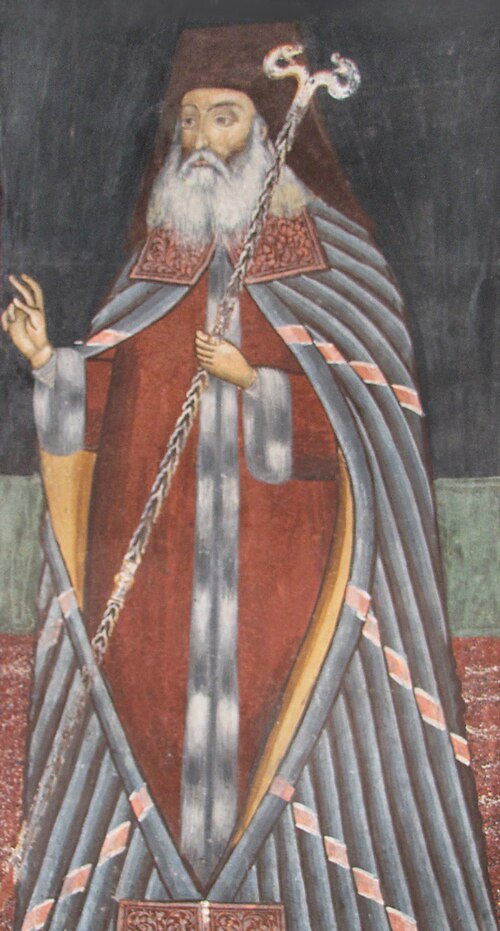
Hieromartyr
Anthim the Iberian
Metropolitan of Ungro-Wallachia
Georgian by birth, Metropolitan of Ungro-Wallachia, printer and scholar, who died a martyr in 1716.
- Feast
- September 27old style October 10
- Reposed
- 171618th century
- Place
- Gelibolu
- Order
- Martyrs
Life
Saint Anthim the Iberian, hieromartyr, was metropolitan of Ungro-Wallachia, printer, engraver, sculptor, theologian and writer, a Georgian by birth, one of the great figures of old Romanian culture. He was born around 1650 in Iberia (Georgia) and died a martyr in September or October 1716. The Romanian Orthodox Church canonized him in 1992 and commemorates him on 27 September. The year 2016 was declared the Year of Saint Anthim the Iberian, three hundred years after his martyrdom.
Youth Neither the year of his birth nor the place in Georgia is known for certain. He himself used the names Anthim, Georgian by race, and hieromonk from Iberia. As a young man he was taken captive by the Turks, brought to Constantinople and sold as a slave. According to some sources, a patriarch, Dositheos of Jerusalem, ransomed him. He lived near the Patriarchate, where he learned wood carving, painting, embroidery, calligraphy and the Greek, Arabic and Turkish languages. Probably in this time he was tonsured with the name Anthim and ordained hieromonk. It is said that he spoke and wrote, besides Georgian, Greek, Turkish and Arabic.
In Wallachia In 1689 to 1690 he was brought to Wallachia by Prince Constantin Brâncoveanu. He learned the Romanian and Slavonic languages and the craft of printing. In 1691 he was given charge of the princely press at Bucharest. After 1694 to 1696 he was appointed abbot of the Snagov Monastery, where he moved the press; in 1693 the Gospels had been printed in Romanian. He printed Greek, Romanian and Slavonic books and even bilingual ones, among them a Greek-Arabic Missal, being the first in Wallachia to use Arabic type. Between 1701 and 1705 he worked again in Bucharest. In 1705 he was consecrated bishop of Râmnic, and in 1708 metropolitan of Ungro-Wallachia. In 1709 he set up a press at Târgoviște. He helped introduce the Romanian language into the Church as its official language.
Also in 1709 he founded the first Georgian printing press at Tbilisi. Through his pupil Mihai Iștvanovici he trained Georgians in the art of printing and himself cut the type with which the first Georgian Gospels were printed, in 1710. In all he printed dozens of books, in Romanian, Slavonic, Greek, Arabic and Georgian. He wrote the Didahii, a collection of sermons for the great feasts, in which he sharply criticized the habits and morals of his time and drew, alongside Christian sources, on classical philosophy. He founded the first public library in Bucharest and between 1713 and 1715 built the All Saints Monastery in Bucharest, now called Antim, for which he composed the rule in thirty-two chapters, painted the door and windows with ornaments combining Georgian and Romanian features, and carved pieces for the church's iconostasis. Under his direction more than twenty churches and monasteries were built.
Martyrdom After the Turks executed Constantin Brâncoveanu, in 1714, they set the Phanariote Nicholas Mavrocordatos on the throne of Wallachia. Anthim openly opposed Ottoman and Phanariote rule and gathered patriotic boyars around him. Mavrocordatos suspected him of conspiracy and asked him to leave his see, and Anthim did not comply. A synod of bishops, without a single Romanian cleric, condemned him, stripped him of his rank as hierarch and as monk and anathematized him. Mavrocordatos condemned him to life exile at the monastery of Sinai. Taken out of the city at night, for fear of the people, he was killed on the road by Turkish soldiers, near Gallipoli or Adrianople, and his body was thrown into a river, according to some sources the Maritsa or the Tundzha. It appears that the killing was ordered by the prince himself.
Veneration Anthim the Iberian was numbered among the saints in 1992. He is regarded as a symbol of the ties between Romania and Georgia; the Georgian Church commemorates him on 13 June, and the Russian Church entered him in its calendar in 2018. A rugby trophy contested yearly between Romania and Georgia bears his name.
Commemorated the same day September 27
 John MarkApostle · Companion of Paul and BarnabasSep 27
 Sigebert of East AngliaRight-Believing · King of East AngliaSep 27
 Sabbatius of SolovkiVenerable · Co-founder of Solovki MonasterySep 27
 Zenas the LawyerApostle · Apostle of the SeventySep 27
 Caius of MilanSaint · Bishop of MilanSep 27
 Peter of KrutitsyHieromartyr · Metropolitan of KrutitsySep 27
- Flavian of AntiochSaint · Patriarch of AntiochSep 27
 Callistratus of CarthageMartyrSep 27
 Aquilina of ZagliveriNew MartyrSep 27
 Herman KosolapovHieromartyr · Bishop of VolskSep 27
- AdheritusSaintSep 27
- Adheritus of RavennaSaintSep 27