Martyr
Callistratus of Carthage
Martyr of Carthage, executed at Rome with forty-nine companions during Diocletian's persecution.
- Feast
- September 27old style October 10
- Reposed
- 3044th century
- Place
- Byzantium
- Order
- Martyrs
Life
Holy Martyr Callistratus of Carthage and his forty-nine companions were Christian martyrs, soldiers, killed in the time of the persecution of Diocletian, in the year 304 by our data. They are remembered on 27 September in the synaxarion of Constantinople, and in the Roman Martyrology on 26 September. Our sources do not agree on the place of the martyrdom: one says at Rome, another at Constantinople (Byzantium). The account we rely on comes from the compilation of Symeon Metaphrastes and has parts that cannot be verified.
Life
Callistratus was born at Carthage, into a Christian family. He lived in the time of the persecution of the Christians by the Roman emperors Diocletian and Maximinus Daia and was an officer in the cohort (by one source "Chalendon") commanded, by one, by the general Persentinus. Once, being seen at prayer, he was denounced to the commander by his pagan comrades. The commander asked him to offer sacrifice to the pagan gods, to show loyalty to the emperor and to the ruling religion. Callistratus refused, and so he was tortured, tied in a sack and thrown into the sea. According to the story, he was saved by a dolphin, or by dolphins, and after he came ashore he preached the Gospel to the forty-nine soldiers who had seen his miraculous rescue. All became Christians. They were arrested together with Callistratus and put to death. The miracles that happened then (the breaking of the chains, the earthquake) led other soldiers too to leave paganism. Callistratus was, by one source, cut into pieces. Other Christian soldiers buried their bodies and there a veneration began, and later a church was built on the spot.
Veneration and image
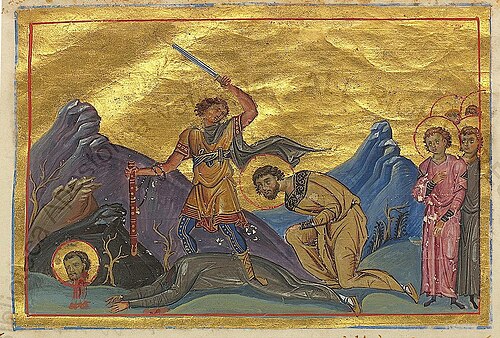
In the Middle Ages the relics of Callistratus were kept in Constantinople and venerated as wonderworking. The Armenian Church remembers Callistratus and his companions on the Monday after the fifth Sunday after Pentecost. His earliest depiction in art is in the Menologion produced for the emperor Basil II about the year 1000. Although a warrior saint, he is not shown as a soldier, but beheaded, and so the pattern of later depictions was set. In a manuscript at Oxford he is shown as a prince. Callistratus and his companions are painted in the church of the Transfiguration, in the monasteries of Meteora and Cozia and, in bust, in the church at Pelinovo.
Commemorated the same day September 27
 Anthim the IberianHieromartyr · Metropolitan of Ungro-WallachiaSep 27
 John MarkApostle · Companion of Paul and BarnabasSep 27
 Sigebert of East AngliaRight-Believing · King of East AngliaSep 27
 Sabbatius of SolovkiVenerable · Co-founder of Solovki MonasterySep 27
 Zenas the LawyerApostle · Apostle of the SeventySep 27
 Caius of MilanSaint · Bishop of MilanSep 27
 Peter of KrutitsyHieromartyr · Metropolitan of KrutitsySep 27
- Flavian of AntiochSaint · Patriarch of AntiochSep 27
 Aquilina of ZagliveriNew MartyrSep 27
 Herman KosolapovHieromartyr · Bishop of VolskSep 27
- AdheritusSaintSep 27
- Adheritus of RavennaSaintSep 27