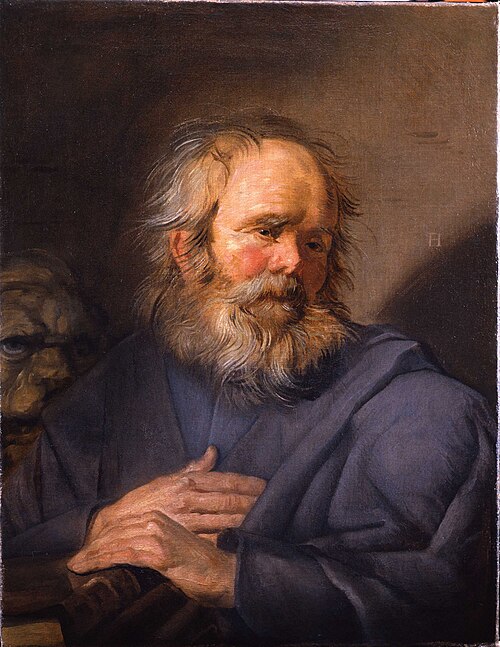
Apostle
John Mark
Companion of Paul and Barnabas
Companion of the Apostles Paul and Barnabas on their missionary journeys, counted among the Seventy.
- Feast
- September 27old style October 10
- Reposed
- 1001st century
- Place
- Alexandria
- Order
- Apostles
Life
Holy Apostle John Mark, called in the Acts of the Apostles "John, who was also called Mark," is remembered as the assistant and companion of the holy Apostles Paul and Barnabas on their missionary journeys. The Orthodox Church counts him among the Seventy Apostles, regards him as the nephew of Barnabas and a disciple of Saint Peter, and commemorates him on 27 September. The tradition of the Orthodox Church calls him bishop of the city of Byblos in Phoenicia.
In Holy Scripture
The Acts of the Apostles mention "John, who was also called Mark," or simply "John," several times. He was a resident of Jerusalem, the son of a woman named Mary, whose house was a place of assembly and prayer for the apostles and for the community of Jerusalem. Saint Peter came to her house after he was freed from prison by a miracle.
Leaving Jerusalem, Barnabas and Paul took John Mark with them. Acts shows him taking part in proclaiming the word at Salamis in Cyprus, and from the word "for ministry" some understand that he had been ordained deacon. When Paul and his companions sailed from Cyprus to Pamphylia, Mark parted from them and returned to Jerusalem. The reasons for this departure have been much discussed, but the data are too few to say anything with certainty.
In chapter 15, Acts tells that Barnabas wished to take him again, while Paul thought it not right to take one who had withdrawn from them in Pamphylia. The disagreement was so sharp that they parted: Barnabas took Mark and sailed to Cyprus, and Paul chose Silas. After this, in the narrative of Acts, the two disappear from view.
Saint John Chrysostom and Paul
Saint John Chrysostom sees good in this parting: each apostle then worked separately more than they could have together, and for Mark the disagreement was of great benefit. Paul's strictness corrected him, and Barnabas's kindness did not let him be lost; so the quarrel of the teachers set the disciple right. Paul treated Mark well: in the Epistle to the Colossians he calls him the cousin of Barnabas and asks that he be received, and in later epistles he calls him his fellow worker. In the Second Epistle to Timothy he writes to bring Mark with him, because he is useful to him for ministry.
Preaching and veneration
It is not known where Barnabas and Mark preached after parting from Paul. Tradition places him at Byblos in Phoenicia, as bishop. The Menaion of Dimitry of Rostov says that he was appointed by the apostles in Babylon and labored zealously in preaching the Gospel, reaching such boldness before God that even his shadow healed the sick. The year of his death is not known; some think he was buried at Ephesus.
The old tradition distinguished John Mark from the other Marks of the New Testament. Mark the Evangelist, the disciple of Peter, is in Orthodox tradition another person, and the cousin of Barnabas mentioned by Paul was regarded as bishop of Apollonia. In the Middle Ages, more and more sources saw in all the New Testament mentions of Mark a single person, and many modern scholars agree.
The Orthodox Church commemorates him on 27 September (10 October by the new calendar), with the apostle Zena, and at the Synaxis of the Seventy Apostles in January. The Catholic Church also commemorates him on 27 September.
Commemorated the same day September 27
 Anthim the IberianHieromartyr · Metropolitan of Ungro-WallachiaSep 27
 Sigebert of East AngliaRight-Believing · King of East AngliaSep 27
 Sabbatius of SolovkiVenerable · Co-founder of Solovki MonasterySep 27
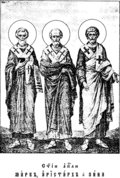 Zenas the LawyerApostle · Apostle of the SeventySep 27
 Caius of MilanSaint · Bishop of MilanSep 27
 Peter of KrutitsyHieromartyr · Metropolitan of KrutitsySep 27
- Flavian of AntiochSaint · Patriarch of AntiochSep 27
 Callistratus of CarthageMartyrSep 27
 Aquilina of ZagliveriNew MartyrSep 27
 Herman KosolapovHieromartyr · Bishop of VolskSep 27
- AdheritusSaintSep 27
- Adheritus of RavennaSaintSep 27