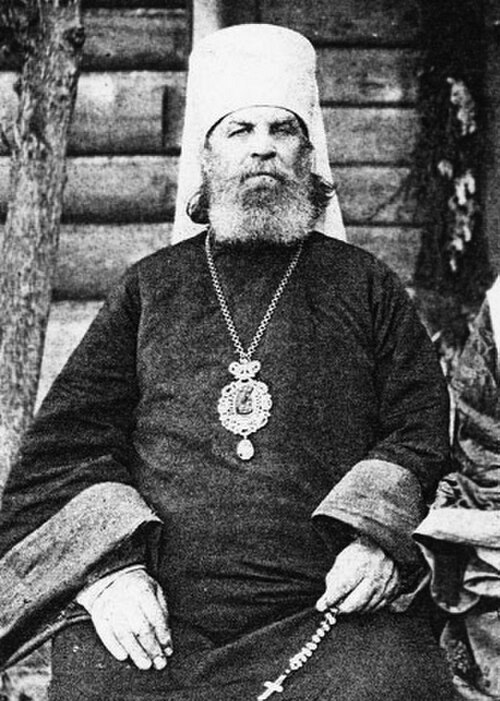
Hieromartyr
Peter of Krutitsy
Metropolitan of Krutitsy
Metropolitan of Krutitsy, head of the Russian Church from April to December 1925; died a martyr in 1937.
- Feast
- September 27old style October 10
- Reposed
- 193720th century
- Place
- Verkhneuralsk
- Order
- Martyrs
Life
Saint Peter, hieromartyr and metropolitan of Krutitsy (in the world Pyotr Fyodorovich Polyansky), born on 28 June (10 July) 1862, was a bishop of the Russian Orthodox Church, patriarchal locum tenens from 12 April to 9 December 1925, and remained so nominally until his death despite imprisonment. He died a martyr in 1937, on 27 September by the old style, that is 10 October. He is commemorated on 27 September. The Russian Church glorified him among the New Martyrs and Confessors of Russia at the Council of Bishops in 1997.
Youth and years of work
He was born in the village of Storozhevoye in the Korotoyak district, Voronezh governorate, in the family of a parish priest. In 1875 he entered the theological school at Kostroma, finishing in 1879, then the seminary at Voronezh, completed in 1885 with first-class honours. He was first a psalm-reader at the church of the village of Devitsa. In 1887 he became an auditor and then a student at the Moscow Theological Academy, where, according to his fellow student, the future metropolitan Evlogy (Georgievsky), he was good-natured, easygoing and kindly. Cheerful memories of his nature survive: the man of enormous height once hid from the assistant inspector in a wardrobe but was found, because the wardrobe was barely bigger than he. He studied without haste and without exhausting himself. In 1892 he graduated from the academy with the degree of candidate of theology, for his work "On the Pastoral Epistles".
He stayed at the academy as assistant inspector, taught the Law of God without pay at a private girls' school in Sergiev Posad and was secretary of the Society for Rescue on the Water. He did not marry, but neither did he take monastic vows, although monasticism together with advanced theological studies would have opened a career to him. From his years at the academy he was a friend of the future patriarch Sergius (Stragorodsky). In 1895 he was church warden at the Epiphany church in his native village, praised by the bishop for his zeal in adorning it. In 1896 he briefly taught Greek at the theological school of Zvenigorod, and in December 1896 was appointed superintendent of the theological school of Zhirovichi, which he raised to a high level, gathering the teachers like a family by his cheerful nature. In 1897 he received the title of master of theology for his work on the First Epistle of the Holy Apostle Paul to Timothy. There he met Archimandrite Tikhon (Bellavin) of the Yablochin monastery, the future patriarch, received the Order of Saint Stanislaus third class and was rewarded by the Holy Synod with a Bible for his care of the parish schools. In 1902 he also received the bishop's blessing with a diploma of praise.
In 1906 he was transferred to Saint Petersburg as assistant to the secretary of the Educational Committee of the Holy Synod, although his salary fell two and a half times and he lost his official lodging. He became a member of the committee, chiefly as inspector of theological schools. He inspected seminaries and diocesan girls' schools in Kursk, Novgorod, Vologda, Kostroma, Minsk and other dioceses, then Siberia, the Urals and Transcaucasia, and after each journey made a detailed report with measures for improvement. From 1906 to 1918 he worked in this institution of the Holy Synod, becoming secretary by 1915, with the rank of Active State Councillor, Class IV, equivalent to major general, as inspector of all theological schools. Travelling widely, he made friends with the future patriarchs Tikhon and Sergius. Remaining a layman, he did not seek ordination, but served for most of his life as a layman in various official church bodies.
The episcopate
After the committee was closed in 1918 in the wake of the Bolshevik revolution, he worked in the apparatus of the All-Russian Council of 1917 to 1918 in Moscow. In 1920, when the Soviet state's anti-religious policy was hardening, Patriarch Tikhon asked him to accept monastic tonsure and ordination as bishop, to help him in governing the Church. After the request he reportedly said: "If I refuse, I will be a traitor to the Church; but I know that by accepting, I sign my own death sentence." He was tonsured a monk by Metropolitan Sergius (Stragorodsky), advanced quickly through the ranks and was consecrated Bishop of Podolsk by Patriarch Tikhon on 8 October 1920. Almost immediately he was arrested and spent 1920 to 1923 in exile at Veliky Ustyug. Returning in 1923, he became one of the prominent figures of church government and a close support to Patriarch Tikhon. In 1923 he was raised to archbishop, and in 1924 became metropolitan of Krutitsy, an ancient see within Moscow, titular since 1919.
Locum tenens
On 25 December 1924 Patriarch Tikhon made a secret "will" in which he named three possible successors to the patriarchal throne: Metropolitan Kirill (Smirnov) of Kazan, Metropolitan Agathangel (Preobrazhensky) of Yaroslavl and Metropolitan Peter of Krutitsy. The step was foreseen neither by the canons nor by the statutes of the Russian Church, but was demanded by circumstances, since a patriarchal election by a free council was impossible. Because Peter was the only one of the three who was not at that time in prison or exile, on 12 April 1925, the day of Tikhon's funeral, he was confirmed as patriarchal locum tenens.
On taking up the duty, Metropolitan Peter came under strong pressure from the Soviet government and the secret services, who wanted to reconcile him with the Renovationist schism called the "Living Church" and make him show unconditional loyalty to the Soviet state. He agreed that Orthodox Christians, as Soviet citizens, must be politically loyal, but considered reconciliation with the Living Church possible only if the schismatics repented. On 28 July 1925 he issued a "Letter" to the faithful confirming the Church's position toward the Renovationists. In response the Renovationists accused him of plotting with Russian emigrants in the West, which contributed to his arrest. Foreseeing prison, he followed Tikhon's example and chose three candidates, one of whom would take over if he were arrested. The arrest came on 10 December 1925, and his duties passed to Metropolitan Sergius (Stragorodsky), who became deputy locum tenens, with Peter remaining head in name only.
Confession and death
The sources at hand give no details of the years of imprisonment. It is known, from Russian sources, that he remained locum tenens in name until a false report of his death, at the end of 1936, and the place of martyrdom is given by the sources as Verkhneuralsk, where the prison stood, or in one source Magnitogorsk. He died on 10 October 1937 (27 September, old style). The Russian Church venerates him as a holy martyr and commemorates him on 27 September.
Commemorated the same day September 27
 Anthim the IberianHieromartyr · Metropolitan of Ungro-WallachiaSep 27
 John MarkApostle · Companion of Paul and BarnabasSep 27
 Sigebert of East AngliaRight-Believing · King of East AngliaSep 27
 Sabbatius of SolovkiVenerable · Co-founder of Solovki MonasterySep 27
 Zenas the LawyerApostle · Apostle of the SeventySep 27
 Caius of MilanSaint · Bishop of MilanSep 27
- Flavian of AntiochSaint · Patriarch of AntiochSep 27
 Callistratus of CarthageMartyrSep 27
 Aquilina of ZagliveriNew MartyrSep 27
 Herman KosolapovHieromartyr · Bishop of VolskSep 27
- AdheritusSaintSep 27
- Adheritus of RavennaSaintSep 27