Right-Believing
Sigebert of East Anglia
King of East Anglia
King of East Anglia, one of the first English kings to receive a Christian upbringing, who died around 636.
- Feast
- September 27old style October 10
- Reposed
- 6367th century
- Place
- Suffolk
Life
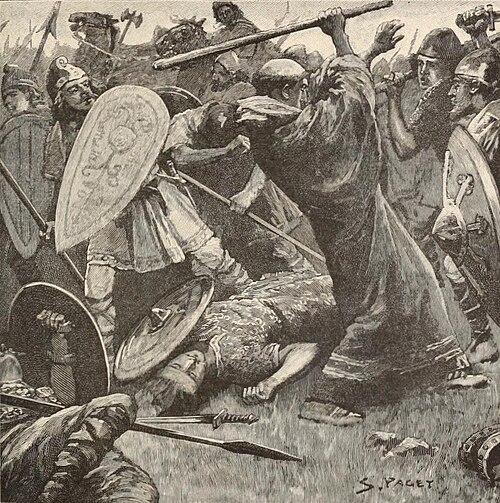
The Holy Right-Believing Sigebert was king of East Anglia, in what is now north-eastern England, in the seventh century, the first English king to receive baptism and a Christian education before coming to the throne and the first to abdicate in order to enter monastic life. He fell in battle around 636. His feast is on 27 September.
The principal source is Bede's Ecclesiastical History of the English People. Sigebert was probably a younger son of Rædwald, king of East Anglia, or his stepson, from a marriage to a pagan princess from Essex. Nothing is known of his life before he was exiled to Gaul, perhaps so that Rædwald's own line should rule. There, at the court of the Frankish king Chlothar II, he was baptised and received a good education. After the murder of his step-brother Eorpwald, around 627, he returned to East Anglia and, perhaps after a campaign, became king, ruling jointly with Ecgric, a relative of Rædwald, who probably remained a pagan. Under Sigebert the Christianisation of East Anglia advanced greatly. Alliances were strengthened with the Christian kingdoms of Kent and Northumbria. Saint Felix came to the country to help him establish the episcopal see at Dommoc, and Sigebert founded a school for teaching Latin, on the model of the one in which he had studied in Francia, and gave the Irish monk Saint Fursey a site for a monastery at Cnobheresburg (perhaps Burgh Castle).
In the end he handed his power to Ecgric and retired to his monastery at Beodricesworth. Later East Anglia was attacked by an army of Mercia, led by King Penda. Ecgric and the East Anglians asked Sigebert to lead them in battle; he refused and had to be dragged from the monastery to the battlefield. He would not bear arms and, in the battle in which both kings were slain and the army destroyed, he died as a man of peace.
Commemorated the same day September 27
 Anthim the IberianHieromartyr · Metropolitan of Ungro-WallachiaSep 27
 John MarkApostle · Companion of Paul and BarnabasSep 27
 Sabbatius of SolovkiVenerable · Co-founder of Solovki MonasterySep 27
 Zenas the LawyerApostle · Apostle of the SeventySep 27
 Caius of MilanSaint · Bishop of MilanSep 27
 Peter of KrutitsyHieromartyr · Metropolitan of KrutitsySep 27
- Flavian of AntiochSaint · Patriarch of AntiochSep 27
 Callistratus of CarthageMartyrSep 27
 Aquilina of ZagliveriNew MartyrSep 27
 Herman KosolapovHieromartyr · Bishop of VolskSep 27
- AdheritusSaintSep 27
- Adheritus of RavennaSaintSep 27