Hieromartyr
Antipas of Pergamum
Bishop of Pergamum
Bishop of Pergamum, mentioned in Revelation as a faithful witness, killed for his faith at the end of the first century.
Life
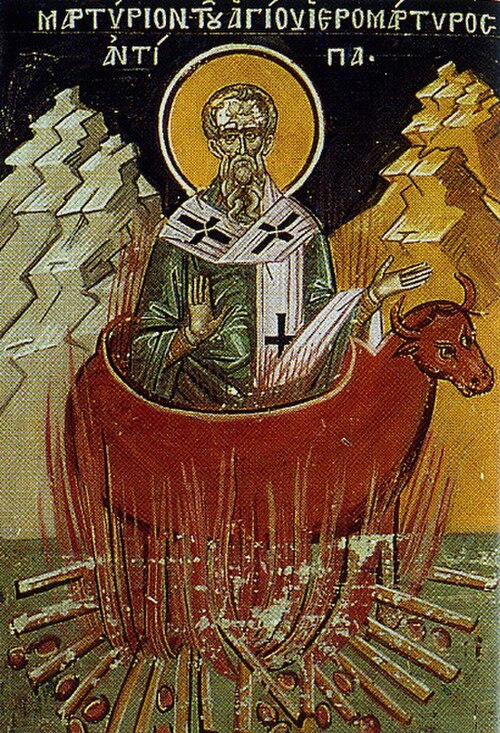
The Holy Hieromartyr Antipas was, according to tradition, a disciple of the Holy Apostle John the Evangelist and bishop of Pergamum in Asia Minor. He is the “faithful witness” spoken of in Revelation 2:13. He is commemorated on 11 April and honoured as a helper in toothache.
Life and martyrdom
Little is known of him apart from the mention in Revelation: “I know your works and where you dwell: where Satan’s throne is; and you hold fast My name and did not deny My faith, even in the days when Antipas, My faithful witness, was killed among you, where Satan dwells.” Tertullian also mentions a saint named Antipas, killed in the time of Domitian. According to tradition, he studied at the famous medical school of Pergamum and practised medicine without fee, especially for pains of the teeth. After the death of Bishop Gaius, around AD 70, he was ordained bishop of the Church of Pergamum, according to some sources by the Holy Apostle John himself, and laboured with divine zeal.
According to his Life, the people of Pergamum were idolaters, and whoever seized and killed a Christian was thought a good man. It is told that the demons, frightened of Antipas, appeared in dreams to the idol priests and told them that they feared him and must flee the city because of him. The priests roused the crowd against him and forced him to renounce Christ and bow to idols. Antipas answered them, “If your gods, masters of the world, fear me, a mortal man, and are forced to flee the city, do you not see that all your faith is an error?” He also spoke to them of the faith of Christ, as the only true one. They grew still angrier, led the old man before the temple of Artemis, where a cast bronze bull stood, heated it in fire and threw him inside. The saint glorified God in the red-hot bull and prayed for his flock and for the whole world, until he gave up his soul. According to some, in that bull he also prayed for those who suffer in their teeth.
The date of the martyrdom is not certain: according to one tradition, around 68, in the time of Nero; according to another, at the end of Domitian’s reign, in 92 or 95. His body was buried in secret by the Christians there. In the fifth century a church was built over his tomb, and the relics, regarded as myrrh-streaming, were a place of healing. According to George Kedrenos, in the time of Theodosius the Great the bull in which he died was taken to Constantinople.
Veneration
Saint Antipas is invoked for the healing of pains and diseases of the teeth; Saint Nicodemus the Hagiorite calls him in his service “physician of toothache”. He was chosen as patron of dentists, and in 1966, on the initiative of Professor Orestis Louridis, it was decided to build a Byzantine church in the grounds of the Dental School of Athens; it was consecrated on 25 May 1975, and a small portion of his relics is kept in it. In Western tradition there is also mention of a holy oil flowing from his relics.
Commemorated the same day April 11
 Guthlac of CrowlandVenerable · Hermit of CrowlandApr 11
 Barsanuphius of TverSaint · Bishop of TverApr 11
- Philip of GortynSaint · Bishop of GortynaApr 11
 Jacob of Zheleznyi BorokVenerableApr 11
- John the ProphetVenerable · Hermit of Seridus MonasteryApr 11
 John of ThessalonicaSaint · Archbishop of ThessalonicaApr 11
 Calinic of CernicaSaint · Bishop of RâmnicApr 11
- Stephen I of NaplesSaint · Bishop of NaplesApr 11
- Aedh of EcharadhSaintApr 11
- AgericusVenerableApr 11
- BacchusVenerable MartyrApr 11
- Dadhnan of Cill CungaSaintApr 11