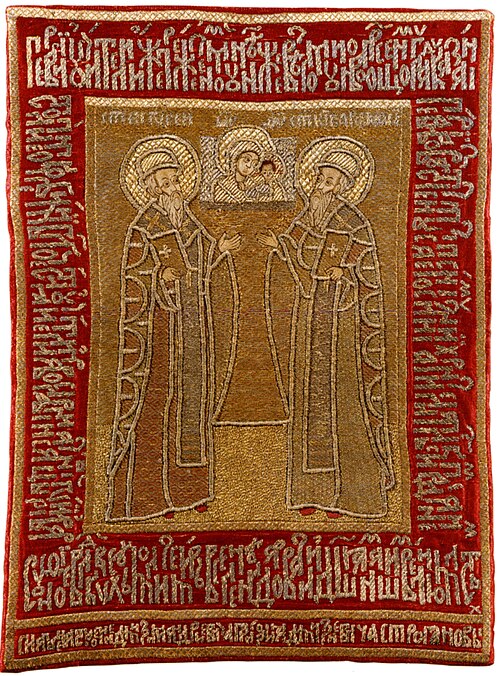
Saint
Barsanuphius of Tver
Bishop of Tver
Bishop of Tver who died at Kazan in 1576, venerated as a wonderworker of Kazan.
Life
Saint Barsanuphius of Tver (in the world Ivan Vasilyevich, about 1495 to 11 April 1576) was bishop of Tver and Kashin, earlier hegumen at Pesnosha and archimandrite at Kazan, where he helped to set up the newly founded diocese. He is commemorated on 11 April, on 4 October (in the synaxis of the saints of Kazan) and on the first Sunday after 29 June (in the synaxis of the saints of Tver); the dates are Old Style.
Captivity and the monastery
He was born about 1495 at Serpukhov, into a priest's family. In 1512, as a young man, he was taken by the Crimean Tatars and sold into slavery. After three years his father ransomed him; during his stay in the Crimea he learned the Tatar language. Set free, he came, in fulfilment of a vow, to the Andronikov monastery in Moscow and received the monastic habit with the name Barsanuphius. In the monastery he became known for his temperate life and in 1544 Metropolitan Macarius set him as hegumen of the monastery of Saint Nicholas at Pesnosha. In 1553 the monastery was visited by Tsar Ivan IV, who noticed the gifted hegumen, who knew the Tatar language.
At Kazan
In 1555 the diocese of Kazan was founded and, at the tsar's command, Barsanuphius was raised to the rank of archimandrite and sent, together with Gurias and Herman, to set the new diocese in order. In 1557 the monastery of the Transfiguration of the Saviour was founded at Kazan; Barsanuphius consecrated in it the first church, of stone, dedicated to Saint Nicholas the Wonderworker, and later also the Transfiguration cathedral. By 1565 the number of dwellers in the monastery had reached one hundred. Knowing the language and customs of the Tatars, he did missionary work. He wore chains of asceticism in secret and was thought able to heal the sicknesses of the body, so many local people sought him, and after his preaching received Christianity. In 1563 the first hierarch of Kazan, Gurias, died, and Barsanuphius performed the funeral; the newly elected bishop was Herman.
Bishop of Tver
In 1567, after the death of Bishop Acacius of Tver, Barsanuphius was ordained at Moscow by Metropolitan Philip as bishop of Tver and Kashin. As hierarch he continued to live strictly: at night he prayed and sewed klobuks. In 1570 he returned to Kazan and settled in retirement in the monastery of the Transfiguration. Writings of the nineteenth century say that there he received the great schema, but his first Life, from the sixteenth century, does not mention this; we leave the question open. He died on 11 April 1576 and was buried by Archbishop Tikhon of Kazan beside Saint Gurias, by the altar of the monastery's cathedral.
The finding of the relics
The relics were found in 1595, together with those of Saint Gurias. The discovery was made by the future patriarch Hermogenes, when a new stone church was being built at the monastery: by the altar wall of the old wooden church the coffins were dug up, untouched by corruption, and opened by Hermogenes before a great crowd. Hermogenes wrote that the relics of Barsanuphius appeared honoured by God with much incorruption; corruption had touched the feet, but the bones were strong and firm, as with Gurias, and the burial garments stronger than new ones. Saints Gurias and Barsanuphius were canonized by order of Patriarch Job. Their first Life was composed by Patriarch Hermogenes, and the service was written by Dimitry of Rostov. Until 1918 the relics stayed in the Transfiguration cathedral, then were moved to the Kazan convent of the Mother of God, closed in 1929. Since then the whereabouts of the relics of Barsanuphius are not known; only parts of his reliquary are kept in the National Museum of the Republic of Tatarstan.
Commemorated the same day April 11
 Antipas of PergamumHieromartyr · Bishop of PergamumApr 11
 Guthlac of CrowlandVenerable · Hermit of CrowlandApr 11
- Philip of GortynSaint · Bishop of GortynaApr 11
 Jacob of Zheleznyi BorokVenerableApr 11
- John the ProphetVenerable · Hermit of Seridus MonasteryApr 11
 John of ThessalonicaSaint · Archbishop of ThessalonicaApr 11
 Calinic of CernicaSaint · Bishop of RâmnicApr 11
- Stephen I of NaplesSaint · Bishop of NaplesApr 11
- Aedh of EcharadhSaintApr 11
- AgericusVenerableApr 11
- BacchusVenerable MartyrApr 11
- Dadhnan of Cill CungaSaintApr 11