Venerable
Guthlac of Crowland
Hermit of Crowland
English hermit of the seventh and eighth centuries, who spent his last years at Crowland in the Lincolnshire Fens.
- Feast
- April 11old style April 24
- Reposed
- 7158th century
- Place
- Crowland
- Order
- Venerables
Life
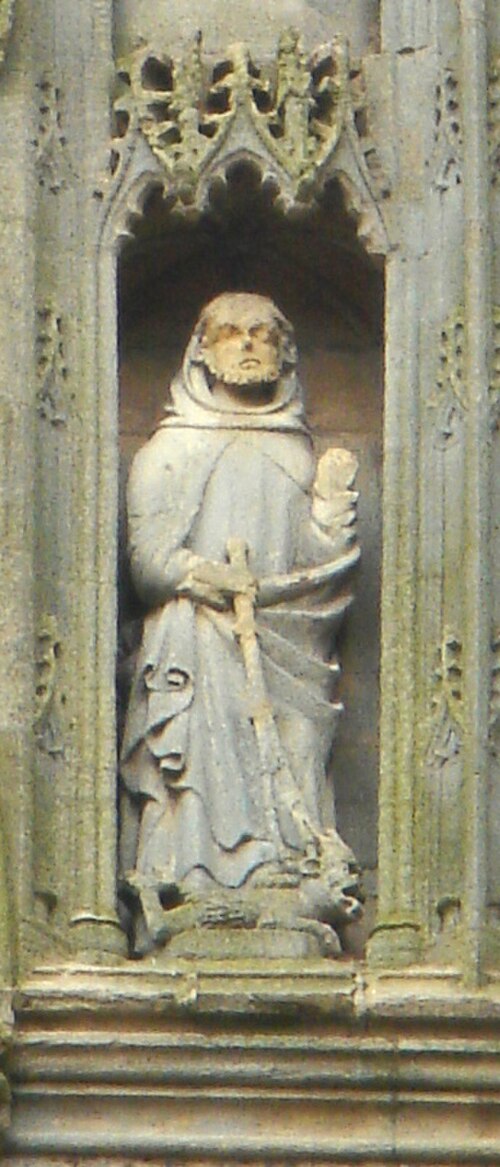
Saint Guthlac was an English hermit of the seventh and eighth centuries who spent his last years at Crowland in the Lincolnshire Fens. He was one of the first saints to come from the Anglo-Saxon people itself. He is venerated by the Orthodox, Catholic and Anglican Churches. He is commemorated on 11 April, and in the Russian Church on the third Sunday after Pentecost, in the Synaxis of the Saints of Britain and Ireland.
He was the son of Penwald, a noble of the kingdom of Mercia, and Tette. His sister Pega is also venerated as a saint. His Life, the surest source, was written between 730 and 740 by the monk Felix. According to it, at his birth a hand surrounded by golden-red light came down from heaven and blessed the house in which his devout mother was giving birth, and vanished into the sky, and the people fell prostrate and glorified the Lord. At fifteen he entered the army of King Æthelred of Mercia, and after nine years, reflecting on his life, he resolved to devote himself to God. He entered the double monastery at Repton, at twenty-four. After two years he felt called to the hermit's life and moved to the island of Croyland, now Crowland, on Saint Bartholomew's Day in 699. Saint Bartholomew was his support and comfort, appearing to him often when he was tempted and attacked by demons. Felix says Guthlac could understand the speech of the Brittonic demons who tormented him because he had spent some time among the Celtic Britons.
He built a small oratory and cells in the side of a plundered barrow on the island and lived there until his death. He was renowned for miracles of healing, foretold the future, drove out demons and had power over birds, fish and wild beasts. Many came to him for counsel. He sheltered Æthelbald, the future king of Mercia, who was fleeing from his cousin Ceolred, and foretold that he would reign. Æthelbald promised to build him a monastery, and after he became king he kept his word and began Crowland Abbey on Saint Bartholomew's Day in 716, though Guthlac had died two years before.
Felix says Guthlac foresaw his death, conversing with angels in his last days. At the moment of death a sweet nectar-like fragrance came from his mouth, and his soul departed in a beam of light while the angels sang. He had asked Ecgburh, abbess of Repton, for a lead coffin and a linen shroud, so that the funeral rites might be performed by his sister Pega. She arrived the day after his death and found the island filled with the scent of ambrosia. She buried him on the mound after three days of prayer. A year later Pega had a divine calling to move the tomb to a nearby chapel, and the body was found uncorrupted, the shroud shining with light. Afterward Guthlac appeared to Æthelbald in a vision, foretelling his reign.
His cult continued in the monastic community at Crowland, and in 971 a Benedictine monastery was founded there. His remains were moved in 1136, and in 1196 his shrine was placed above the main altar. The Yorkshire village of Golcar bears his name, for he preached there in the eighth century. Felix wrote his Life at the command of King Ælfwald of East Anglia, and two Old English poems, Guthlac A and B, are in the Exeter Book, the oldest surviving collection of English poetry. It has been proposed that Shakespeare drew on a lost play about Guthlac for The Tempest.
Commemorated the same day April 11
 Antipas of PergamumHieromartyr · Bishop of PergamumApr 11
 Barsanuphius of TverSaint · Bishop of TverApr 11
- Philip of GortynSaint · Bishop of GortynaApr 11
 Jacob of Zheleznyi BorokVenerableApr 11
- John the ProphetVenerable · Hermit of Seridus MonasteryApr 11
 John of ThessalonicaSaint · Archbishop of ThessalonicaApr 11
 Calinic of CernicaSaint · Bishop of RâmnicApr 11
- Stephen I of NaplesSaint · Bishop of NaplesApr 11
- Aedh of EcharadhSaintApr 11
- AgericusVenerableApr 11
- BacchusVenerable MartyrApr 11
- Dadhnan of Cill CungaSaintApr 11