Venerable
John the Prophet
Hermit of Seridus Monastery
Hermit of Seridus Monastery near Gaza, called the Prophet, teacher of Saint Dorotheus of Gaza.
- Feast
- April 11old style April 24
- Reposed
- 5306th century
- Place
- Palestine
- Order
- Venerables
Life
Venerable John the Prophet was a hermit at the monastery of Abba Seridus, near Gaza in Palestine, a disciple of Saint Barsanuphius the Great and a teacher of Saint Dorotheus of Gaza, in the time of the emperor Justinian I (483 to 565). He is honoured as a saint by the Orthodox and the Catholic Churches. The Orthodox Church remembers him on 6 February on the old calendar, and our calendar gives also the day of 11 April.
Life
Of the beginnings of his life little is known, but it is known that he was not ordained. A scholar, Jennifer Hevelone-Harper, identifies him as John of Beersheba, the monk with whom Barsanuphius exchanged letters, but this remains disputed. It is known that between 525 and 527 he came to the monastery of Seridus, at the invitation of Barsanuphius, who gave up his own cell to make room for John.
According to tradition, he lived in the cell in which his teacher, Barsanuphius, had lived, eighteen years in silence, labours and virtue, and was like him in everything. It is said, in the Christian view, that he received the gifts of prophecy and discernment, for which he was called "the prophet". While the abbot Seridus was scribe and letter carrier of Barsanuphius, Dorotheus of Gaza, later a renowned writer, served for eight years as letter carrier of John.
Death and letters
According to the tradition of the Church, he knew the day of his death. He foretold that it would come right after the death of Abba Seridus, but the young abbot of the same monastery, named Elianus, begged him to live at least two weeks more and to teach him how to run the monastery, and John postponed his death.
The exchange of letters of John with Barsanuphius has been preserved. In the eighteenth century, through the labour of the Moldavian elder, the schema-archimandrite Paisius Velichkovsky, two of the fullest and oldest Greek parchment manuscripts of the Answers of Barsanuphius to John were found on Athos. During the elder Paisius's lifetime they were translated into Moldavian and Slavonic. An edition of these manuscripts, as well as a translation into Russian, was made in the nineteenth century by the elders of Optina Monastery. The instructions of Barsanuphius to John show the degree of their moral perfection and love for people, and contain few details of their lives.
The troparion of Saints Barsanuphius the Great and John the Prophet, in tone four, asks that the God of our fathers, who always deals with us according to His meekness, not withdraw His mercy from us, but through their prayers direct our life in peace.
Commemorated the same day April 11
 Antipas of PergamumHieromartyr · Bishop of PergamumApr 11
 Guthlac of CrowlandVenerable · Hermit of CrowlandApr 11
 Barsanuphius of TverSaint · Bishop of TverApr 11
- Philip of GortynSaint · Bishop of GortynaApr 11
 Jacob of Zheleznyi BorokVenerableApr 11
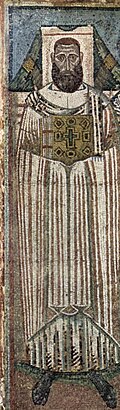 John of ThessalonicaSaint · Archbishop of ThessalonicaApr 11
 Calinic of CernicaSaint · Bishop of RâmnicApr 11
- Stephen I of NaplesSaint · Bishop of NaplesApr 11
- Aedh of EcharadhSaintApr 11
- AgericusVenerableApr 11
- BacchusVenerable MartyrApr 11
- Dadhnan of Cill CungaSaintApr 11