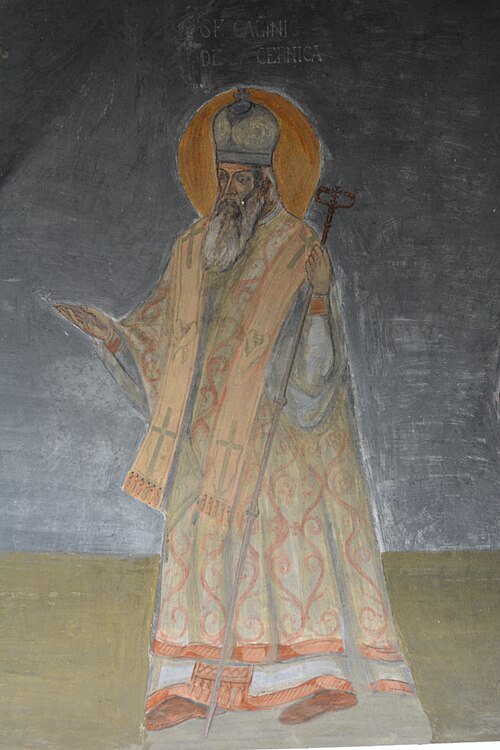
Saint
Calinic of Cernica
Bishop of Râmnic
Abbot of Cernica and bishop of Râmnic, born in 1787 and died in 1868; canonized in 1955.
Life
Saint Calinic of Cernica (7 October 1787 - 11 April 1868), hierarch, was a monk, builder of churches, theologian, abbot of the Cernica monastery and Bishop of Râmnic. He was canonized by the Romanian Orthodox Church on 21 October 1955, being, according to the English source, the first Romanian saint recognized by it in modern times. He is commemorated on 11 April.
Childhood and youth
He was born on 7 October 1787 in Bucharest, in the Saint Visarion quarter, the son of townspeople of middle condition, Anthony and Floarea Antonescu. At baptism he received the name Constantine, his godmother being Luxandra Văcărescu, wife of the ban Barbu Văcărescu and mother of the poet Ienăchiță Văcărescu. He attended a Romanian school attached to a church (Colțea, or perhaps Saint George the New) and learned Greek there too. In 1807, before he was twenty, the young Constantine Antonescu followed his inner call and entered Cernica monastery as a novice. On 12 November 1808 he was tonsured a monk with the name Calinic, and a month later was ordained hierodeacon in the church of Saint Nicholas at Cernica by the scholar and Bulgarian metropolitan Sophronius of Vratsa.
Abbot and bishop
In 1813, after the plague had killed many priests as well, Calinic was ordained priest against his will and became the spiritual father and great sacristan of Cernica monastery. He was confessor not only of the monks but of people outside the monastery, among them the metropolitan of the time, Nectarie. By now he had become in fact the head of the monastery, since the old abbot had entrusted all its affairs to him. In 1817 he visited the monasteries of Mount Athos, where he learned the life of the monks and their severe rule, which was later to be applied at Frăsinei skete and to which he himself willingly submitted all his life.
On 14 December 1818, eleven years after entering the monastery, the whole community elected him abbot. From the first the new abbot sought to establish order and spiritual discipline, drawing up comprehensive written rules, and he provided a library with the most important books of theology.
He was a tireless organizer, builder and restorer of churches. In less than two years he completed the restoration and painting of the church of Saint Nicholas on the large island at Cernica. For his qualities, Metropolitan Dionysius Lupu honored Abbot Calinic on 9 April 1820 with the rank of archimandrite. Perhaps his most important foundation is the church of Saint George the Victorious, built in 1831-1832 and rebuilt in 1838 after the earthquake of that year. In 1846 he began to build the church of Pasărea monastery, consecrated a year later; there the saint's mother found peace in old age, a nun at Pasărea with the name Philofteia. Through his care the monastery of Ghighiu near Ploiești was also founded. Abbot Calinic proved not only a good administrator but a talented builder, drawing up himself the plans of the churches he raised. According to contemporaries he also had the gift of working miracles, among them exorcisms and healings.
As early as 1834 Prince Alexandru Dimitrie Ghica had advised him to accept the metropolitan see. In 1850, when all four episcopal sees of Wallachia were vacant, Prince Barbu Știrbei, who greatly admired the abbot of the monastery founded by his ancestor, the vornic Cernica Știrbei, persuaded him to accept the see of Râmnic. He was elected on 15 September and consecrated bishop on 26 October 1850, at the age of 63. He was enthroned at Craiova, because the episcopal residence at Râmnic had been destroyed by fire. Immediately after enthronement he undertook to raise a new cathedral to his own plans, with paintings by Gheorghe Tattarescu. The episcopal residence was moved to Râmnicu Vâlcea in 1854. He saw to the reopening of the seminary, closed during the revolution of 1848: it was reopened first at Craiova (1851) and then moved to Râmnicu Vâlcea (1854).
In 1859-1864 he rebuilt and reopened Frăsinei skete, built in 1763 and then abandoned. In 1863 he built there a new church, a bell tower and new cells. At this skete he introduced the Athonite rule and the "curse" on the monastery's boundaries, which forbids the entry of anything female (women, birds or domestic animals). When the law of secularization of monastic estates came into force, Bishop Calinic asked Prince Alexandru Ioan Cuza that the skete be allowed to keep all its possessions, and the prince approved the request. In 1859 he published at his own expense the "Pravoslavnica mărturisire" (the Orthodox Confession) at the National Printing House of Iosif Romanov and Co. in Bucharest.
The printing house
For the needs of the churches he founded with his own means the printing house "Kallinik Rîmnik" in 1861, with borrowed money, as he was later to confess. There important church books came from the press: the collection of the Menaia, the Typikon, the Manual of church law, the Gospel, the Octoechos, the Liturgikon, the Akathist book, Book Useful to the Soul, Instruction for Confessors and the Monastic Rule, by which the communities of Cernica and Frăsinei were governed. By this press he continued the cultural work of his predecessors, the bishops Anthim the Iberian, Damaschin, Clement, Chesarie and Philaret. A year before his death he gave the printing house, with all its inventory and the books in store, to the town, but with conditions; the text of our source breaks off here and does not say what they were. He reposed on 11 April 1868 and was canonized on 21 October 1955.
Commemorated the same day April 11
 Antipas of PergamumHieromartyr · Bishop of PergamumApr 11
 Guthlac of CrowlandVenerable · Hermit of CrowlandApr 11
 Barsanuphius of TverSaint · Bishop of TverApr 11
- Philip of GortynSaint · Bishop of GortynaApr 11
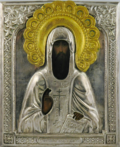 Jacob of Zheleznyi BorokVenerableApr 11
- John the ProphetVenerable · Hermit of Seridus MonasteryApr 11
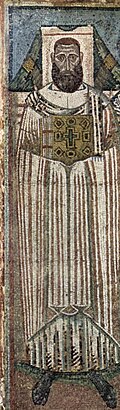 John of ThessalonicaSaint · Archbishop of ThessalonicaApr 11
- Stephen I of NaplesSaint · Bishop of NaplesApr 11
- Aedh of EcharadhSaintApr 11
- AgericusVenerableApr 11
- BacchusVenerable MartyrApr 11
- Dadhnan of Cill CungaSaintApr 11