Saint
Stephen I of Naples
Bishop of Naples
Bishop of Naples in the late 5th and early 6th centuries, who died in 513.
Life
Saint Stephen I was bishop of Naples at the end of the fifth century and the beginning of the sixth, died in 513 or about that time. He is venerated as a saint in the Catholic Church and remembered on 11 April. Our sources show no Orthodox commemoration or canonization, but only a veneration from the time of the undivided Church, kept in the West.
The bishop
The main source on him is the first part of the "Deeds of the Bishops of Naples", written at the end of the eighth century or the beginning of the ninth by an unknown author. Nothing has been preserved of his family or his early years. He took the see of Naples after Saint Victor, who died about 496. Formerly church historians believed that Stephen became bishop right after the death of his predecessor, but the letters sent by Pope Gelasius I to the bishop of Naples, on which this opinion rested, proved to be later forgeries. The first certain mention of him as bishop is from March 499, when he took part in the council called at Rome by Pope Symmachus. His enthronement may have taken place in February 498. A Greek source says he held the see fifteen years and two months.
In the time of the schism
In the time of his rule, at Rome a schism raged which had divided Christians into two camps: some held with Pope Symmachus, lawfully elected, others with Laurentius. To fight the schismatics Symmachus held several synods at Rome, in at least two of which Stephen took part: those of 499 and 501. By his order a church built already in the time of the emperor Constantine the Great, dedicated to the Holy Saviour, was restored, and since then it was called Stefania. In December 512 or 513, in his time, the eruption of Vesuvius took place, which struck the people of Campania hard. According to Cassiodorus, the Ostrogothic king Theodoric the Great forgave part of the taxes of the inhabitants of the stricken regions, and the bishop gave the needy money from the revenues of his diocese.
The end
Stephen died after fifteen years and two months of rule and was buried beneath the altar of the church which was then the cathedral of Naples, but the date is not known. He was followed in the see by Saint Pomponius. Soon after his death he was venerated by the Neapolitans as a saint, as the mention of his name in a martyrology of the ninth century shows, whose author used older church sources.
Commemorated the same day April 11
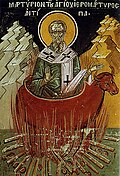 Antipas of PergamumHieromartyr · Bishop of PergamumApr 11
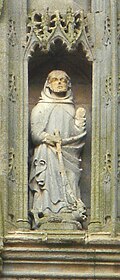 Guthlac of CrowlandVenerable · Hermit of CrowlandApr 11
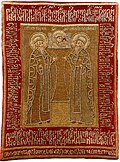 Barsanuphius of TverSaint · Bishop of TverApr 11
- Philip of GortynSaint · Bishop of GortynaApr 11
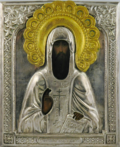 Jacob of Zheleznyi BorokVenerableApr 11
- John the ProphetVenerable · Hermit of Seridus MonasteryApr 11
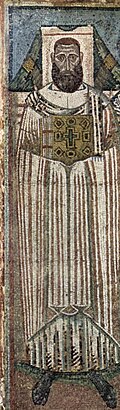 John of ThessalonicaSaint · Archbishop of ThessalonicaApr 11
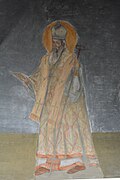 Calinic of CernicaSaint · Bishop of RâmnicApr 11
- Aedh of EcharadhSaintApr 11
- AgericusVenerableApr 11
- BacchusVenerable MartyrApr 11
- Dadhnan of Cill CungaSaintApr 11