Saint
Asclepiades of Antioch
Patriarch of Antioch
Patriarch of Antioch from 211 until his death around 218, called the Confessor, successor of Serapion.
- Feast
- October 18old style October 31
- Reposed
- 2173rd century
- Order
- Hierarchs
Life
Saint Asclepiades was bishop (patriarch) of Antioch from 211 or 212 until his death, around the year 218, called the Confessor, the ninth Orthodox archbishop of Antioch, successor of Serapion. He is remembered on 18 October, in the Catholic Church and in the Russian Orthodox Church Outside Russia (where he is called hieromartyr). Almost all the details of his life are known from the Church History of Eusebius of Caesarea.
Bishop of Antioch
Nothing is known of his youth, but probably he came from an educated, Romanised Greek pagan family (see the Asclepiadae). His predecessor on the throne of Antioch was Serapion, one of the leading theologians of his time, whose lost writings Eusebius of Caesarea often cites. The same Eusebius says that Asclepiades succeeded Serapion in the first year of the reign of the emperor Caracalla, that is, in 211 or 212. Harnack, following another source, suspects a somewhat earlier beginning. On the occasion of his accession, Alexander, bishop of Jerusalem, sent the Church of Antioch a letter of congratulation, preserved by Eusebius.
In the time of Caracalla's persecution of the Christians, Asclepiades became renowned, according to Eusebius, as a confessor, but it is not clear whether he was killed or died a natural death. An English source says that he was given the title of martyr because of the trials he endured in the Roman persecution. In any case, his end was around the years 217 to 220 (218 by some sources, 220 by others). On the throne he was succeeded by Philetus.
Relics
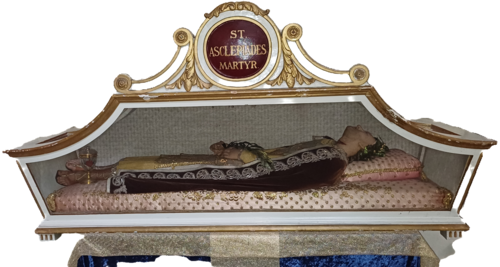
The remains that the Catholic Church holds to be the relics of Asclepiades of Antioch are kept in one of the churches of Vienna, in the Liesing district, in a transparent shrine, in the church of the Saviour (Erlöserkirche). The origin of these relics is not clear, for the church in which they lie was built only in 1909. It is supposed that they were given to the church, in the 1910s, by Cardinal Franz Xaver Nagl.
Commemorated the same day October 18
 LukeApostle · Apostle and EvangelistOct 18
 Peter of CetinjeSaint · Metropolitan of MontenegroOct 18
 Gwen TeirbronSaint · Wife of FraganOct 18
 Justus of BeauvaisMartyrOct 18
 Proculus of PozzuoliMartyr · Martyr of PozzuoliOct 18
 Wenna of CornwallSaint · Queen in CornwallOct 18
 Marinus of AnazarbusMartyrOct 18
 David of SerpukhovVenerable · Founder of David's HermitageOct 18
- Julian of PersiaVenerable · Abbot in MesopotamiaOct 18
- Andrew VoskresenskyHieromartyr · Archpriest of MoscowOct 18
- Brothen and GwendolenHoly MartyrsOct 18
- Colman son of CoirtchidhVenerableOct 18