
Apostle
Luke
Apostle and Evangelist
Physician and companion of Paul, author of the third Gospel and the Acts of the Apostles.
- Feast
- October 18old style October 31
- Reposed
- 841st century
- Place
- Thebes
- Order
- Apostles
Life
The holy Apostle and Evangelist Luke was a physician, a companion of the holy Apostle Paul, and the author of the third Gospel and of the Acts of the Apostles. The Church honours him as one of the seventy apostles and, according to tradition, as the first painter of icons of the Mother of God. His feast is 18 October.
Beginnings
Luke came from Antioch in Syria, of Greek stock, and was trained in Greek medicine. Saint Paul calls him "the beloved physician" in the epistle to the Colossians, in a place where he lists him among his friends from the Gentiles, and for that reason he is usually held not to have been a Jew. Hearing about Christ, he came to Palestine and, according to the Synaxarion, received the preaching of salvation from the Lord Himself. Tradition counts him among the seventy apostles sent by the Saviour to proclaim the Kingdom, and after the Resurrection he and Cleopas are said to have been the two disciples to whom Christ appeared on the road to Emmaus. The Greek Synaxarion gives another account: that he was instructed in the faith by Paul, whom he met at Thebes.
With Paul
Luke accompanied Paul on his second missionary journey and from then on they were inseparable. In the Acts of the Apostles the narrative passes several times to the first person plural, "we", a sign that the author was present. When Paul's other helpers had left him, he writes that only Luke remained with him. After the martyrdom of Saints Peter and Paul, Luke preached in Achaia, Libya, Egypt and the Thebaid; other sources add Dalmatia, Italy, Gaul and Boeotia.
The Evangelist
The Gospel and the Acts are addressed to a certain Theophilus. In the prologue Luke says that he investigated everything carefully from the beginning, and he drew on the oral tradition of the Church and on what the All-Pure Virgin herself had told him. He is held to have written at Rome, around the years 62 or 63, under Paul's guidance. Only in his Gospel are found the Annunciation, the meeting of the Mother of God with Elizabeth, and the parables of the prodigal son, the good Samaritan, and the Pharisee and the publican. The Acts tell of the fruits of the apostles' labours after the Ascension, dwell upon the Council of Jerusalem in the year 51, and have as their thread the coming of the Holy Spirit, who guides the Church into all truth.
Tradition adds that Luke painted the first icons of the Mother of God with the Child in her arms, and also of the Apostles Peter and Paul. One of them is still kept at the monastery of Megalo Spilaio, and the Synaxarion relates that the Virgin, seeing them, said that the grace of the One born of her would be with these icons. Tradition, attested from the eighth century, links him with the Hodegetria icon of Constantinople.
Repose and relics
Luke ended his life at Thebes in Boeotia, either as a martyr or, according to other accounts, in peace at the age of eighty-four. In 357 his relics were moved to Constantinople, to the church of the Holy Apostles. Later, perhaps at the time of the Crusade of 1204, they came to Padua in Italy, where they are kept in the church of Santa Giustina. The skull is in Saint Vitus Cathedral in Prague, where it was brought in 1354.
In 1992 Metropolitan Ieronymos of Thebes, later Archbishop of Athens, asked the bishop of Padua for a portion of the relics for the empty tomb in the Orthodox cathedral at Thebes. The bishop appointed a committee to examine the bones. It found that the skeleton belonged to an elderly man of strong build, that a tooth found in the coffin fits the jaw of the skull in Prague, and, in 2001, that the DNA agrees with that of Syrians from the region of Antioch in the early centuries. A rib was sent to Thebes, to be venerated at the saint's tomb.
The Church commemorates him on 18 October and, more briefly, on 22 April.
Commemorated the same day October 18
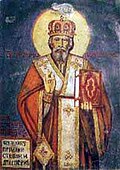 Peter of CetinjeSaint · Metropolitan of MontenegroOct 18
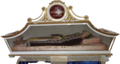 Asclepiades of AntiochSaint · Patriarch of AntiochOct 18
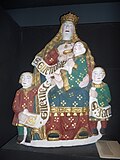 Gwen TeirbronSaint · Wife of FraganOct 18
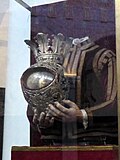 Justus of BeauvaisMartyrOct 18
 Proculus of PozzuoliMartyr · Martyr of PozzuoliOct 18
 Wenna of CornwallSaint · Queen in CornwallOct 18
 Marinus of AnazarbusMartyrOct 18
 David of SerpukhovVenerable · Founder of David's HermitageOct 18
- Julian of PersiaVenerable · Abbot in MesopotamiaOct 18
- Andrew VoskresenskyHieromartyr · Archpriest of MoscowOct 18
- Brothen and GwendolenHoly MartyrsOct 18
- Colman son of CoirtchidhVenerableOct 18