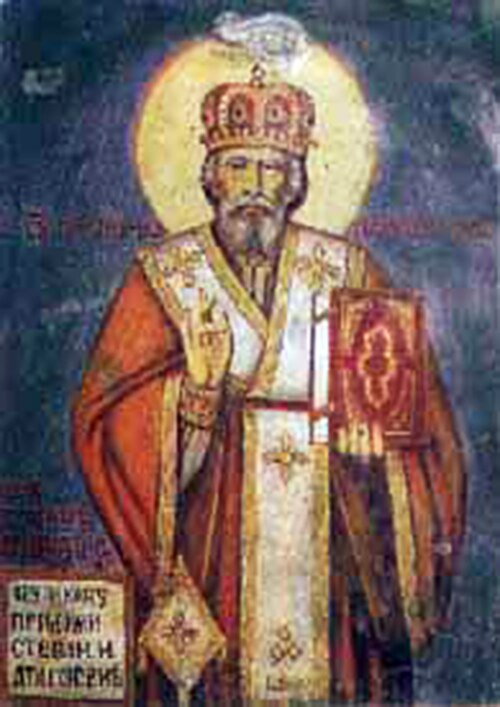
Saint
Peter of Cetinje
Metropolitan of Montenegro
Prince-bishop of Montenegro from 1784 to 1830 and exarch of the Serbian Orthodox Church there.
- Feast
- October 18old style October 31
- Reposed
- 183019th century
- Place
- Cetinje
- Order
- Hierarchs
Life
Saint Peter of Cetinje, hierarch, was metropolitan and ruler of Montenegro from 1784 until his death, in 1830, and exarch of the Serbian Orthodox Church in Montenegro. He was the best-loved leader, spiritual and military, of the Petrović-Njegoš dynasty. He is commemorated on 31 October.
Beginnings
Petar Petrović-Njegoš was born in 1747 or 1748, at Njeguši, in Montenegro, the son of Marko and Anđelija, née Martinović. He was tonsured a monk and ordained deacon young, following his relatives, and spent several years in Russia, studying, from 1765. On his return he was ordained hieromonk and raised to archimandrite. In 1779 he was part of the Montenegrin embassy that asked at Vienna for protection and financial help from the empress Maria Theresa. After Metropolitan Sava, who died in 1781, the successor he chose, Arsenije Plamenac, was inactive and without power, and after his death, in 1784, the chieftains chose Petar. He was consecrated bishop on 13 October 1784, at Sremski Karlovci, by Metropolitan Mojsije Putnik.
The early years
From Karlovci, Petar went to Russia to improve ties with the Russian court, but was received coldly and was expelled from Saint Petersburg, in November 1785. In his absence Montenegro was attacked by Kara Mahmud Pasha, the pasha of Scutari, who burned Njeguši and reached Cetinje. In the land there were two heads: the metropolitan, by title, and the governor Jovan Radonjić, by actual power. The two opposed each other in foreign policy: the metropolitan held to Russia, and Jovan to Austria. The land was divided into several districts, governed by them with the help of serdars, voivodes and knezes. This mingling of worldly and spiritual power brought strife until 1832-1833.
The victories
In 1796 Kara Mahmud Pasha was defeated at Martinići, and when he returned, he was defeated and killed in the battle of Krusi, on 22 September, where half of the Montenegrin army was led by Metropolitan Petar and the other half by Jovan. A cry of the metropolitan to the soldiers remained in the people’s memory: whoever is against Russia is against all the Slavs. The victory brought the land an extension of territory, and the country became in fact independent of the Ottoman Porte. In 1798 he gave the first laws of Montenegro, the Zakonik. He united the tribes that often quarrelled and prepared the land for new institutions, taxes, schools and larger enterprises. In 1813, under his leadership, the Montenegrin forces, helped by the English and Russian fleets, successfully faced Napoleon’s troops in Dalmatia. At the Congress of Vienna, however, Montenegro’s independence was not recognized, and thousands of Montenegrins went to Serbia and Russia, escaping famine and persecution.
His life
Despite his political and church role, Petar lived as a simple monk, giving much of the day to prayer and struggle in his small cell. His day was divided among prayer, fasting and the affairs of the land, and yet he found time to read books in French, Italian and Russian, to strengthen his knowledge of Orthodox teaching and of secular culture. An English writer wrote of him that he was a man of unusual stature, with fine features, great gifts and a very respected character.
Repose and veneration
He fell asleep at Cetinje, on 31 October 1830 by some sources, on 18 October by the old calendar. His nephew, Petar II, succeeded him as metropolitan. He was numbered among the saints by the Serbian Orthodox Church, under the name Saint Peter of Cetinje.
Commemorated the same day October 18
 LukeApostle · Apostle and EvangelistOct 18
 Asclepiades of AntiochSaint · Patriarch of AntiochOct 18
 Gwen TeirbronSaint · Wife of FraganOct 18
 Justus of BeauvaisMartyrOct 18
 Proculus of PozzuoliMartyr · Martyr of PozzuoliOct 18
 Wenna of CornwallSaint · Queen in CornwallOct 18
 Marinus of AnazarbusMartyrOct 18
 David of SerpukhovVenerable · Founder of David's HermitageOct 18
- Julian of PersiaVenerable · Abbot in MesopotamiaOct 18
- Andrew VoskresenskyHieromartyr · Archpriest of MoscowOct 18
- Brothen and GwendolenHoly MartyrsOct 18
- Colman son of CoirtchidhVenerableOct 18