Martyr
Justus of Beauvais
Martyr of Roman Gaul in the late 3rd century, known from semi-legendary tradition.
- Feast
- October 18old style October 31
- Reposed
- 2873rd century
- Place
- Amiens
- Order
- Martyrs
Life
Saint Justus of Beauvais is a child martyr of Roman Gaul at the end of the third century, known from a semi-legendary tradition. According to the account, he was nine years old when he was put to death for his faith in Christ, in the time of Diocletian's persecution. He is commemorated on 18 October.
Martyrdom
Tradition says that an uncle of the boy had been imprisoned during the persecution in a town that some accounts name as Amiens. Justus's father, the brother of the prisoner, went there with his son, hoping to ransom or rescue his kinsman. It seems that the father managed to free his brother and hide, but Justus was caught. Denounced as a Christian, he confessed his faith and refused to reveal where his father and uncle were hiding. For this his head was cut off.
What follows, the tradition says, is wholly legendary. The boy's body is said to have risen from the ground and picked up the severed head, which began to speak. In later versions the head preached the Christian faith to the pagans gathered round, and many of them turned to Christ. The father, who had watched from a distance, seeing that he had nothing more to fear, came back to the square. Justus then gave him the head, asking him to bring it to his mother so that she might kiss it. When the father took the head, the boy gave up his soul. Justus is thus one of the so-called cephalophores, the saints who spoke or moved after being beheaded.
The place and the question of history
For a long time nothing certain could be said about whether Justus really lived. The persecution of Diocletian is historical fact, but the preaching of the severed head is not. His legend became confused with that of other saints, among them Justin of Paris. Local people long pointed out as the place of his death a spot beside the old Roman road between Beauvais and Compiègne (by other accounts, between Beauvais and Senlis), where the town of Saint-Just-en-Chaussée, named after him, stands today.
Since the 1970s a large Gaulish pagan sanctuary has been excavated there, one that was in use before Julius Caesar's conquest of Gaul and continued in the time of Justus, until the end of the third century. The digs show animal sacrifices in great numbers (pigs, horses, sheep, oxen, goats) and valuable objects, probably votive: helmets, coins, brooches and weapons. Graves made on purpose, from the time of the sanctuary, were also found, with well-preserved skeletons but without skulls, only a few teeth and in one case a jawbone, a sign that the bones had been removed later. By one explanation, those buried had died naturally, and their skulls were taken by people searching for the relics of Saint Justus. Some journalists thought human sacrifice was in question.
Veneration
Veneration of Justus was widespread in France, Belgium, the Netherlands, Switzerland and England, and many places called Saint-Just or Sankt Just bear his name, though he was not the only saint of that name. From the tenth century Winchester claimed a part of his relics: according to the Annales monasterii de Wintonia, in 924 King Athelstan gave the head of the martyr to its treasury, possibly only a fragment of it. In the first half of the eleventh century the diocese of Chur in Switzerland also received relics of him. The abbey of Malmedy in Belgium said that its monks had acquired his body, at a good price, at the beginning of the tenth century, and Saint-Riquier also claimed to have it.
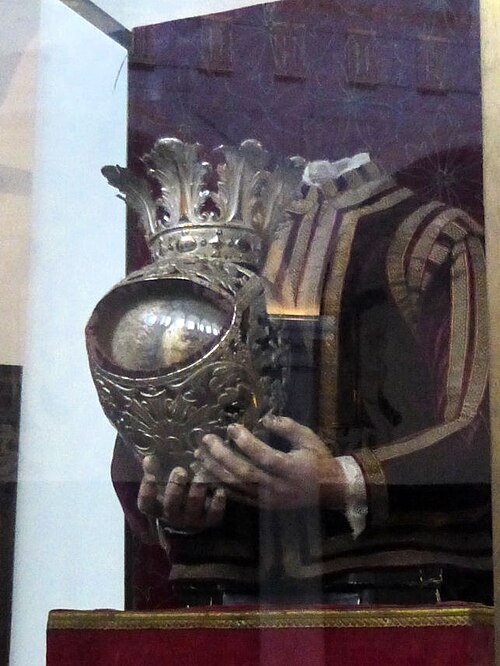
At Zutphen in the Netherlands some of his relics have been kept since the fourteenth century, perhaps from the eleventh. Franciscans brought his skull there around 1450. A confraternity dedicated to Ewald and Justus was founded in 1454, and the feast is kept there on 11 October. The skull was rescued from the burning Franciscan monastery in June 1572, in the assault of Protestant rebels on the town. A few years later a priest took it to Antwerp, where it still is, in the church of Saint Charles Borromeo, in a reliquary shaped as a bust holding a knight's helmet with the relic inside.
Commemorated the same day October 18
 LukeApostle · Apostle and EvangelistOct 18
 Peter of CetinjeSaint · Metropolitan of MontenegroOct 18
 Asclepiades of AntiochSaint · Patriarch of AntiochOct 18
 Gwen TeirbronSaint · Wife of FraganOct 18
 Proculus of PozzuoliMartyr · Martyr of PozzuoliOct 18
 Wenna of CornwallSaint · Queen in CornwallOct 18
 Marinus of AnazarbusMartyrOct 18
 David of SerpukhovVenerable · Founder of David's HermitageOct 18
- Julian of PersiaVenerable · Abbot in MesopotamiaOct 18
- Andrew VoskresenskyHieromartyr · Archpriest of MoscowOct 18
- Brothen and GwendolenHoly MartyrsOct 18
- Colman son of CoirtchidhVenerableOct 18