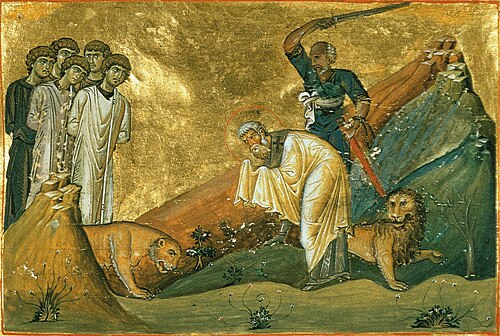
Martyr
Proculus of Pozzuoli
Martyr of Pozzuoli
Martyr of Pozzuoli, died around 305 at the same time as Saint Januarius.
- Feast
- October 18old style October 31
- Reposed
- 3054th century
- Place
- Pozzuoli
- Order
- Martyrs
Life
Saint Proculus of Pozzuoli (ancient Puteoli) was a deacon and suffered as a martyr, according to tradition, on 19 September 305, in the time of Diocletian's persecution, together with Saint Januarius, bishop of Benevento, and five other companions. He is venerated in the West, in the Roman Catholic Church, where he is entered in the Roman Martyrology, and above all as a local saint at Pozzuoli; our sources do not show a commemoration of him in the Orthodox calendar. He is commemorated on 18 October (with Eutyches and Acutius) and on 16 November at Pozzuoli.
The story of the martyrs
The seven martyrs are first mentioned in connection with the life of Saint Januarius: Januarius, Sossius (deacon of Miseno), Festus (lector), Desiderius (lector), Proculus (deacon), Eutyches and Acutius (laymen). The oldest acts were kept in the archive of the curia of Pozzuoli and published for the first time at Paris in 1867 by the Jesuit Bollandist Stilting. The Bologna acts, kept in a codex of 1180, contain the legend of Proculus, from older accounts, of at least the seventh century.
According to the legend, in the time of Diocletian's persecution Januarius, bishop of Benevento, fled from his see and came secretly to Pozzuoli. His presence nevertheless became known to the Christians there, and he kept in touch with the deacon Sossius of Miseno and with the deacon Festus and the lector Desiderius. Sossius was soon revealed as a Christian to the authorities and the judge Dragontius condemned him to be killed by bears in the local amphitheatre. Januarius, Festus and Desiderius, learning of his arrest, went at risk to see him in prison, at the sulphur mines of Pozzuoli, near the volcano Solfatara. The authorities learned that these too were Christians and they were thrown to the beasts as well; according to the later account, the beasts came near the saints and lay gently at their feet, without harming them. They were then condemned to be beheaded, together with Sossius. The deacon Proculus and the laymen Eutyches and Acutius protested the sentence, while the others were being led to death, and for that reason were beheaded too near the Solfatara, on 19 September 305.
Veneration
The relics of Proculus were first buried in the Calpurnian temple, later made the cathedral of Pozzuoli. The bodies of Festus and Desiderius were buried near Benevento, then moved to the cathedral of that city and finally to the abbey of Montevergine; the relics of Sossius were buried at Miseno and, after the destruction of Miseno in the ninth century, moved to Naples, and in 1807 to Frattamaggiore, of which he became patron. The relics of Eutyches and Acutius lay near the Paleochristian basilica of Saint Stephen in Pozzuoli, and in the second half of the eighth century were placed in the cathedral of Naples, under the high altar, with those of Agrippinus. A document of the ninth century, which one scholar believes to be fictitious, says that in 871 the bodies of Januarius, Proculus, Eutyches and Acutius were taken to the island of Reichenau by a Swabian knight; examinations in 1964 showed that the bones at Reichenau do not belong to these Italian martyrs. Desiderius and Acutius are painted in a ninth-century fresco in the catacombs of San Gennaro at Naples.
In the old Roman Martyrology the whole group was commemorated on 19 September, Festus and Desiderius on 7 September, Sossius on 23 September, Proculus, Eutyches and Acutius on 18 October; 16 November was the official day at Pozzuoli. The people of Pozzuoli were also used to celebrating him on the second Sunday of May, and had given him affectionately a jesting nickname, tied to the usual rains of November.
Commemorated the same day October 18
 LukeApostle · Apostle and EvangelistOct 18
 Peter of CetinjeSaint · Metropolitan of MontenegroOct 18
 Asclepiades of AntiochSaint · Patriarch of AntiochOct 18
 Gwen TeirbronSaint · Wife of FraganOct 18
 Justus of BeauvaisMartyrOct 18
 Wenna of CornwallSaint · Queen in CornwallOct 18
 Marinus of AnazarbusMartyrOct 18
 David of SerpukhovVenerable · Founder of David's HermitageOct 18
- Julian of PersiaVenerable · Abbot in MesopotamiaOct 18
- Andrew VoskresenskyHieromartyr · Archpriest of MoscowOct 18
- Brothen and GwendolenHoly MartyrsOct 18
- Colman son of CoirtchidhVenerableOct 18