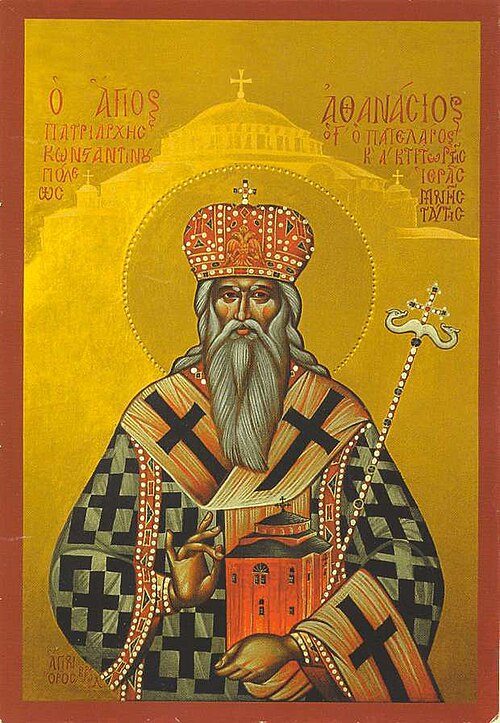
Saint
Athanasius III of Constantinople
Patriarch of Constantinople
Ecumenical Patriarch in 1634 and 1652, venerated as the wonderworker of Lubny, who died in 1654 at Mhar Monastery.
Life
Saint Athanasius III Patellarios (Alexios Patellarios) was Patriarch of Constantinople for short periods in 1634, 1635 and 1652, and before that Metropolitan of Thessalonica. He died on 5 April 1654 at the Mhar Monastery near Lubny in Ukraine, where he remained among the people as a wonderworker, known in Russia as Athanasius of Lubny or Athanasius of Tsargrad, the Sitting. He is commemorated on 2 May.
Early life and studies
He was born in 1597 (other sources indicate years between 1580 and 1597), according to some sources at Rethymno in Crete, according to others in a village of Mylopotamos, into a noble family related to the Palaiologoi. His father George was a scientist and publisher, and his elder brother Eustathios a physician. For twenty-six years he lived in Crete at the Arkadi Monastery, then under Venetian rule, where he was educated. He knew philosophy, ancient Greek, Latin, Hebrew, Arabic and Italian. He was tonsured a monk at the Sinaitic metochion of Candia, then retired to the Holy Mountain, to a cell he built himself. In 1631 he was elected metropolitan of Thessalonica, under the patronage of Patriarch Cyril Lukaris.
The patriarchal throne
In February 1634 Athanasius was elected Patriarch, in an attempt by some metropolitans to remove Cyril Lukaris, whose Confession of Faith of 1629 had some Calvinist accents. According to some Russian sources he paid the sultan a large sum for this, chiefly from the money of the French embassy. He was enthroned on 25 March, but after a few days gave up the throne to Lukaris, who had returned from exile. He withdrew to Athos, to his cell, where the Russian Skete of Saint Andrew was later raised and consecrated in 1849; in the skete was kept his icon Consolation in Sorrow and Grief, celebrated on 19 November.
After his second removal, in 1635, he went to Italy, to Ancona and Venice. The pope proposed that he become a cardinal and accept the Creed with the Filioque, but the saint refused. From 1637 he was called to Constantinople, and after Lukaris was strangled at the command of Murad IV, in 1638, he became a claimant to the patriarchate. Patriarch Parthenios I required him to renounce it and return to Thessalonica. Because of the taxes of the metropolis he was imprisoned twice and asked Tsar Michael of Russia for help. He set out for Russia in 1643, but fell ill on the way and remained in Moldavia with the prince Vasile Lupu. At Galati he founded the Monastery of Saint Nicholas, a metochion of the Monastery of Saint Catherine on Sinai, and at that time wrote a hymn to the Mother of God and an encomium of Lupu.
His last years in the East
In 1652 Athanasius returned to Constantinople and took the patriarchate a third time, for a few days. Speaking in that time, he preached a sermon in which he distanced himself from Catholicism. He then left Constantinople for ever, visited Vasile Lupu at Iasi and Bohdan Khmelnytsky at Chyhyryn, and reached Moscow on 16 April 1653, where he was received by Tsar Alexis on 22 April. There, at the request of Patriarch Nikon, he wrote the Order of the Episcopal Liturgy in the East, which formed the basis of the Moscow Archieratikon, still used in the Russian Church today. He also handed the tsar a writing urging him to unite with Moldavia and the Cossacks for a war with the Turks. Other sources say that he sold many indulgences in Ukraine and Russia.
At the end of December 1653 he left for Moldavia, to Galati. On the way he stopped with Khmelnytsky, and in February 1654 he stayed at the Mhar Monastery near Lubny, where he died on 5 April, in the week of Thomas. He was buried by the abbot of the monastery of the Transfiguration, seated on a throne beneath the ambo of the church.
Veneration
On 1 February 1662, in the presence of Metropolitan Paisios Ligarides of Gaza, the saint's relics were found. In 1672 the tsar sent an official to investigate the miracles worked by them, and veneration was established between 1672 and 1676 by Metropolitan Joseph Tukalsky of Kiev. He was formally entered in the calendar of the Russian Church in the nineteenth century, as an enlightener, in the Synaxis of the Athonite Venerables. In 1922 the cathedral at Lubny, with the saint's silver throne, was plundered; in the 1930s the relics were moved to Kharkiv, and in 1947 to the Annunciation Cathedral in that city.
Commemorated the same day May 2
 Boris-Michael of BulgariaEqual-to-the-Apostles · Prince of BulgariaMay 2
 Boris and GlebHoly Passion-Bearers · Passion-bearing princes of Kievan RusMay 2
 Secundus of ÁvilaHieromartyr · First Bishop of AbulaMay 2
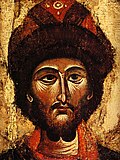 Boris of RostovPassion-Bearer · Prince of RostovMay 2
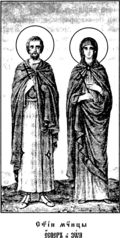 Exuperius, Zoe, Cyriacus and TheodulusHoly Martyrs · Family of martyrs of PamphyliaMay 2
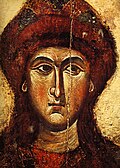 Gleb of MuromPassion-Bearer · Prince of MuromMay 2
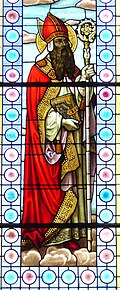 Vindemialis of CapsaSaint · Bishop of CapsaMay 2
 Basil of RyazanFool-for-Christ · Fool for ChristMay 2
- Nikephoros of KalugaVenerable · HegumenMay 2
- Zoe of AttaliaMartyrMay 2
- Athanasius of RadonezhVenerableMay 2
- Athanasius of SvirVenerableMay 2