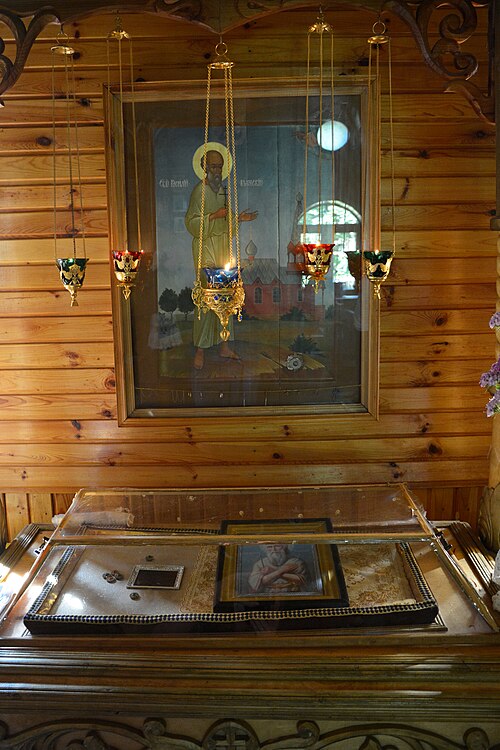
Fool-for-Christ
Basil of Ryazan
Fool for Christ
Fool for Christ in Ryazan, born in 1776 and died in 1848; honored as a local saint since 1997.
- Feast
- May 2old style May 15
- Reposed
- 184819th century
- Place
- Ryazan
- Order
- Fools-for-Christ
Life
Blessed Basil of Ryazan (Vasily Petrovich Kadomsky, 1776 - 2 [15] May 1848) was a fool for Christ of Ryazan, a former officer, venerated as a local saint of Ryazan. By a decision of July 1997 he was entered in the Synaxis of the Local Saints of Ryazan; his veneration is not general throughout the Russian Church. He is commemorated on 2 May by the old calendar (15 May by the new), the day of his death.
Youth
The first mention of Vasily Petrovich Kadomsky is in the journal "Strannik" of 1865, in an article by the priest Pyotr Vnukov, who had known the blessed one for many years. According to his memories, which later entered the Russian Biographical Dictionary of 1897, under A. A. Polovtsov, Vasily Kadomsky was born in 1776 in the village of Shakhmanovo, Ryazan district, in a noble family. His mother, Evdokia Mikhailovna (née Leonova, daughter of a retired captain), died early, leaving besides Vasily two younger sons, Alexei and John, and a daughter, Alexandra. His father, Pyotr Alexeevich Kadomsky, had a house, land and thirty peasant souls, and in his last years of service was secretary of the town. After his wife's death he sold part of the estate and moved with the children from near Ryazan into the town.
Vasily received his education at home, under his father. From youth he loved to visit monasteries and dreamed of a monastic struggle, but his fate was tied to the army. It is known that from 14 March 1791 he was a non-commissioned officer in the Revel regiment. On 19 June 1801 he petitioned Archbishop Simon (Lagov) of Ryazan to be admitted among the residents (at his own expense) of the Olgov men's monastery, but, having no means of support, soon left it. In April 1802 he petitioned to be taken as a laborer at the Radovitsky monastery. What was decided is unknown, but two years later he joined the militia formed for the war with Napoleonic France, with the rank of junker, without taking part in fighting. His unit was quartered in Kiev, which gave him the chance to visit the Kiev Caves Lavra, where he resolved to leave the army and give himself to God.
Foolishness for Christ
Back in Ryazan, he took up the labor of foolishness for Christ and wandered among monasteries and churches. All year he wore a robe over a long linen shirt and called himself a military man, kept a tidy appearance, trimmed his hair and beard, saying that military discipline required it. He ate little, on Wednesday and Friday ate nothing, slept no more than two hours a day and spent the night in prayer. Townspeople gladly gave him alms, knowing he would give it to orphans and the needy, and for this he received the nickname "God's treasurer". He often walked surrounded by children, whom he loved, and they returned his love: seeing him, they ran to him, then walked humbly and unhurried beside him and called him "Grandfather Petrovich".
He addressed people simply, without ranks and titles: "Greetings, mata" ("mata" meaning mother, used for men and women alike), and on entering a yard he used to sing "Lord, have mercy". In church he was sure to walk among the people, lit and put out candles, sang in the choir, and after the service went into the altar for a blessing. "Rather few people..." the blessed one would say when the church was full. According to many people of Ryazan, Basil had the gift of clairvoyance, which he usually showed in parable and allegory, more rarely directly. For example, once he went in to a noble lady whose nieces were getting married; the groom and bride gave the guest two apples, and he ate one and threw the other away. The meaning became clear two days later: the young couple parted.
In time all Ryazan came to know Vasily Petrovich Kadomsky. He was a welcome guest in the houses of nobles and clergy, merchants and plain people, helping all, and was refused nowhere. Foreseeing his approaching death, the blessed one asked to be taken to the house of the merchant Frol Sergeevich Batrakov, where he confessed, communed and on 2 May (15 May by the new style) 1848, at three in the morning, peacefully departed. The body of the ascetic was buried beside the cemetery church of the holy righteous Lazarus.
Veneration
The veneration of Vasily Petrovich as a servant of God began already in his earthly life. Later his grave became a place of pilgrimage, and by prayers to Basil Kadomsky miracles were worked. Academician I. P. Pavlov, when he came to Ryazan, visited the Lazarus cemetery, where his parents were buried, and always went to the blessed Basil. It is known that the memory of the blessed one was especially honored by the future hieromartyr Juvenal, who after every service at the Lazarus church served a panikhida at his grave; other bishops of Ryazan followed this tradition.
On 6 July 1996 the remains of Basil Kadomsky were reburied in the grounds of the cathedral of Boris and Gleb, beside the first resting place of Saint Basil, bishop of Ryazan; later, over the spot, under a wrought-iron canopy, monuments to the two saints were set up. In July 1997 Basil Kadomsky was canonized and entered in the Synaxis of the Local Saints of Ryazan. The relics of the blessed were moved to the cathedral of Boris and Gleb, and in June 2001 to the restored Lazarus church (where they remain today), and in the same year an akathist to the saint was written. Particles of the relics are also kept in the Kazan convent of Ryazan and in the Bogolyubsky side chapel of the cathedral of Boris and Gleb. His memory is kept on 2 May (15 May by the new style), the day of his repose; on 10 (23) June, in the synaxis of the Ryazan saints; on 13 (26) June, the day of the finding of the relics; and on 23 June (6 July by the new style), the day of the transfer of the relics to the cathedral of Boris and Gleb.
Commemorated the same day May 2
 Boris-Michael of BulgariaEqual-to-the-Apostles · Prince of BulgariaMay 2
 Boris and GlebHoly Passion-Bearers · Passion-bearing princes of Kievan RusMay 2
 Athanasius III of ConstantinopleSaint · Patriarch of ConstantinopleMay 2
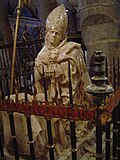 Secundus of ÁvilaHieromartyr · First Bishop of AbulaMay 2
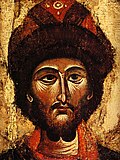 Boris of RostovPassion-Bearer · Prince of RostovMay 2
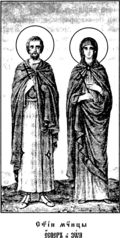 Exuperius, Zoe, Cyriacus and TheodulusHoly Martyrs · Family of martyrs of PamphyliaMay 2
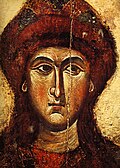 Gleb of MuromPassion-Bearer · Prince of MuromMay 2
 Vindemialis of CapsaSaint · Bishop of CapsaMay 2
- Nikephoros of KalugaVenerable · HegumenMay 2
- Zoe of AttaliaMartyrMay 2
- Athanasius of RadonezhVenerableMay 2
- Athanasius of SvirVenerableMay 2