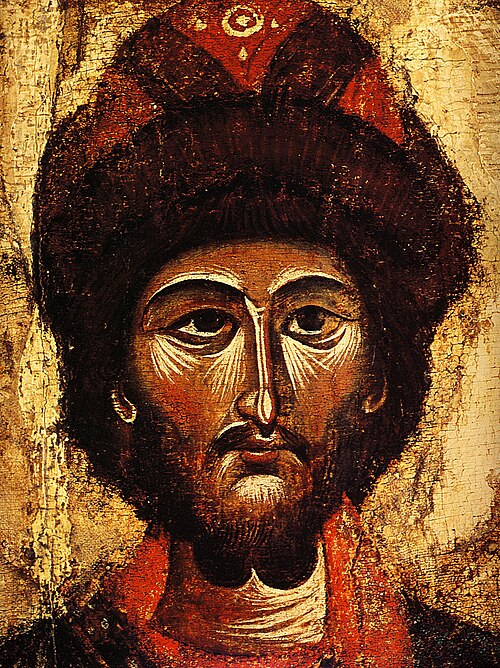
Passion-Bearer
Boris of Rostov
Prince of Rostov
Son of Prince Vladimir, prince of Rostov, killed in 1015 and canonized together with his brother Gleb.
Life
Saint Boris, baptised Roman, son of Grand Prince Vladimir of Kiev and Prince of Rostov, is, together with his brother Gleb, among the very first saints of Kievan Rus'. In 1015, after their father's death, he refused to raise his sword against his elder brother Svyatopolk and accepted death without resistance. The Church honours Boris and Gleb as “passion-bearers”, those who met death meekly, in the likeness of Christ.
Birth and his mother
Boris was born around 986 or 990 and was one of Vladimir's beloved sons. The chronicle says he was born of a “Bulgarian woman”. His mother's origin has given rise to several hypotheses. According to one, the mother of Boris and Gleb came from Danubian Bulgaria, accompanied by her spiritual father, the priest Michael, and played an important part in the spread of Orthodoxy in Rus'. The brothers' baptismal names, Roman and David, were common among the Bulgarian aristocracy of the time, and the name Boris, until then unknown in the princely house of Kiev, recalled Tsar Boris I, the baptiser of Bulgaria. According to another hypothesis, their mother was a princess from Volga Bulgaria named Milolika, baptised Anna, whose marriage sealed the peace between the two lands. Others hold that Boris's mother was the Byzantine princess Anna Porphyrogenita, Vladimir's wife, from whom the baptismal name Roman would come, after her grandfather, Emperor Romanos II.
Prince of Rostov
At the second division of the land among Vladimir's sons, around 994-996, Boris received the city of Rostov, which his elder brother Yaroslav had held before him. According to lost chronicles used by the historian Tatishchev, he may have ruled Murom before Rostov. The sources say nothing about his life until 1015.
The Tale of Boris and Gleb, written no later than 1072, describes him as a handsome young man, tall, with a round face, broad shoulders and a slender waist, kind eyes and a cheerful manner.
The refusal to fight
In 1015 Grand Prince Vladimir fell gravely ill and summoned Boris to Kiev; some believe he was preparing him as his successor. Soon after his arrival news came that the Pechenegs had invaded the land, and Vladimir sent him with the army against them. Boris did not meet the Pechenegs anywhere; he brought peace to the towns of the Severians and on his way back made camp on the river Alta. There he learned that his father had died and that his half-brother Svyatopolk had taken the throne of Kiev.
His father's warriors urged him to march on Kiev and seize the throne. But Boris would not shed his brother's blood or violate the sanctity of family bonds, and he rejected the proposal with indignation. His father's army then left him, and he remained with only the young men of his household.
Martyrdom
Svyatopolk had sent him news of their father's death, promising brotherly love and even to enlarge his inheritance. At the same time, seeing in Boris, loved by the people and the army, a dangerous rival, he sent Putsha and the boyars of Vyshgorod, among them Talets Yelovich and Lyashko, to kill him.
The murderers reached Boris's tent on the Alta on the night of Sunday, 24 July 1015. Hearing the singing of psalms from the tent, Putsha decided to wait until the prince lay down to sleep. Boris, doubly grieved by his father's death and by the news of his brother's murderous intent, had barely finished his prayer and lain down when the killers burst into the tent. They pierced with their spears both him and his servant, George the Hungarian, who had tried to shield his master with his own body.
They wrapped Boris, still breathing, in the tent cloth and carried him off. Learning that he was still alive, Svyatopolk sent two Varangians to finish him, and they pierced him through the heart with a sword. He was about twenty-five years old. His body was brought secretly to Vyshgorod and buried by the church of Saint Basil. Soon afterwards his brother Gleb was also murdered at Svyatopolk's command, and in 1019 Prince Yaroslav buried both brothers in the church of Saint Basil in Vyshgorod.
Glorification
Boris and Gleb were numbered among the saints by the Church of Rus' around 1071, as its first saints. The princes of the house of Rurik regarded them as their protectors and intercessors. The chronicles speak of miraculous healings at their tomb, of victories won in their name and with their help, such as that of Prince Rurik Rostislavich over Khan Konchak or that of Saint Alexander Nevsky, and of princes' pilgrimages to their tomb.
On 2 May the Church commemorates the translation of their relics to the new church built in Vyshgorod by Prince Izyaslav I. In 1115 the relics were again solemnly translated to the stone church of Saints Boris and Gleb in the same town. After the Mongol invasion of 1240 they were lost. In 1117 Vladimir Monomakh built a stone church on the place where Boris was killed, known as the shrine on the Alta, around which grew the town of Boryspil, which bears his name.
The story of their murder became the subject of many writings, the oldest being the Tale of Saints Boris and Gleb, attributed to Saint Nestor and the monk Jacob. A chronicle entry for 1175 mentions Boris's sword, then held by Prince Andrei Bogolyubsky. In 2011 a battle axe with silver inlay bearing the signs of the Rurikids was found near the village of Shekshovo, and it has been suggested that it belonged to one of Boris's warriors.
The historians' debate
Most historians regard the chronicle's account of Boris's murder at Svyatopolk's command as reliable. Some scholars, however, relying on Eymund's Saga, written in Scandinavia in the late thirteenth century, have proposed that Boris was killed by Varangians hired by Yaroslav, identifying Boris with the king “Burislaf” of the saga. The historian Leontiy Voitovych showed that this hypothesis rests on very weak arguments and ignores the Christian mentality of the age: Yaroslav and his sons would not have pressed for Boris's speedy glorification had he been his murderer. Burislaf is usually identified with Svyatopolk or with the Polish king Bolesław, and the historian A. V. Nazarenko regarded the saga as a literary rather than a historical source.
Veneration
Saints Boris and Gleb are greatly loved in the Slavic Orthodox world. Many churches and monasteries are dedicated to them, among them the Borisoglebsky Monastery in Russia (twelfth to fourteenth centuries), the churches in Smolensk (twelfth century) and Navahrudak (1517-1519) and the monastery in Polotsk. In 2011 a monument to them was unveiled in Vyshgorod, whose patrons they are, and in Boryspil stands a monument to Prince Boris. Boris is also listed, as Roman the Russian, in the calendar of the Roman Catholic Church.
The Orthodox Church celebrates Saint Boris together with his brother Gleb on 24 July, the day of his death, and on 2 May, the translation of the relics, as well as in the Synaxes of the Saints of Vladimir, of Rostov and Yaroslavl, of Ryazan and of Tula.
Commemorated the same day May 2
 Boris-Michael of BulgariaEqual-to-the-Apostles · Prince of BulgariaMay 2
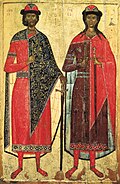 Boris and GlebHoly Passion-Bearers · Passion-bearing princes of Kievan RusMay 2
 Athanasius III of ConstantinopleSaint · Patriarch of ConstantinopleMay 2
 Secundus of ÁvilaHieromartyr · First Bishop of AbulaMay 2
 Exuperius, Zoe, Cyriacus and TheodulusHoly Martyrs · Family of martyrs of PamphyliaMay 2
 Gleb of MuromPassion-Bearer · Prince of MuromMay 2
 Vindemialis of CapsaSaint · Bishop of CapsaMay 2
 Basil of RyazanFool-for-Christ · Fool for ChristMay 2
- Nikephoros of KalugaVenerable · HegumenMay 2
- Zoe of AttaliaMartyrMay 2
- Athanasius of RadonezhVenerableMay 2
- Athanasius of SvirVenerableMay 2