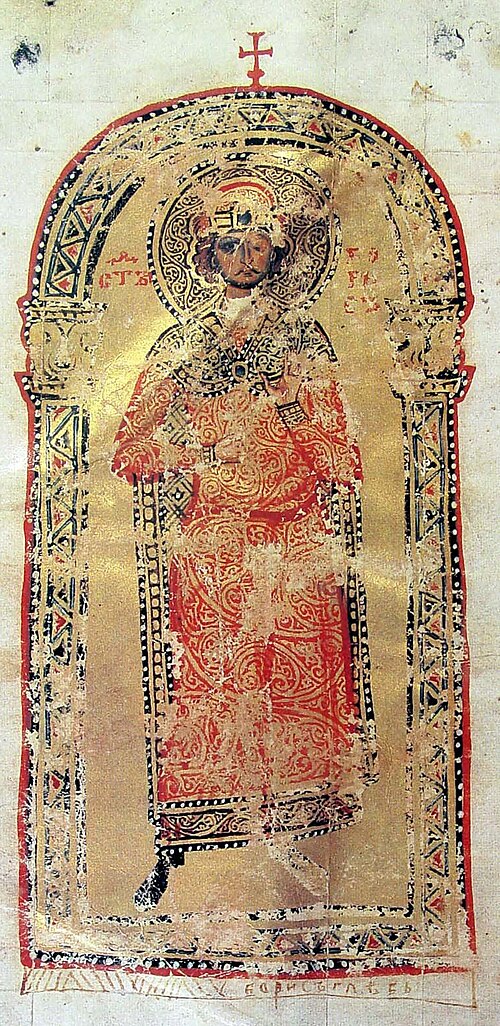
Equal-to-the-Apostles
Boris-Michael of Bulgaria
Prince of Bulgaria
Ruler of Bulgaria from 852 to 889, who accepted baptism and Christianized the Bulgarian people.
- Feast
- May 2old style May 15
- Reposed
- 90710th century
- Place
- Veliki Preslav
Life
Saint Boris-Michael, Equal of the Apostles, was prince of Bulgaria from 852 to 889, the one who received holy Baptism and brought the Bulgarian people to Christianity. At baptism he received the name Michael from his godfather, the Byzantine emperor Michael III. He is the baptizer of Bulgaria and protector of the Bulgarian Church. The Church commemorates him on 2 May.
Reign and baptism
Boris was the son of Khan Presian and came to the throne in 852. His land, on the banks of the Danube, was made up of Bulgars of Turkic origin and of Slavs, with different beliefs and customs, while stronger neighbours, Byzantium and the Frankish kingdom, threatened it. The first years of his reign were marked by war, famine and plague. Boris understood that a common faith would unite his people and strengthen the land. There are several accounts of how he came to Christianity: through his sister, who had been raised a Christian at Constantinople, through a Greek slave, or through an icon of the Last Judgement that frightened him. Political calculation certainly counted as well.
At the end of 863, during a famine, Michael III declared war on Bulgaria. Boris made peace, promising to accept Christianity according to the eastern rite. At the beginning of 864 he was baptized in secret at Pliska, with his family and some of the nobles, with the emperor as godfather, and took the name Michael. An older tradition adds that Saint Methodius performed the baptism. Then his subjects were baptized as well, by Byzantine priests. Many pagan nobles resisted, and in the summer of 865 they rose in revolt. Boris crushed it harshly, putting fifty-two nobles to death together with their families.
Between Rome and Constantinople
Boris wanted a Church of his own, with its own bishop, so as not to depend on Byzantium. He wrote to Patriarch Photius, but the answer did not satisfy him. In 866 he sent envoys to Pope Nicholas I with a hundred and six questions about Christian life, and the pope answered and sent missionaries. But the pope refused the request to make Formosus archbishop of Bulgaria. Photius answered with an encyclical in 867. At the council of Constantinople in 870, Bulgaria was placed under Constantinople, as an archbishopric with its own governance.
The Slavonic letters
When the disciples of Saints Cyril and Methodius were driven out of Moravia in 885 to 886, Boris received them with love. Clement and Naum, of Slavic Bulgarian origin, received his support and founded schools at Pliska and at Ohrid, where servants of the Church were trained in the language of the people. In 893, at the assembly of Preslav, Slavonic was decreed the language of the Church and the state, in place of Greek. This gave birth to written Slavic culture. At the same time Boris built churches and monasteries throughout his land.
Retirement
In 889 Boris laid down the throne and entered a monastery. His elder son and successor, Vladimir-Rasate, tried to bring back paganism. In 893 Boris came out of the monastery, overthrew him and had him blinded. At the assembly of Preslav he set on the throne his younger son Simeon, threatening him with the same fate if he too fell away from the faith. Then he returned to the monastery. Around 895 he came out once more, to help Simeon against the Hungarians.
Repose
Boris died on 2 May 907 in the monastery where he had withdrawn. The place is not known with certainty: it may be near Preslav, near Pliska, or at the Ravna monastery near Varna. The Orthodox Church honours him as a saint and Equal of the Apostles, because he brought a whole people to Christ. His commemoration is on 2 May, and the Synaxis of all the holy Bulgarian fathers is kept on the second Sunday after Pentecost.
Commemorated the same day May 2
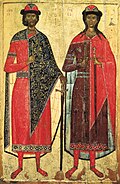 Boris and GlebHoly Passion-Bearers · Passion-bearing princes of Kievan RusMay 2
 Athanasius III of ConstantinopleSaint · Patriarch of ConstantinopleMay 2
 Secundus of ÁvilaHieromartyr · First Bishop of AbulaMay 2
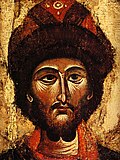 Boris of RostovPassion-Bearer · Prince of RostovMay 2
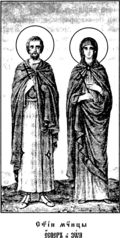 Exuperius, Zoe, Cyriacus and TheodulusHoly Martyrs · Family of martyrs of PamphyliaMay 2
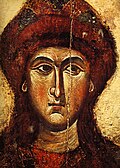 Gleb of MuromPassion-Bearer · Prince of MuromMay 2
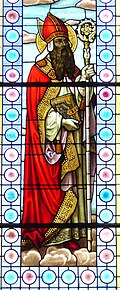 Vindemialis of CapsaSaint · Bishop of CapsaMay 2
 Basil of RyazanFool-for-Christ · Fool for ChristMay 2
- Nikephoros of KalugaVenerable · HegumenMay 2
- Zoe of AttaliaMartyrMay 2
- Athanasius of RadonezhVenerableMay 2
- Athanasius of SvirVenerableMay 2