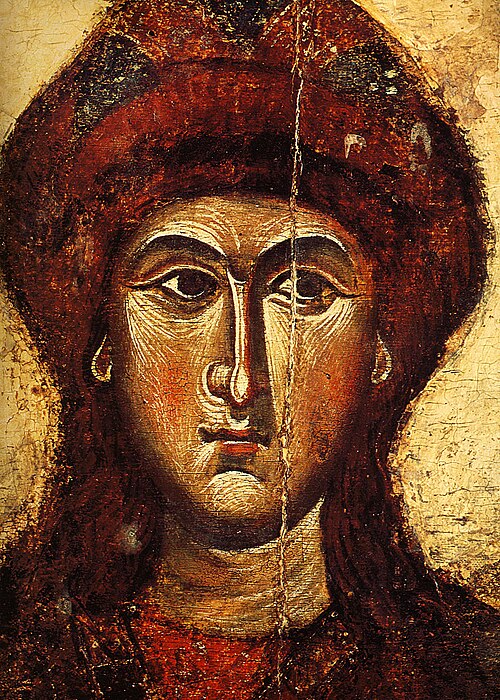
Passion-Bearer
Gleb of Murom
Prince of Murom
Son of Prince Vladimir, prince of Murom, killed in 1015 and canonized together with his brother Boris.
Life
Saint Gleb (David in baptism), prince of Murom, was a son of Grand Prince Vladimir of Kiev. He was killed in 1015 on the orders of his brother Sviatopolk and is venerated, together with his brother Boris, as a passion-bearer, among the first saints of Rus. His commemoration is on 5 September by the old calendar, which is 18 September by the new.
Who he was
Gleb was born around 987 or 991, a son of Grand Prince Vladimir the Saint. His mother was, according to the chronicles, a Bulgar woman, probably of the Volga Bulgars, or, in another view, Princess Anna. Around 1013 his father made him prince of Murom, but the town was held by the local nobility of the Ugro-Finnic people, so he lived for two years in a camp beneath the walls of his capital.
Martyrdom
After the murder of Boris, Sviatopolk summoned Gleb to Kiev, fearing that, since he was Boris's brother by both father and mother, he might avenge him. In 1015, while Gleb had halted near Smolensk, on the river Smyadyn, he received word from another brother, Yaroslav the Wise, of the death of their father, of the seizure of Kiev by Sviatopolk, of the murder of Boris and of the intent to kill him too. Yaroslav advised him not to go to Kiev.
According to his life, while the young prince was praying with tears for his father and brother, the men sent by Sviatopolk arrived, with the clear intention of killing him. The attendants accompanying him, according to the chronicles, lost heart, and according to the lives of the saint he forbade them to use their weapons to defend him. Goryaser, the leader of the men sent, ordered the prince's own cook, a Torkil by birth, to cut his throat. In 1019, after Yaroslav took Kiev, Gleb's body was sought, brought to Vyshgorod and buried with Boris's beside the church of Saint Basil.
Veneration
The Russian Orthodox Church canonized the two brothers as passion-bearers, as Saints Boris and Gleb. They are commemorated on 2 May, the day of the translation of the relics, on 24 July and on 5 September, as well as in the synaxes of the saints of Vladimir, Rostov, Yaroslavl, Ryazan and Tula. Saint Gleb is regarded as protector of grain, from the similarity of the names Gleb and khleb, bread. The Roman Catholic Church venerates him under the name David of Poland.
The Rurikids saw in Boris and Gleb their protectors and intercessors, and the chronicles record healings at their shrine and victories won in their name, for example that of Alexander Nevsky over the Teutonic knights. Their relics were moved in 1115 to a stone church at Vyshgorod and were lost after the Mongol invasion of 1240. The earliest text about their murder is the Tale of Saints Boris and Gleb, attributed to Nestor and the monk Jacob.
Commemorated the same day May 2
 Boris-Michael of BulgariaEqual-to-the-Apostles · Prince of BulgariaMay 2
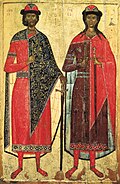 Boris and GlebHoly Passion-Bearers · Passion-bearing princes of Kievan RusMay 2
 Athanasius III of ConstantinopleSaint · Patriarch of ConstantinopleMay 2
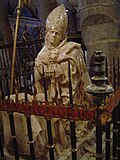 Secundus of ÁvilaHieromartyr · First Bishop of AbulaMay 2
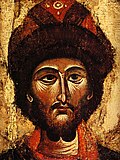 Boris of RostovPassion-Bearer · Prince of RostovMay 2
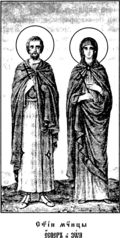 Exuperius, Zoe, Cyriacus and TheodulusHoly Martyrs · Family of martyrs of PamphyliaMay 2
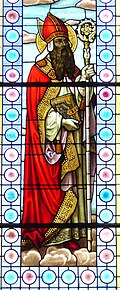 Vindemialis of CapsaSaint · Bishop of CapsaMay 2
 Basil of RyazanFool-for-Christ · Fool for ChristMay 2
- Nikephoros of KalugaVenerable · HegumenMay 2
- Zoe of AttaliaMartyrMay 2
- Athanasius of RadonezhVenerableMay 2
- Athanasius of SvirVenerableMay 2