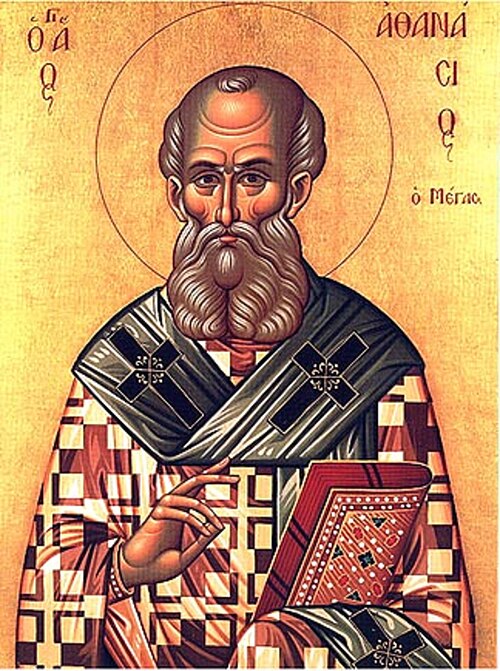
Saint
Athanasius the Great
Patriarch of Alexandria
Defender of the Nicene faith and Patriarch of Alexandria, who was exiled several times.
- Feast
- January 18old style January 31
- Reposed
- 3734th century
- Place
- Alexandria
- Order
- Hierarchs
Life
Saint Athanasius the Great was archbishop of Alexandria in the fourth century and the firmest defender of the faith of Nicaea. The Church calls him the Father of Orthodoxy: for almost half a century he confessed that the Son is of one essence with the Father, even when emperors and much of the episcopate stood against him.
Beginnings
He was born in Alexandria into a well-off Christian family sometime between 293 and 298; the Orthodox tradition places his birth around 297. He received a good secular education but gained more learning from diligent study of Holy Scripture. A story preserved by the historian Rufinus says that as a boy he played at baptism on the seashore with other children, who chose him as their bishop. Patriarch Alexander, watching from a window, examined the matter, found that the form had been kept correctly, and took the children under his care. Athanasius became a reader, then a deacon and Alexander's secretary.
Around 319 the priest Arius began to teach that the Son is a creature made by the Father and that there was a time when He was not. Before this dispute, the young Athanasius had already written Against the Heathen and On the Incarnation of the Word. In 325 he accompanied Alexander to the First Ecumenical Council at Nicaea, where Arius was condemned and the teaching that the Son is of one essence with the Father entered the Creed.
Archbishop of Alexandria
After Alexander's repose the people and the bishops of Egypt elected Athanasius unanimously, although, thinking himself unworthy, he tried to avoid it. His episcopate began on 9 May 328 and lasted forty-five years. In the early years he visited the churches of Egypt and Libya and formed ties with the hermits and monks of the desert, among them Pachomius.
The Arian party at court, led by Eusebius of Nicomedia, slandered him in many ways. The Synod of Tyre in 335 deposed him, and Emperor Constantine the Great sent him into exile at Trier in Gaul, where Bishop Maximin received him with honour.
The five exiles
In all, four emperors drove him from his see five times, for about seventeen years in total, not counting other occasions when he fled people who sought his life.
After Constantine's death he returned, but in 338 Constantius II ordered his banishment again, and an Arian bishop, Gregory of Cappadocia, took his throne. Athanasius went to Rome, where Pope Julius took up his cause and called a synod that recognised him as the lawful bishop. The Council of Serdica in 343 also cleared him of the charges, among them the false one that he had murdered a bishop, Arsenius. In 356 another Arian, George of Cappadocia, was installed in Alexandria, and Athanasius withdrew to the desert of Upper Egypt, where he spent six years among the monks and wrote the Orations against the Arians, the Apology for His Flight and the History of the Arians.
Under Julian the Apostate he returned on 22 February 362 and held a council at Alexandria with Eusebius of Vercelli, calling for unity among those who held the same faith despite differences of wording. Julian soon expelled him again, and Athanasius stayed in Upper Egypt until the emperor's death on 26 June 363. Julian's successor Jovian reinstated him, and Athanasius met him at Antioch and was received kindly. Under Valens he left in October 364 for a country house outside the city, but within a few weeks the emperor, fearing a popular revolt, allowed him to return.
Writings
His works are among the most precious left by the Fathers. On the Incarnation of the Word shows that the Son of God became man so that man could be saved. The four Orations against the Arians, the letter On the Decrees of the Council of Nicaea and the four Letters to Serapion, bishop of Thmuis, defend the divinity of the Son and of the Holy Spirit against the followers of Macedonius. His letter to Epictetus of Corinth defends the fullness of Christ's human nature, and his letter to Marcellinus shows how to use the Psalms in prayer.
He wrote the Life of Saint Anthony the Great, which Saint John Chrysostom advised every Christian to read and which spread the monastic ideal in East and West. He left forty-five Festal Letters; the thirty-ninth, of 367, is regarded as a milestone in fixing the New Testament canon. He was also the first patriarch of Alexandria to preach in Coptic as well as Greek.
Repose and veneration
After years of calm, on 2 May 373 he reposed peacefully in his own bed, surrounded by his clergy and faithful, having consecrated his presbyter Peter as successor. His relics were later moved to Venice, where most of them remain in the church of San Zaccaria; in 1973 Pope Paul VI gave a part of them to the Coptic Pope Shenouda III, and it is kept in Saint Mark's Cathedral in Cairo. Portions also rest at the Athonite monasteries of Iveron, Zographou and Esphigmenou.
The Orthodox Church keeps his feast on 18 January together with Saint Cyril of Alexandria, and he is remembered again on 2 May, the day of his repose in the West. He is counted among the four great Greek Fathers, with Basil the Great, Gregory the Theologian and John Chrysostom. The Copou Monastery in Iași is dedicated to Saints Athanasius and Cyril.
Commemorated the same day January 18
 Cyril of AlexandriaSaint · Patriarch of AlexandriaJan 18
 Prisca of RomeMartyrJan 18
 Maximus BrankovićSaint · Archbishop of SerbiaJan 18
 Aleksi ShushaniaVenerable · Georgian archimandriteJan 18
 Marcian the MonkVenerable · Hermit of SyriaJan 18
 Joachim I of BulgariaSaint · Patriarch of BulgariaJan 18
 Christopher PapoulakosVenerable · Monk and itinerant preacherJan 18
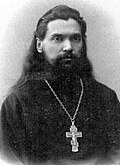 Alexander RusinovHieromartyr · ArchpriestJan 18
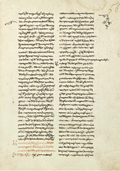 Ephrem the LesserVenerable · Georgian monk at AntiochJan 18
- Michael KargopolovHieromartyr · PriestJan 18
- Nicholas KrasovskyHieromartyr · PriestJan 18
- Athanasius of SyandemaVenerable · Abbot, founder of Syandema HermitageJan 18