
Venerable
Ephrem the Lesser
Georgian monk at Antioch
Georgian monk at Antioch, theologian and translator of patristic works from Greek; died around 1101.
- Feast
- January 18old style January 31
- Reposed
- 110112th century
- Place
- Georgia
- Order
- Venerables
Life
Venerable Ephrem the Lesser (Ephrem Mtsire) was a Georgian monk at Antioch, theologian and translator from Greek of the writings of the Holy Fathers, who died around 1101 (according to one source on 18 January 1101; according to another between 1101 and 1103). Our sources give no feast in the menaion and show no act of canonization, though a Russian source calls him venerable. Little is known of his life.
Life
It seems that in youth he received a thorough Greek education, perhaps at Constantinople, where his supposed father, Vache Karichisdze, a Georgian nobleman from Tao, had moved in 1027, after the Byzantine-Georgian war for Tao-Klarjeti. Ephrem then became a monk on the Black Mountain near Antioch, where a lively Georgian community of about seventy monks lived. From there, according to a Russian source, he never left. About 1091 he became abbot of the Kastana monastery, probably at the Castalia spring in Daphne, outside Antioch. He died in 1101, and in the acts of the council of Ruisi-Urbnisi of 1103 he is named among the departed.
His translations
Ephrem translated from Greek into Georgian five writings of Dionysius the Areopagite, the Ascetica of Saint Basil the Great and of Saint Ephrem the Syrian, commentaries on the Psalter and on the Epistles of the holy Apostles, writings of Saint John of Damascus and others. His translation, close to the Greek, proved decisive for later Georgian literature. He was the first to bring literal rendering into Georgian and to make scholia and lexica familiar to Georgian readers. At first he probably followed the principles worked out by Venerable Euthymius and George the Hagiorite, that is, a free translation, of dynamic equivalence, based on exact rendering of the content. Gradually he developed and defended a new method, adequate translation, which renders both the content and the form of the original. He wrote his theoretical principles in colophons. He devised a system of marginal comments for hard passages, set Georgian equivalents for Greek grammatical terms, introduced a system of punctuation of his own and used a critical, scientific method. He was the first Georgian theorist of versification and of literature and compiled the first Georgian alphabetical dictionary of symbolic interpretations.
His original work
He also wrote a book, the Tale on the Reason for the Conversion of the Georgians, a defence of the autocephaly of the Georgian Church, which was in the eleventh century a cause of dispute between Georgian and Antiochian churchmen. The book was entrusted to him by the leadership of his monastery, to convince the Greek clergy of the apostolic origin and independence of the Georgian Church, and it rests on many Greek sources.
Commemorated the same day January 18
 Athanasius the GreatSaint · Patriarch of AlexandriaJan 18
 Cyril of AlexandriaSaint · Patriarch of AlexandriaJan 18
 Prisca of RomeMartyrJan 18
 Maximus BrankovićSaint · Archbishop of SerbiaJan 18
 Aleksi ShushaniaVenerable · Georgian archimandriteJan 18
 Marcian the MonkVenerable · Hermit of SyriaJan 18
 Joachim I of BulgariaSaint · Patriarch of BulgariaJan 18
 Christopher PapoulakosVenerable · Monk and itinerant preacherJan 18
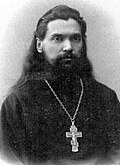 Alexander RusinovHieromartyr · ArchpriestJan 18
- Michael KargopolovHieromartyr · PriestJan 18
- Nicholas KrasovskyHieromartyr · PriestJan 18
- Athanasius of SyandemaVenerable · Abbot, founder of Syandema HermitageJan 18