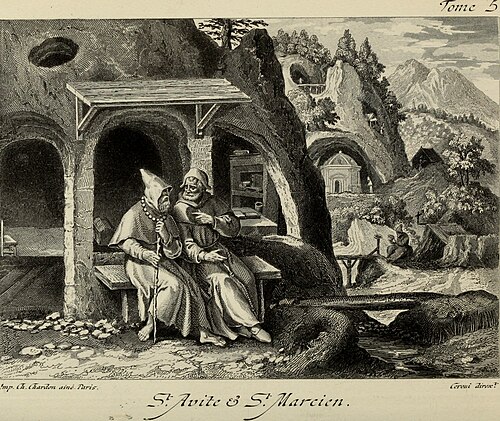
Venerable
Marcian the Monk
Hermit of Syria
Syrian hermit of the 4th century, born at Cyrrhus of a noble family, known from Theodoret's writings.
- Feast
- January 18old style January 31
- Reposed
- 3884th century
- Place
- Cyrrhus
- Order
- Venerables
Life
Venerable Marcian was a Syrian hermit of the fourth century, born at Cyrrhus, in Syria, into a noble family, and known from the writings of Theodoret of Cyrrhus. He died in 387, according to one source, or in 388, according to our calendar. He is remembered on 18 January and on 2 November.
Life
Of his life Theodoret of Cyrrhus speaks in the third chapter of the book History of the Friends of God. Marcian was of noble stock and lived with his parents, of good family; Theodoret writes that he lived in a palace. Leaving his former dwelling, he chose a desert for his abode, in which he made a small hut, even too cramped for his body. He surrounded it with a small fence and shut himself in it for ever, breaking off all contact with men and desiring only the things of God. In the hut he spent his time in fasting and prayer. His food was only bread, and that by measure: a pound of bread, divided into four parts, he set for four days, and each day there were still leftovers. He ate once a day, in the evening, and never to satiety. His fast was constant hunger.
For a time he lived alone, then he took into his cell and lived with two disciples, Eusebius and Agapetus. Since his cell was very cramped for three, Marcian allowed the disciples to make a cell beside it, in which the two might live together. The disciple Agapetus passed to Apamea, to the large, populous village of Nikerte, where he founded two monasteries, one bearing his name and the other the name of Symeon, the godly man, who for fifty years shone by his philosophy. In the 440s over four hundred people lived in these monasteries. Agapetus later became a bishop. Around Marcian disciples gathered and a monastery was formed, which Eusebius led, who took upon himself the care of the teacher and alone had leave to visit him at times.
Honour and end
Marcian enjoyed great honour among the hierarchs. Theodoret tells that once there came together to him, for spiritual profit, Patriarch Flavian of Antioch, Bishop Acacius of Beroea, Bishop Eusebius of Chalcis, Bishop Isidore of Cyrrhus and Bishop Theodotus of Hierapolis. After conversation and prayer with Marcian, the hierarchs wished to ordain him priest, but did not dare to lay their hands on him: each urged the other to do it, but each refused, and then they left. By his sermons Marcian turned people from heresies, such as Apollinarianism, Arianism, Sabellianism and Messalianism. He managed to persuade the old man Abraham to celebrate Pascha according to the decision of the Council of Nicaea. Many people everywhere made funeral chapels for Marcian: at Cyrrhus his nephew, Alipius, at Chalcedon a wealthy noblewoman, Zenobiane, and many others did the same, to draw the ascetic to themselves. Learning of it, Marcian called Eusebius and bound him by oath to lay his body in a hidden place and that no one except his two close companions should know where he was buried, until a great number of years had passed.
Marcian wore chains of eighty pounds, and his disciples followed him: Agapetus wore chains of fifty pounds, and Eusebius of a hundred and twenty. After the death of Marcian and Agapetus, Eusebius took their chains and wore them together with his own. Marcian raised the disciple Basil, who, after much time, founded a monastery near the city of Seleucobelus. Theodoret also tells of exorcisms performed by Marcian. A Serbian source says that he was a contemporary of Patriarch Flavian of Antioch and of the emperors Constantius II and Valentinian, that he was much honoured among Christians even in life, that he refused priestly rank and honours and that, before his death, he commanded his disciple Eusebius to hide his body and bury it secretly, because of the many who wished to venerate him.
Commemorated the same day January 18
 Athanasius the GreatSaint · Patriarch of AlexandriaJan 18
 Cyril of AlexandriaSaint · Patriarch of AlexandriaJan 18
 Prisca of RomeMartyrJan 18
 Maximus BrankovićSaint · Archbishop of SerbiaJan 18
 Aleksi ShushaniaVenerable · Georgian archimandriteJan 18
 Joachim I of BulgariaSaint · Patriarch of BulgariaJan 18
 Christopher PapoulakosVenerable · Monk and itinerant preacherJan 18
 Alexander RusinovHieromartyr · ArchpriestJan 18
 Ephrem the LesserVenerable · Georgian monk at AntiochJan 18
- Michael KargopolovHieromartyr · PriestJan 18
- Nicholas KrasovskyHieromartyr · PriestJan 18
- Athanasius of SyandemaVenerable · Abbot, founder of Syandema HermitageJan 18