Venerable
Christopher Papoulakos
Monk and itinerant preacher
Greek monk and itinerant preacher, born in 1770 and died in 1861; he was excommunicated by the Church of Greece.
- Feast
- January 18old style January 31
- Reposed
- 186119th century
- Place
- Andros
- Order
- Venerables
Life
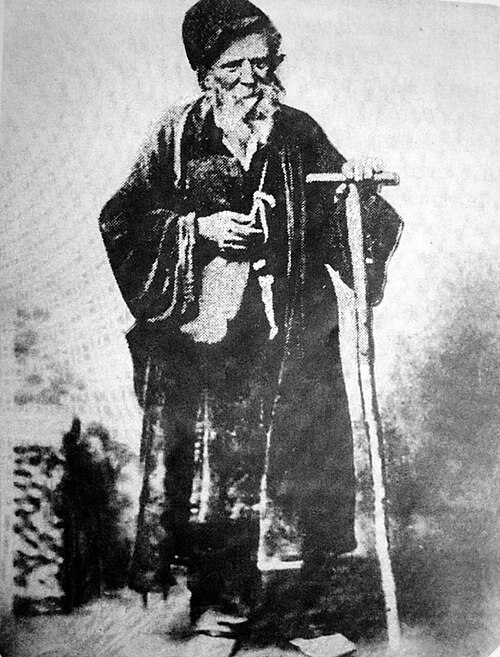
Saint Christopher Papoulakos (born Christopher Panagiotopoulos, 1770 to 1861) was a Greek monk and itinerant preacher, at first unlettered, who in the Peloponnese of the mid-nineteenth century gathered thousands of listeners. For his preaching he was declared in 1852 by the Church of Greece a "self-ordained preacher", and his teaching "unlawful and void", and he came to prison and exile. He was numbered among the saints on 30 August 2024 by a unanimous decision of the Holy Synod of the Ecumenical Patriarchate, on the proposal of the Church of Greece. He is commemorated on 18 January.
Beginnings
He was born in 1770 in the village of Arbounas, in the province of Kalavryta in Achaia, with the name Christopher Panagiotopoulos, and at first worked as a butcher. He was wholly unlettered when he resolved to follow the monastic life. He lived first at the monastery of the Great Cave, and later struggled in a hut near his village. He remained in solitude for about twenty years, during which he learned to write and read. His thinking was greatly influenced by his spiritual teacher, Cosmas Flamiatos, whose work ran parallel and whose teaching was similar.
Preaching
At the age of eighty he resolved to preach, and his fame spread quickly, for he had his own way of holding his audience. He preached mostly against adultery and theft and for prayer. He denounced the policy of the Bavarian government in the country and the Synod's compliance with it, spoke against the separation of the Church of Greece from the Ecumenical Patriarchate, and criticized Western influences and the unhindered activity of foreign missionaries. Thus he came into conflict with state authority and with intellectuals such as Theoklitos Pharmakidis. He was summoned before the bishop of Kalavryta, who rebuked him and asked him to limit his sermons.
After six months he began a tour through the south of the Peloponnese, gathering thousands. Under pressure, King Otto signed a decree to confine him to a monastery. Papoulakos took refuge in the Mani. The government sent General Gennaios Kolokotronis with officers to arrest him, but in the morning the army found itself surrounded by two thousand Maniots. An uprising of the Maniots followed, and in many cases the army fought hand to hand with Papoulakos's supporters. At last, on 21 June 1852, he was captured, after a betrayal, and taken to the prison of Rio, where he spent two years in isolation. He was to be tried by the criminal court of Athens as a rebel, but the events of the Crimean War forced Otto to grant him amnesty.
Exile and repose
In 1854 he was exiled to the monastery of Panachrantos on Andros, where he reposed on 18 January 1861, at the age of ninety-one, and was buried there. During his stay at the monastery he received many visitors. His legacy has remained disputed: it was said that for the state he was an impostor, for the official Church an outcast, and for the poor peasant and seafaring masses a saint and a prophet. His relics are kept, according to the Russian source, at the men's monastery of Saint Seraphim of Sarov and Saint Augustine of Hippo, in the metropolis of Phocis, fifteen kilometres from Nafpaktos.
Commemorated the same day January 18
 Athanasius the GreatSaint · Patriarch of AlexandriaJan 18
 Cyril of AlexandriaSaint · Patriarch of AlexandriaJan 18
 Prisca of RomeMartyrJan 18
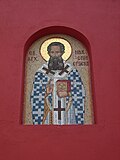 Maximus BrankovićSaint · Archbishop of SerbiaJan 18
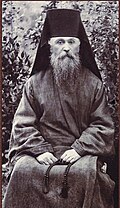 Aleksi ShushaniaVenerable · Georgian archimandriteJan 18
 Marcian the MonkVenerable · Hermit of SyriaJan 18
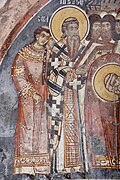 Joachim I of BulgariaSaint · Patriarch of BulgariaJan 18
 Alexander RusinovHieromartyr · ArchpriestJan 18
 Ephrem the LesserVenerable · Georgian monk at AntiochJan 18
- Michael KargopolovHieromartyr · PriestJan 18
- Nicholas KrasovskyHieromartyr · PriestJan 18
- Athanasius of SyandemaVenerable · Abbot, founder of Syandema HermitageJan 18