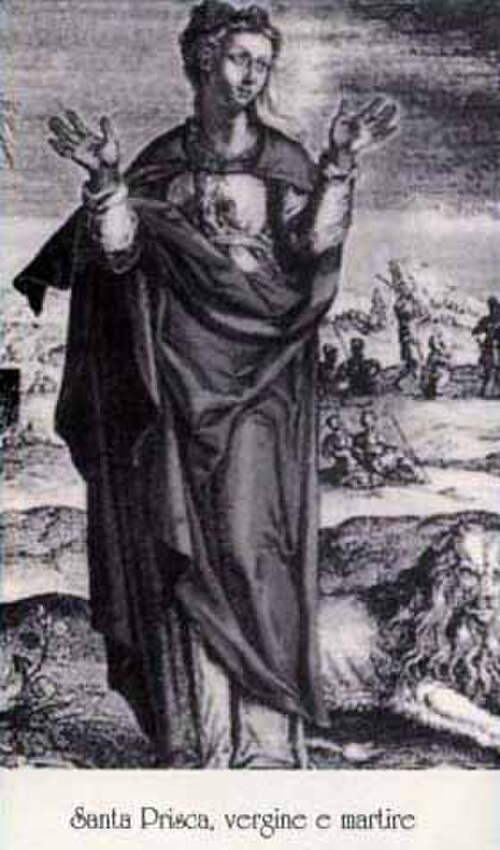
Martyr
Prisca of Rome
Young Roman woman tortured and put to death for her faith, venerated in both East and West.
- Feast
- January 18old style January 31
- Reposed
- 2693rd century
- Place
- Rome
- Order
- Martyrs
Life
The Holy Martyr Prisca (Priscilla) of Rome was a young Roman woman tortured and put to death for her Christian faith. The years of her birth and death are not known. She is venerated in Orthodoxy, in the Catholic Church and in the Anglican Communion, especially in England, as a child martyr. Her feast is on 18 January. Scholars do not regard her as the same as the Priscilla of the New Testament, wife of Aquila, friend of the Apostle Paul, though some legends say otherwise.
The legend
According to the legend, Prisca was of a noble family and, at thirteen, was baptised by Saint Peter. The emperor Claudius (in her Acts, Claudius II, 268-270) ordered her to sacrifice to the god Apollo; when she refused she was beaten and imprisoned. She was then thrown to a lion in the amphitheatre, but it lay down gently at her feet (so she is shown with one or two lions, with a sword and a palm branch). She was left three days without food in a slaves' prison, tortured on the rack and thrown on a burning pile, but remained alive; at last she was beheaded at the tenth milestone on the Via Ostiensis, the road from Rome to Ostia. Her body is said to have been moved later by Pope Eutychian to the church of Saint Prisca on the Aventine hill. A local Roman synod enrolled her among the saints in 595.
Who she really was
It is hard to establish the true identity of this martyr, since various reports probably refer to three persons. On the Aventine stands the church of Santa Prisca, built on the site of a very early titular church, the Titulus Priscae, mentioned in the fifth century and probably built in the fourth; almost nothing of the earlier building survives. In the eighteenth century a bronze tablet of the year 224 was found near it, with an inscription granting the senator Gaius Marius Pudens Cornelianus citizenship in a Spanish city. It is possible that the senator's palace stood where the church was later built; the Prisca who founded the church or, perhaps as early as the third century, gave part of the house for Christian services, would have belonged to the family of Pudens Cornelianus. In the catacomb of Priscilla on the Via Salaria the grave of a martyr Prisca was venerated, mentioned in all the seventh-century itineraries; the Martyrologium Hieronymianum names under 18 January a martyr Priscilla on the Via Salaria, probably the same. An eighth-century legend took the founder of the Titulus Priscae to be the same as Paul's friend Priscilla. The account of the martyr beheaded at the tenth milestone on the Via Ostiensis, whose remains Pope Eutychian is said to have moved, is not historical. Her name was given to one of the oldest Christian churches in Rome, Santa Prisca, and to an asteroid, (997) Priska, discovered in 1923.
Commemorated the same day January 18
 Athanasius the GreatSaint · Patriarch of AlexandriaJan 18
 Cyril of AlexandriaSaint · Patriarch of AlexandriaJan 18
 Maximus BrankovićSaint · Archbishop of SerbiaJan 18
 Aleksi ShushaniaVenerable · Georgian archimandriteJan 18
 Marcian the MonkVenerable · Hermit of SyriaJan 18
 Joachim I of BulgariaSaint · Patriarch of BulgariaJan 18
 Christopher PapoulakosVenerable · Monk and itinerant preacherJan 18
 Alexander RusinovHieromartyr · ArchpriestJan 18
 Ephrem the LesserVenerable · Georgian monk at AntiochJan 18
- Michael KargopolovHieromartyr · PriestJan 18
- Nicholas KrasovskyHieromartyr · PriestJan 18
- Athanasius of SyandemaVenerable · Abbot, founder of Syandema HermitageJan 18