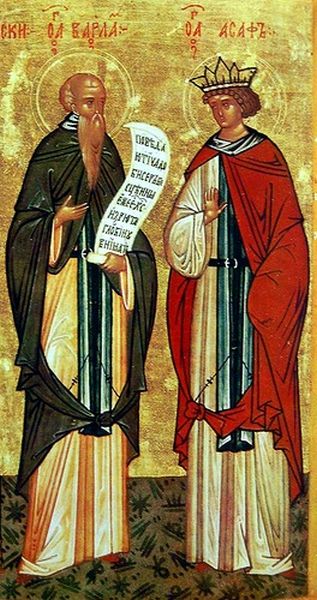
Venerable
Barlaam of India
The hermit
Hermit of India who, according to tradition, taught the faith to Prince Ioasaph.
- Feast
- November 19old style December 2
- Era
- unknown
- Order
- Venerables
Life
Holy Venerable Barlaam of India was a hermit. In India, which had once received the faith through the preaching of the holy Apostle Thomas, there reigned King Abenir, an idolater and a fierce persecutor of Christians. For a long time he had no children. At last a son was born to him, named Josaphat. At the prince's birth, the wisest of the king's astrologers predicted that he would embrace the Christian faith his father persecuted. The king, to prevent this, ordered a separate palace built for the prince and arranged that he should hear not a word about Christ and His teaching.
Reaching youth, the prince asked his father's leave to go out beyond the palace and saw then that there are suffering, sickness, old age and death. This led him to think on the vanity and futility of life, and he remained in heavy thought. At that time the wise hermit, Venerable Barlaam, was struggling in a distant desert. By divine revelation he learned of the young man seeking the truth in suffering. Leaving the desert, he set out for India in the guise of a merchant and, arriving in the city where the prince's palace stood, said that he brought a precious stone with powers of healing. Brought before Josaphat, he began to set out the Christian teaching in parables, and then "from the Holy Gospel and the Holy Apostles". From his instruction the young man understood that the precious stone was faith in the Lord Jesus Christ, believed and wished to receive Holy Baptism. After baptizing him, Barlaam left him a rule of fasting and prayer and returned to the desert.
Learning that his son had become a Christian, the king was angry and grieved. On the advice of one of his nobles he arranged a debate on faith between Christians and pagans, to which the sorcerer Nachor came in the guise of Barlaam. He was to admit defeat in the debate and so turn the prince away from Christianity. Through a vision in a dream Saint Josaphat learned of the deception and threatened Nachor with a cruel death if he were defeated. Frightened, Nachor not only defeated the pagans but himself believed in Christ, repented, was baptized and went off into the desert. The king tried to turn his son from Christianity by other means too, but the prince overcame all temptations. Then, on the advice of the nobles, Abenir gave his son half the kingdom. Saint Josaphat, becoming king, restored Christianity in his country, rebuilt the churches and at last brought his father to Christianity. Soon after baptism King Abenir passed to the Lord, and Saint Josaphat left the kingdom and went into the desert in search of his teacher, the elder Barlaam. For two years he wandered in the desert, bearing hardships and temptations, until he found the cave of Venerable Barlaam, who was struggling in stillness. The old man and the young man began to labour together. When the time of his death drew near, Barlaam served the Liturgy, communed of the Holy Mysteries and gave communion to Saint Josaphat, and then departed to the Lord, having spent seventy years in the desert out of a hundred years lived. After burying the elder, Josaphat remained in the same cave, continuing the life of a hermit. He spent thirty-five years in the desert and passed to the Lord at the age of sixty.
Josaphat's successor in the kingdom, Barachias, at the prompting of a hermit, found in the cave the incorrupt and fragrant relics of the two ascetics, carried them to his country and buried them in the church built by Josaphat.
Saint Barlaam is commemorated on 2 December, in the new style.
Commemorated the same day November 19
 ObadiahProphet · The ProphetNov 19
 Eucherius of LyonSaint · Bishop of LyonNov 19
 Philaret of MoscowSaint · Metropolitan of MoscowNov 19
 Nerses the GreatSaint · Catholicos of ArmeniaNov 19
 Hilarion the GeorgianVenerable · Georgian monk and wonderworkerNov 19
 Barlaam of the Kyiv CavesVenerable · First Abbot of the Caves LavraNov 19
 Porphyrios the KavsokalyviteVenerable · Athonite hieromonkNov 19
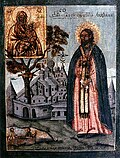 Adrian of PoshekhonyeVenerable Martyr · Abbot of the Dormition MonasteryNov 19
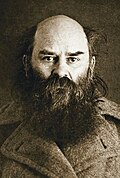 Joasaph UdalovHieromartyr · Bishop of ChistopolNov 19
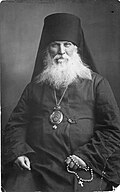 Porphyry GulevichHieromartyr · Bishop of SimferopolNov 19
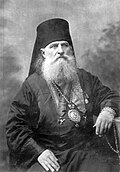 Alexis BelkovskyHieromartyr · Archbishop of Velikiy UstyugNov 19
 Macarius KarmazinHieromartyr · Bishop of YekaterinoslavNov 19