Right-Believing
Bertha of Kent
Queen of Kent
Frankish princess who became queen of Kent and prepared the way for the mission of Augustine in 597.
- Feast
- May 1old style May 14
- Born
- 5657th century
- Place
- Canterbury
Life
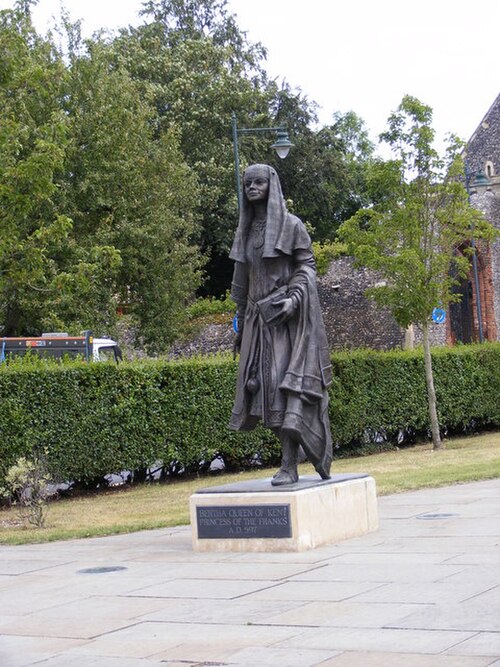
Bertha, also called Aldeberge, was a Frankish princess who became queen of Kent in south-eastern England. Born about 565, she was a Christian married to a pagan king, and she kept her faith in his court. Her presence in Kent prepared the way for the mission sent by Pope Gregory the Great under Augustine in 597, from which the conversion of Anglo-Saxon England began. She is honoured by many Christians as a saint, though there is no formal act of canonization and no firm early cult, and the sources do not give a feast day that we could confirm.
Her life
Bertha was the daughter of Charibert I, Merovingian king at Paris, and his wife Ingoberga, and a descendant of Clovis and Saint Clotilde. Her father died in 567. She grew up near Tours. She married Æthelberht, the pagan king of Kent, on condition that she be allowed to keep her religion. The date is uncertain: one source gives 580, but since Bertha was born about 565, a marriage about 590 is also proposed.
She crossed the Channel with a Frankish bishop, Liudhard, as her chaplain. At Canterbury an old church from Roman times was restored for her use and dedicated to Saint Martin of Tours. The church of Saint Martin there stands on the same site today, with Roman walling in its chancel, and is part of the Canterbury World Heritage Site.
The mission of Augustine
In 596 Pope Gregory sent the monk Augustine and his companions to Britain, and he asked Bertha to move her husband's heart to receive them kindly. They came in 597, and Æthelberht gave them land at Canterbury, where Augustine founded the abbey of Saints Peter and Paul. Without the support of the queen and the goodwill of the king, the first monastery and the cathedral might have been founded elsewhere.
In 601 Gregory wrote to Bertha again. Some read this letter as a reproach for not having done more to guide the king toward the Church, others as an encouragement, and it also praises her faith and learning. After this the sources do not mention her, so she died after 601. The year 606 has been suggested, but it is disputed.
She is the probable mother of the two known children of Æthelberht: Eadbald, who succeeded him as king, and Æthelburg, who became the queen of Northumbria.
Remembrance
No traces of a cult after her death survive, but the writer Goscelin of Saint-Bertin, in the eleventh century, lists her among the saints whose relics were moved at Canterbury in 1091. A statue of her stands on the west front of Canterbury Cathedral, and bronze statues of Bertha and Æthelberht were set up at Lady Wootton's Green in 2006. She should not be confused with Saint Bertha of Val d'Or, abbess of Avenay, whose day is 1 May.
Commemorated the same day May 1
 JeremiahProphet · The ProphetMay 1
 Tamar of GeorgiaRight-Believing · Queen of GeorgiaMay 1
 Sigismund of BurgundyPassion-Bearer · King of the BurgundiansMay 1
 Theodulf of OrléansSaint · Bishop of OrléansMay 1
 Æthelred of MerciaRight-Believing · King of MerciaMay 1
 OrientiusSaint · Latin Christian poetMay 1
 Isidore of ChiosMartyrMay 1
 Marculf of NantusVenerable · Abbot in the CotentinMay 1
 Asaph of LlanelwySaint · First Bishop of St AsaphMay 1
 AndeolusMartyr · Missionary in GaulMay 1
 Torquatus of GuadixSaint · Bishop of GuadixMay 1
 Arigius of GapSaint · Bishop of GapMay 1