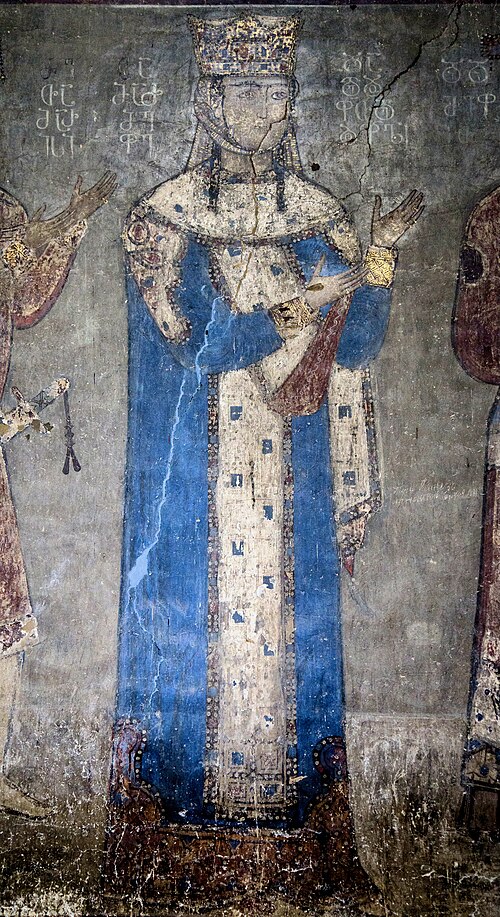
Right-Believing
Tamar of Georgia
Queen of Georgia
Queen of Georgia from 1184 to 1213, in whose reign the country reached the height of its power and culture.
- Feast
- May 1old style May 14
- Reposed
- 121313th century
- Place
- Tabakhmela
Life
The Holy Right-Believing Queen Tamar of Georgia, called Tamar the Great, reigned in Georgia from 1184 to 1213, at the height of the country's Golden Age. Of the Bagrationi dynasty, she was the first woman to rule Georgia in her own right, and medieval sources give her the title mepe, that is, king. The Orthodox Church of Georgia honours her as a saint, and she is commemorated on 1 May.
Beginnings
She was born around 1160 or 1166, the daughter of King George III and Queen Burdukhan, daughter of the king of Alania. The name Tamar is of Hebrew origin, and the Bagrationi favoured it because they claimed descent from King David. In 1177 her father put down a revolt of the nobles, and in 1178 he crowned her co-ruler. For five or six years she ruled with him.
After George died in 1184, Tamar became sole ruler and was crowned a second time at the cathedral of Gelati near Kutaisi. She was eighteen. Georgia had never had a female ruler, so part of the nobility questioned her legitimacy, while others tried to exploit her youth. Her aunt Rusudan and Catholicos-Patriarch Michael IV gave her decisive support. At the start of her reign, according to the synaxarion, she called a council and told the clergy to judge by righteousness, beginning with herself, for the royal crown is sent from above as a sign of service to God. The Russian synaxarion keeps her words that she is a father to orphans and a mother to widows. She freed the Church from taxes and eased the lot of the peasants. She is said to have abolished the death penalty and all forms of torture.
Marriages
Her marriage was a matter of state. The nobles wanted a leader for the army and an heir. The choice fell on Yuri, son of Prince Andrei Bogolyubsky of Vladimir-Suzdal, called in Georgia George the Russian. The wedding took place in 1185. He was a valiant soldier but not a good husband: the synaxarion says he was often drunk and did many improper things. Tamar endured two and a half years, then in 1187 the council of nobles approved the divorce and Yuri was sent to Constantinople. He tried twice to seize power without success and vanishes from history after 1191.
She chose her second husband herself: the Alan prince David Soslan, in 1191. According to the OCA, she asked her aunt and nurse Rusudan to find him, and he was the son of an Ossetian ruler and a descendant of King George I. The marriage was happy. They had two children: George-Lasha, the future King George IV, born in 1192 or 1194, and Rusudan, born around 1195, who would reign after her brother. David was king consort, but Tamar remained king of kings.
Victories and the Golden Age
In 1195 a Muslim army under the atabeg Abu Bakr rose against Georgia. The synaxarion says Tamar ordered vigils, Liturgies and almsgiving, then climbed barefoot to the Metekhi church of the Mother of God in Tbilisi and prayed until news came of the victory at Shamkor. According to Wikipedia, the victor was David Soslan.
Around 1203 the sultan of Rum marched in turn on Georgia. The synaxarion says Tamar replied that she trusted not in any army but in the right hand of Almighty God and the help of the Cross, then prayed before the Vardzia Icon of the Mother of God, and the army marched to Basiani, where the enemy was crushed. Her chronicler describes how the army was assembled at Vardzia and how she addressed the soldiers from the balcony of the church. Under the Armenian generals Zakare and Ivane Mkhargrdzeli, the Georgians gradually freed fortresses and districts in Armenia.
In 1204 Alexios and David Komnenos, her nephews raised at the Georgian court, founded with the help of Georgian troops the Empire of Trebizond, in the same year that the crusaders sacked Constantinople. The borders of Georgia then ran from the Black Sea to the Caspian. In the synaxarion's words, Georgia was recognized for a time by both the Christian West and the Muslim East. In her reign a monastic city was carved into the rock at Vardzia, where she herself laboured during Great Lent, and the churches of Pitareti, Kvabtakhevi, Betania and many others were built. She supported monasteries not only in Georgia but in Palestine, Cyprus, Sinai, Mount Athos, Bulgaria, Macedonia, Thrace, Romania and Constantinople.
Life of prayer
By day, says the OCA, she shone in royal robes and governed wisely; by night, on her knees, she begged the Lord with tears to strengthen the Georgian Church. She sewed vestments and gave her needlework to the poor. One day, before the Liturgy at Gelati, she had fastened rubies to her belt; hearing that a beggar waited by the tower, she went out but found no one. Grieved that she had not received Christ Himself in the poor at the door, she gave her belt to the Gelati Icon of the Mother of God. It is also said that she fasted in secret, slept on stone and chanted litanies barefoot.
Repose
The hidden severity of her labours weakened her health. Physicians could not diagnose the illness, and all of Georgia prayed for her. She took leave of the court, commended her people to Christ, and fell asleep in peace on 18 January 1213. The exact place of her tomb is still disputed among historians and archaeologists.
Georgia has kept her as the ideal of a ruler, and in art and memory she is often romanticized. The Church of Georgia honours her as a saint and right-believing queen, and the Russian synaxarion calls her protector of orphans and widows, to whom some tribes in Georgia pray for healing from illness. Her feast is on 1 May.
Commemorated the same day May 1
 JeremiahProphet · The ProphetMay 1
 Sigismund of BurgundyPassion-Bearer · King of the BurgundiansMay 1
 Bertha of KentRight-Believing · Queen of KentMay 1
 Theodulf of OrléansSaint · Bishop of OrléansMay 1
 Æthelred of MerciaRight-Believing · King of MerciaMay 1
 OrientiusSaint · Latin Christian poetMay 1
 Isidore of ChiosMartyrMay 1
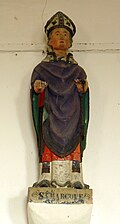 Marculf of NantusVenerable · Abbot in the CotentinMay 1
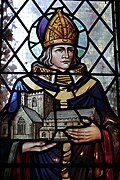 Asaph of LlanelwySaint · First Bishop of St AsaphMay 1
 AndeolusMartyr · Missionary in GaulMay 1
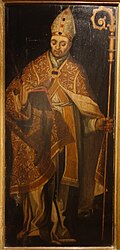 Torquatus of GuadixSaint · Bishop of GuadixMay 1
 Arigius of GapSaint · Bishop of GapMay 1