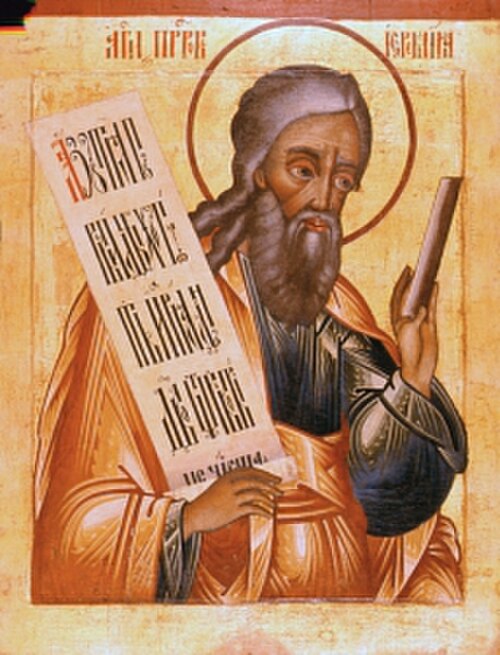
Prophet
Jeremiah
The Prophet
One of the great prophets of the Old Testament, who foretold the Babylonian captivity and wept over Jerusalem.
Life
The Holy Prophet Jeremiah is one of the four great prophets of the Old Testament, the one who foretold the fall of Jerusalem and the Babylonian captivity and wept over his people. The Book of Prophecies, the Lamentations and an Epistle are ascribed to him. The Church commemorates him on 1 May.
His calling
He was the son of the priest Hilkiah, from the town of Anathoth near Jerusalem, of the tribe of Benjamin. He lived about six hundred years before Christ, in the time of Josiah, king of Judah, and four of his successors. The Lord called him to prophecy in the thirteenth year of Josiah (626 before Christ), when, according to the Synaxarion, he was fifteen years old. From his mother's womb he had been appointed a prophet.
Jeremiah hesitated, saying that he was too young and did not know how to speak. The Lord promised to be with him and to guard him, touched his mouth and said: Behold, I have put My words in your mouth; see, I have set you this day over nations and over kingdoms, to root out and to pull down, to destroy and to overthrow, to build and to plant (Jeremiah 1:9-10).
His ministry and trials
He stood at the gates of the city, at the entrance to the Temple, wherever the people gathered, and rebuked those who had forsaken God for idols, often with tears. He spoke against kings, against greedy priests, against false prophets who gave false hopes, and against those who oppressed the poor. The people mocked him, and even his kin of Anathoth plotted to kill him. The priest Pashhur had him beaten and put in the stocks.
By God's command he wore on his neck first a wooden yoke and then an iron one, a sign of servitude to the king of Babylon. The false prophet Hananiah broke the wooden yoke, and Jeremiah answered that he had broken a yoke of wood but an iron one would be put in its place. King Jehoiakim cut up with a penknife the scroll written by Baruch, the prophet's disciple and scribe, and threw it into the fire; Jeremiah ordered it written again.
Under King Zedekiah the officials cast him into a pit full of mire, where he was near death. The God-fearing royal official Ebed-melech drew him out, but Jeremiah stayed in prison until the fall of the city. His prophecy was fulfilled: Nebuchadnezzar came, laid Jerusalem waste, burned the Temple in 587 before Christ and carried the people into captivity.
After the fall of the city
Nebuchadnezzar set the prophet free and allowed him to live wherever he wished. He stayed among the ruins of Jerusalem, at Mizpah, with the governor Gedaliah, and mourned for his homeland. According to tradition he took the Ark of the Covenant and the tablets and hid them in a cave on Mount Nebo, so that the Jews could not find it again (2 Maccabees 2). The second ark, made later, did not have the glory of the first.
When Gedaliah was murdered, the people, fearing Babylon, decided to flee to Egypt. Jeremiah tried to stop them, but they would not listen and took him by force, with Baruch, to the city of Tahpanhes. There, according to the Synaxarion, he lived four years and was honoured by the Egyptians because by his prayer the crocodiles and other creatures infesting the region perished. When he foretold that the king of Babylon would conquer Egypt, the Jews killed him, by tradition with stones. That same year his prophecy was fulfilled.
What he proclaimed
Jeremiah was the prophet of lamentation: he watched the potter at his vessel, wrote to those carried off to captivity that they should seek the welfare of the city where they lived and pray for it, and promised them a return. His most important prophecy is that of the new covenant, which the Lord will write on the hearts of men, and the Epistle to the Hebrews (chapter 8) sees it fulfilled in Christ. The Gospel of Matthew sees in the purchase of the potter's field with thirty pieces of silver a foretelling of the betrayal of the Lord (Matthew 27:9-10). The holy Fathers read in his words, let us put wood into His bread (Jeremiah 11:19 in the Septuagint), an announcement of the Passion.
Of his relics it is told that after two hundred and fifty years Alexander the Great transferred them to Alexandria. It is also believed that dust from his tomb heals snakebite, so that many Christians ask his help for this. This belongs to tradition.
In the kontakion of the day he is called a great prophet and martyr.
Commemorated the same day May 1
 Tamar of GeorgiaRight-Believing · Queen of GeorgiaMay 1
 Sigismund of BurgundyPassion-Bearer · King of the BurgundiansMay 1
 Bertha of KentRight-Believing · Queen of KentMay 1
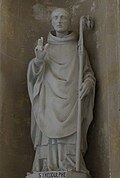 Theodulf of OrléansSaint · Bishop of OrléansMay 1
 Æthelred of MerciaRight-Believing · King of MerciaMay 1
 OrientiusSaint · Latin Christian poetMay 1
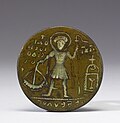 Isidore of ChiosMartyrMay 1
 Marculf of NantusVenerable · Abbot in the CotentinMay 1
 Asaph of LlanelwySaint · First Bishop of St AsaphMay 1
 AndeolusMartyr · Missionary in GaulMay 1
 Torquatus of GuadixSaint · Bishop of GuadixMay 1
 Arigius of GapSaint · Bishop of GapMay 1