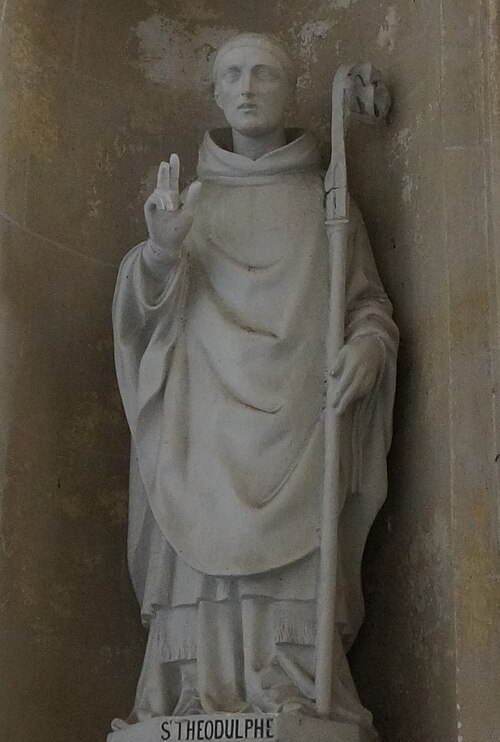
Saint
Theodulf of Orléans
Bishop of Orléans
Bishop of Orléans, poet and scholar at the court of Charlemagne, who died in 821.
Life
Saint Theodulf of Orléans was bishop of Orléans, a poet and scholar at the court of Charlemagne, and died in 821. He is commemorated on 1 May.
His life
He was born in Spain, probably at Zaragoza, between 750 and 760, of Gothic stock. He fled Spain because of the Moorish invasion and came to Aquitaine, where he received an education. Then he entered the monastery near Maguelonne, led by the abbot Benedict of Aniane. In 786, at Rome, he was impressed by the centers of learning there and wrote to many abbots and bishops of the Frankish empire, urging them to found public schools. Charlemagne saw his importance and made him, around 798, bishop of Orléans and abbot of several monasteries, among them Fleury-sur-Loire. He founded schools outside the monasteries, as he had planned, was one of Charlemagne’s favoured theologians and laboured for the reform of the Church, correcting translated texts that Charlemagne judged faulty and translating sacred texts directly from Greek and Hebrew. He witnessed the emperor’s will, in 811. He also set out two capitularies for the priests of his diocese, reminding them of the importance of work, study, prayer and chastity.
His writings
He is thought to be the author of the Libri Carolini, the fullest statement of the medieval West on the veneration of icons. He wrote poems, among them a long poem urging judges to deal justly, and about eighty poems survive. In the Bible manuscripts made under his guidance, the Book of Baruch and the Letter of Jeremiah entered the canon of the Vulgate. He is the author of the hymn “Gloria, laus et honor”, sung on Palm Sunday; tradition says that he sang it from the window of his prison cell and that the king, hearing it, pardoned him.
The oratory at Germigny
In 806 he built an oratory beside his villa at Germigny-des-Prés, which still stands, with a mosaic of the Ark of the Covenant and angels, almost the only Carolingian mosaic to survive.
His trial
After the death of Charlemagne, in 814, his successor, Louis the Pious, judged that many people at his court had plotted with King Bernard of Italy, and Theodulf was accused of treason. In 817 he was forced to leave his see, and in 818 he was exiled to a monastery in Angers. He was released in 820 and tried to return to Orléans, but did not reach it; he is thought to have died on the way or soon afterwards, in 821. His body was taken to Angers and buried there. To the end he denied having done wrong.
Commemorated the same day May 1
 JeremiahProphet · The ProphetMay 1
 Tamar of GeorgiaRight-Believing · Queen of GeorgiaMay 1
 Sigismund of BurgundyPassion-Bearer · King of the BurgundiansMay 1
 Bertha of KentRight-Believing · Queen of KentMay 1
 Æthelred of MerciaRight-Believing · King of MerciaMay 1
 OrientiusSaint · Latin Christian poetMay 1
 Isidore of ChiosMartyrMay 1
 Marculf of NantusVenerable · Abbot in the CotentinMay 1
 Asaph of LlanelwySaint · First Bishop of St AsaphMay 1
 AndeolusMartyr · Missionary in GaulMay 1
 Torquatus of GuadixSaint · Bishop of GuadixMay 1
 Arigius of GapSaint · Bishop of GapMay 1