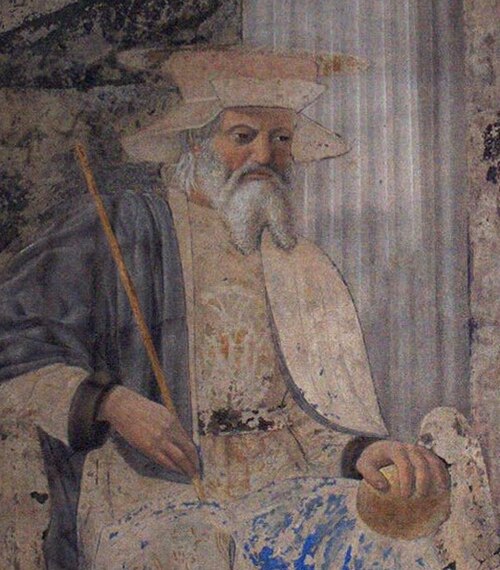
Passion-Bearer
Sigismund of Burgundy
King of the Burgundians
King of the Burgundians from 516 to 524, killed by the Franks after defeat in battle, founder of Saint-Maurice abbey.
Life
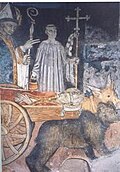
Saint Sigismund, martyr, was king of the Burgundians from 516 to 524, son of Gundobad and Caretene. He founded the monastery of Saint Maurice at Agaunum, passed from Arianism to the faith of Nicaea, and was killed by the Franks after a defeat. He is commemorated on 1 May and is honoured as patron of those with fever and, in the Czech lands, as patron of the country.
Life
His teacher was Avitus, bishop of Vienne, who turned him from the Arianism of his forebears, perhaps around 497. In 515 he founded, at Agaune in Valais, the monastery dedicated to Saint Maurice, on the site where the relics of the third-century martyr lay, and made it a place of pilgrimage. In 516 he succeeded his father on the throne. He was married to Ostrogotho, daughter of the Ostrogothic king Theodoric the Great, with whom he had a son, Sigeric, and a daughter, Suavegotha. He sought confirmation from the emperor Anastasius I and received the title of patrician. In 517 he held the synod of Epaone, which strengthened the bond between the king and the Nicene clergy.
Sigismund came into conflict with Bishop Apollinaris of Valence over the laws of marriage. The king’s treasurer, Stephen, was living in flagrant incest, and the four bishops of the province ordered him to separate, but he appealed to the king, who took his side and exiled the bishops to Sardinia. The four would not bend, and after a time the king allowed them to return, except Apollinaris, who had angered him more; he kept him a year in prison. At last the king fell gravely ill, and the queen sent to ask Apollinaris to come and heal him. He refused, but gave his cloak, which the queen put on the sick man. The king recovered, and Apollinaris returned to his see.
The murdered son and repentance
According to Gregory of Tours, after the death of his first wife Sigismund married a second time, and the new queen mocked her stepson. On a feast day, in 517 or later, Sigeric saw his stepmother dressed in his mother’s festal clothes and cried that she was unworthy to wear them. The queen persuaded Sigismund to do justice, accusing Sigeric of plotting to kill his father and take the crown. Sigismund ordered the young man seized, drunk, and drowned in a well (according to other sources, strangled). Then, overcome with remorse, he withdrew to the monastery he had founded and prayed there for forgiveness.
War and martyrdom
In 523 Clotilde, whose parents had been killed by Gundobad, Sigismund’s father, urged her sons to attack him, and the four Frankish kings, Chlodomer, Childebert I, Clotaire I and Theuderic I, began the Burgundian War. Sigismund and his brother Godomar defended the land but were defeated; Godomar fled, and Sigismund put on a monk’s habit and hid in a cell near the monastery. He was captured by Chlodomer, king of Orléans, and taken to Orléans. Godomar gathered the army, with Theodoric’s help, and took back the kingdom; then, on 1 May 524, Chlodomer ordered Sigismund beheaded, with his wife and their two sons, and the bodies were thrown into a well near Coulmiers. Chlodomer died at Vézeronce, on 25 June 524, according to some at Godomar’s own hand.
Veneration
In 535 his remains were taken from the well, where a chapel was built, around which the monastery and village of Saint-Sigismond grew up, and his body was taken to Agaune and buried in the monastery. Both places became centres of his cult, as patron of those with fever. The devotion spread to Switzerland, France and Italy. In 675 Dagobert II received the saint’s skull from Agaune and placed it in the abbey he had founded at Rouffach in Alsace; relics were also kept at Milan and Imola. In 1366 the emperor Charles IV moved the relics from Agaune to Prague, into the cathedral, so Sigismund is patron of Bohemia and of the city of Cremona. The feast of the translation of the relics is kept at Freising on 5 September.
Commemorated the same day May 1
 JeremiahProphet · The ProphetMay 1
 Tamar of GeorgiaRight-Believing · Queen of GeorgiaMay 1
 Bertha of KentRight-Believing · Queen of KentMay 1
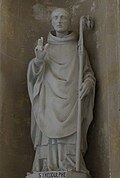 Theodulf of OrléansSaint · Bishop of OrléansMay 1
 Æthelred of MerciaRight-Believing · King of MerciaMay 1
 OrientiusSaint · Latin Christian poetMay 1
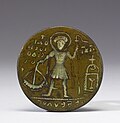 Isidore of ChiosMartyrMay 1
 Marculf of NantusVenerable · Abbot in the CotentinMay 1
 Asaph of LlanelwySaint · First Bishop of St AsaphMay 1
 AndeolusMartyr · Missionary in GaulMay 1
 Torquatus of GuadixSaint · Bishop of GuadixMay 1
 Arigius of GapSaint · Bishop of GapMay 1