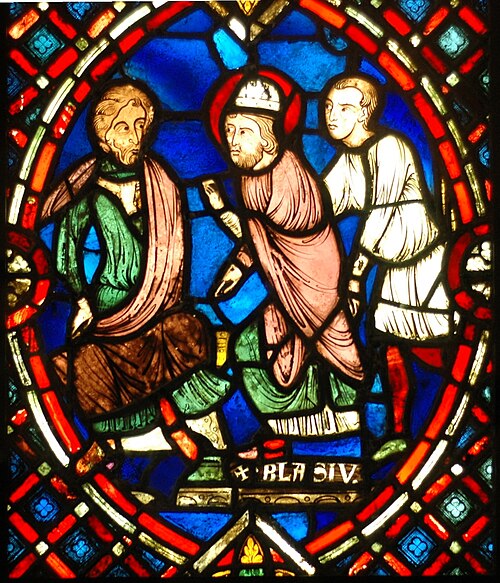
Hieromartyr
Blaise of Sebaste
Bishop of Sebaste
Physician and bishop of Sebaste in Lesser Armenia, killed for his faith around 316.
- Feast
- February 11old style February 24
- Reposed
- 3164th century
- Place
- Sivas
- Order
- Martyrs
Life
The Holy Hieromartyr Blaise of Sebaste, called Blasius in the West, was a physician and bishop of Sebaste in Lesser Armenia (today Sivas, in Turkey). He was killed for his faith in Christ around the year 316. The Orthodox Church commemorates him on 11 February, new style (24 February in Churches keeping the old calendar), and the Roman Catholic Church on 3 February. He is invoked for the health of domestic animals, against wild beasts and for illnesses of the throat.
His life
Saint Blaise lived purely and gently from his youth. Born at Sebaste, he studied medicine and healed the bodies of the sick, then became a physician of souls. The people, valuing his mercy to the sick and the poor, unanimously chose him as bishop. He shepherded by the example of his life as much as by his word, and his holiness was attested by many miracles.
In the time of the emperors Diocletian and Licinius, fierce persecutors of Christians, Blaise encouraged his flock, visited those imprisoned and supported the martyrs. Many Christians fled to desolate places, and he withdrew to a cave on Mount Argeos, where he prayed day and night. Wild beasts came to him and waited meekly for him to finish his prayer so that he might bless them. The sick ones among them he healed by laying his hands on them.
The arrest
The governor Agricola (called Agrilaus in other sources) had been sent by the emperor Licinius to Sebaste to kill the Christians. His servants caught beasts in the mountains and forests to let them tear apart those thrown into the arena. On Mount Argeos they came upon the cave in which Blaise was praying and were amazed to see him surrounded by lions, bears, wolves and other animals. They went back to the governor, who ordered the one who prayed there to be seized.
When the soldiers told him they had come to take him, the bishop answered: "Welcome, my children. I have long been waiting for you. Let us go in the name of the Lord."
Miracles on the road
On the way he worked miracles. A mother laid at his feet her only child, who was choking on a fish bone, and the saint, laying his hands on him, healed him. From this comes the prayer to him for illnesses of the throat. A poor widow complained that a wolf had taken her piglet, her only possession. Blaise smiled at her and told her not to weep. The wolf came back and brought the piglet unharmed.
Later, when he was in prison and close to starving, the same woman killed the pig, cooked it with beans and brought it to the saint. He blessed her and told her to do so every year in his memory, so that nothing would ever lack in her house. In some Greek places the custom of eating pork with beans on his day is kept to this day. In some tellings the woman also brought him two wax candles, to dispel the gloom of the prison.
Martyrdom
Agricola greeted him with deceitful words and called him a friend of the gods. Blaise blessed him, but said they were not gods but unworthy spirits who could not profit him. They beat him with rods and led him to prison, and the next day they put him again to tortures, among them the tearing of his body with iron combs like those used to card wool.
Seven Christian women followed him and gathered the drops of his blood. Seized, they were forced to worship the idols. They said they would first wash the idols in the lake, but they threw them into the deep. For this they were cruelly tortured and then beheaded. One of them had two small boys, whom she entrusted to the saint.
The governor ordered Blaise thrown into the lake. He made the sign of the Cross and walked on the water as on dry land, then challenged the pagans to come to him with the help of their gods. Sixty-eight men of the governor's retinue entered the water and drowned. The saint returned to shore, obeying an angel who appeared to him. Enraged, Agricola ordered the heads of Blaise and the two children struck off. Before he died, Blaise prayed for the whole world, and especially for those who honour his memory. This happened around the year 316.
Veneration
The first written trace of him is in the medical writings of Aetius of Amida, from about 500, where his help is invoked for patients with a bone lodged in the throat. The Acts of his martyrdom were written down some four hundred years after his death. Marco Polo mentioned the place at Sebaste where he received the crown of martyrdom.
His relics, say Orthodox sources, were brought to the West in the time of the Crusades, while another tradition says they reached the monastery of Sankt Blasien in the Holy Roman Empire in 855. Parts of them are also kept on the Holy Mountain, at Dionysiou. He is patron of the city of Dubrovnik, under the name Sveti Vlaho, with great festivities on 3 February, and of the town of Blaj, whose name is attested in 1313 as villa Blasii. In the Roman Catholic Church the blessing of throats with two crossed candles is given on his day, and he is counted among the Fourteen Holy Helpers. In Armenia he has been venerated from ancient times.
Commemorated the same day February 11
 Gregory II of RomeSaint · Bishop of RomeFeb 11
 Paschal I of RomeSaint · Bishop of RomeFeb 11
 TheodoraRight-Believing · Byzantine EmpressFeb 11
 CaedmonVenerable · Monk and poet at WhitbyFeb 11
 Vsevolod of PskovRight-Believing · Prince of PskovFeb 11
 George the New of SofiaNew Martyr · Silversmith of KratovoFeb 11
 GobnaitVenerable · Saint of BallyvourneyFeb 11
 Demetrius of PrilutskVenerable · Founder of the Saviour MonasteryFeb 11
 Castrensis of SessaSaint · Bishop of SessaFeb 11
 ArdanVenerableFeb 11
 Berthevin of ParignyMartyrFeb 11
- Cassian the BarefootVenerable · Venerable of VolokolamskFeb 11