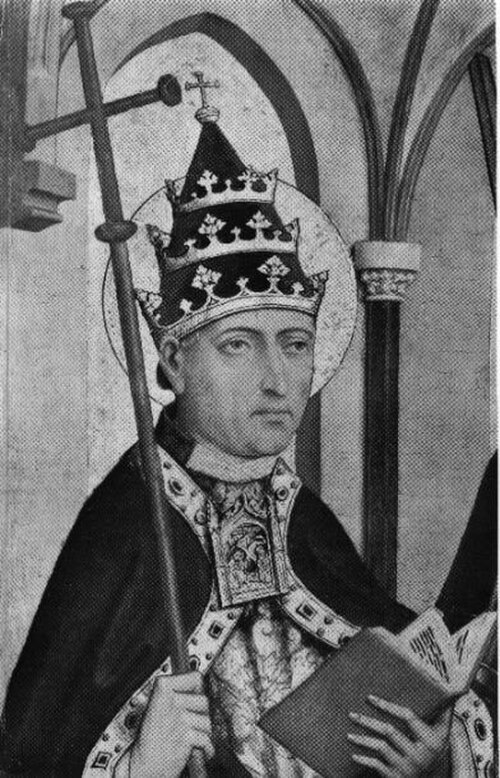
Saint
Gregory II of Rome
Bishop of Rome
Bishop of Rome from 715 to 731, who resisted the iconoclast policy of Emperor Leo III.
- Feast
- February 11old style February 24
- Reposed
- 7318th century
- Place
- Rome
- Order
- Hierarchs
Life
Pope Gregory II of Rome was bishop of Rome from 715 to 731, when the Byzantine emperor Leo III began the persecution of the holy icons. The Church honours him as a saint of the undivided Church and a defender of the veneration of icons; the English-language Orthodox calendars and OrthodoxWiki give his feast as 11 February, the Roman martyrology as 13 February.
Youth
He was born in Rome around 669 or 670, the son of Marcellus and Honesta, and grew up in the service of the Church of Rome: subdeacon and treasurer under Pope Sergius I, then deacon and keeper of the library. As secretary to Pope Constantine he went with him to Constantinople in 711, where he himself carried out the negotiations with Emperor Justinian II. After Constantine's death he was elected bishop of Rome and consecrated on 19 May 715.
Ministry
He began to repair the walls of Rome, which were threatened by the Lombards and by Arab raids, and ordered litanies during the great flood of the Tiber in 716. He supported the mission to the Germanic lands. He sent the Anglo-Saxon monk Winfrid, who took the name Boniface, to preach in Germany in 719 and made him a bishop in November 722, and he placed Corbinian as bishop of Freising in Bavaria. He also helped restore monasteries; in 718 he supported the renewal of Monte Cassino, destroyed by the Lombards in 584.
Against iconoclasm
Around 722 Emperor Leo III tried to raise taxes on the Church's estates in Italy, and Gregory refused. In 726 the emperor issued an edict condemning icons of the saints, and the pope rejected it at once. The Exarchate of Ravenna itself rose in revolt, and Gregory dissuaded the Italians from marching against Leo. In 727 he held a synod that condemned iconoclasm and wrote to the emperor that the doctrines of the Church belong not to the emperor but to the bishops; historians discuss whether the surviving letters are reliable. He supported Patriarch Germanus I of Constantinople and did not recognise Anastasius, the emperor's choice to succeed him.
Repose
He reposed on 11 February 731 and was buried in the basilica of Saint Peter; the place of his tomb has since been lost. His veneration is bound above all to his stand for the holy icons.
Commemorated the same day February 11
 Paschal I of RomeSaint · Bishop of RomeFeb 11
 Blaise of SebasteHieromartyr · Bishop of SebasteFeb 11
 TheodoraRight-Believing · Byzantine EmpressFeb 11
 CaedmonVenerable · Monk and poet at WhitbyFeb 11
 Vsevolod of PskovRight-Believing · Prince of PskovFeb 11
 George the New of SofiaNew Martyr · Silversmith of KratovoFeb 11
 GobnaitVenerable · Saint of BallyvourneyFeb 11
 Demetrius of PrilutskVenerable · Founder of the Saviour MonasteryFeb 11
 Castrensis of SessaSaint · Bishop of SessaFeb 11
 ArdanVenerableFeb 11
 Berthevin of ParignyMartyrFeb 11
- Cassian the BarefootVenerable · Venerable of VolokolamskFeb 11