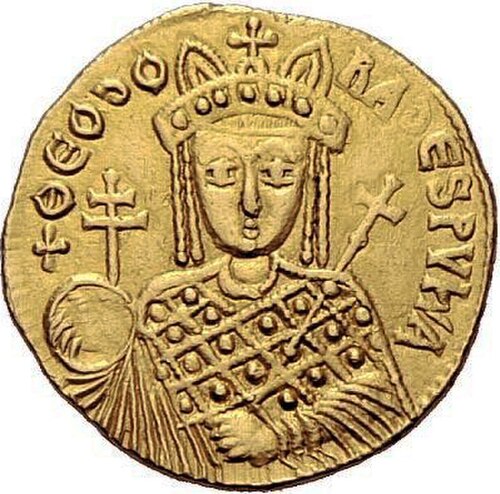
Right-Believing
Theodora
Byzantine Empress
Wife of Emperor Theophilos who, as regent, restored the veneration of holy icons in 843.
- Feast
- February 11old style February 24
- Reposed
- 8679th century
- Place
- Constantinople
Life
Saint Theodora the Righteous Empress was the wife of the emperor Theophilos, regent for her son Michael III, and the one through whom the struggle against the icons was ended in 843. The victory of the right faith is celebrated on the first Sunday of Great Lent, the Sunday of Orthodoxy. The Church commemorates her on 11 February.
Early life
She was born around 815 at Ebissa in Paphlagonia, the daughter of Marinos and Theoktiste. Scholars believe her family was of Armenian descent, though sources from her own time do not say so. She was a niece of the general Manuel the Armenian. In 830 the stepmother of the emperor Theophilos, Euphrosyne, held a bride-show, and Theophilos chose Theodora, giving her a golden apple. She was crowned in the church of Saint Stephen in Daphne and married in Hagia Sophia. They had seven children: Constantine, Michael, Thekla, Anna, Anastasia, Pulcheria and Maria.
Theophilos was an iconoclast, like his predecessors, but Theodora kept in secret the veneration of the holy icons. It is told that she sent her daughters to the monastery where Euphrosyne had retired, and there they were taught to venerate icons. In 839 the youngest daughter, Pulcheria, about two years old, told her father of the "beautiful dolls" they kissed at the monastery. Theophilos was angry and forbade the girls to see Euphrosyne again, but the teaching had taken root: none of their children became an iconoclast. Theodora also persuaded the emperor to release the icon painter Lazarus, who was in prison.
Regent and restoration of the icons
Theophilos died on 20 January 842, of dysentery, leaving Theodora regent for their son Michael, then two years old, with a group of advisers, among them the logothete Theoktistos. She wished to restore the veneration of icons, patiently and with the support of those around her. Nearly all the bishops had been forced to accept iconoclasm, so she gathered at the house of Theoktistos a group of officials and clergy, who condemned iconoclasm by accepting the decisions of the Seventh Ecumenical Council of Nicaea (787). The iconoclast patriarch John the Grammarian was removed from the throne and Methodios, a confessor of the icons, was put in his place. On 11 March 843, the first Sunday of Great Lent, a solemn procession with the icons in Hagia Sophia closed the dispute, and this day has been kept ever since as the Sunday of Orthodoxy.
Theodora said that Theophilos had repented before his death, to protect him and the reign of her son, and prayed for his forgiveness.
As regent she governed the empire well, kept a small surplus in the treasury, and secured a period of relative peace with the Bulgarians and the Arabs through new treaties, though most of Sicily was lost and Crete was not retaken. She was harsh toward the Paulicians, a dualist sect in Asia Minor, whose persecution was cruel and in which thousands died.
Later years
As Michael grew up, he was influenced by his uncle Bardas, who had Theoktistos murdered in November 855. On 15 March 856 Michael declared himself sole emperor and removed Theodora from power. She accepted the decision without resistance and withdrew in peace. She stayed in the palace until 857 or 858, when she was moved with her daughters to the convent of Gastria. Near the end of their lives she was reconciled with her son. She passed to the Lord around 867, after the murder of Michael, at whose burial she was present, weeping, with her daughters. She was buried at Gastria.
Veneration
The Orthodox Church honours her as a saint for the restoration of the icons and commemorates her on 11 February. After the fall of Constantinople her relics reached Corfu, where they rest in the cathedral of Panagia Spiliotissa, a place of pilgrimage. A copy of the Gospels written in her own hand is also preserved.
Commemorated the same day February 11
 Gregory II of RomeSaint · Bishop of RomeFeb 11
 Paschal I of RomeSaint · Bishop of RomeFeb 11
 Blaise of SebasteHieromartyr · Bishop of SebasteFeb 11
 CaedmonVenerable · Monk and poet at WhitbyFeb 11
 Vsevolod of PskovRight-Believing · Prince of PskovFeb 11
 George the New of SofiaNew Martyr · Silversmith of KratovoFeb 11
 GobnaitVenerable · Saint of BallyvourneyFeb 11
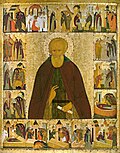 Demetrius of PrilutskVenerable · Founder of the Saviour MonasteryFeb 11
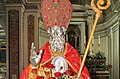 Castrensis of SessaSaint · Bishop of SessaFeb 11
 ArdanVenerableFeb 11
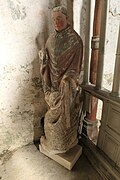 Berthevin of ParignyMartyrFeb 11
- Cassian the BarefootVenerable · Venerable of VolokolamskFeb 11