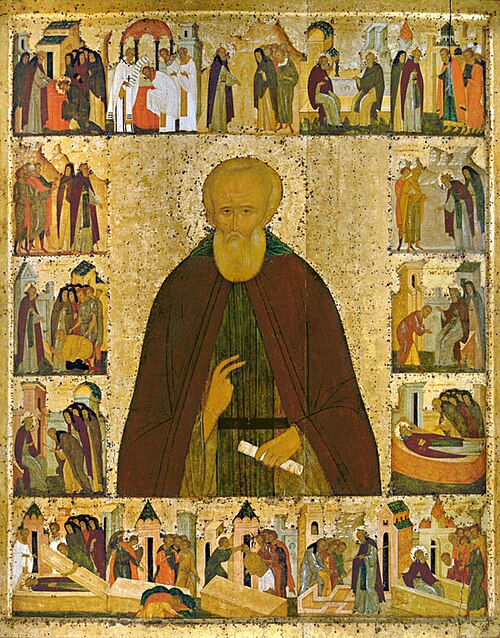
Venerable
Demetrius of Prilutsk
Founder of the Saviour Monastery
Russian hieromonk, founder of the Saint Nicholas and Saviour monasteries at Prilutsk, died in 1392.
- Feast
- February 11old style February 24
- Reposed
- 140615th century
- Place
- Spaso-Prilutsky Monastery
- Order
- Venerables
Life
Venerable Demetrius of Prilutsk (early fourteenth century - 1392 or 1406) was a hieromonk and abbot, founder of the Saint Nicholas Monastery at Pereslavl and of the Saviour Monastery at Prilutsk near Vologda, the first communal monastery of the Russian North. He was a friend of Saint Sergius of Radonezh. He is commemorated on 11 February (repose) and 3 June (finding of the image), by the old calendar.
Life
He was born into a wealthy merchant family, the Pokropaevs, at Pereslavl-Zalessky (according to other sources, in the village of Veslevo). He was tonsured at the Dormition Monastery at Goritsy, where he was ordained priest. On the shore of Lake Pleshcheyevo he founded the communal Saint Nicholas Monastery and was its abbot. In 1354 he met Saint Sergius of Radonezh, who had come to Pereslavl to Bishop Athanasius, and conversed with him many times. His fame grew so much that he was godfather to the children of Grand Prince Dmitry Donskoy. Under Sergius's influence he wished to withdraw to a wild place and went north with his disciple Pachomius. In the forests of Vologda, on the river Velikaya, in the Avnezh district, they built a church of the Resurrection and wanted to found a monastery, but the locals feared losing their lands, and the hermits went further.
Not far from Vologda, in a bend of the river, he decided to make the first communal monastery of the Russian North. The people of Vologda and the surroundings helped gladly. In 1371 the wooden Saviour Cathedral was raised and brethren began to gather, many of them disciples who came from Pereslavl. Deep prayer and strict asceticism were joined in the abbot of Prilutsk with mercy: he fed the poor and hungry, received travellers, spoke with those needing comfort and gave advice. He liked to pray alone. His food was only prosphora with warm water, and on feast days he did not take the wine and fish allowed by the rule. In winter and summer he wore the same old sheepskin coat, and until deep old age he went with the brethren to the common works. He accepted gifts to the monastery with discrimination, so that benefactions would not harm the neighbour. The life speaks of his foresight. His special virtue was unusual humility, which made him hide not only the beauty of his soul but also his handsome face.
Repose and veneration
He fell asleep in deep old age. The dating to 1392 in the Description of Russian Saints is not exact, says the Orthodox Encyclopedia, because in the manuscript the tens and units of the year are not written, and the most probable date, around 1406, results from the date of the first posthumous miracle. The Serbian and Ukrainian sources give 11 February 1406. He was buried by the south wall of the wooden Saviour church. Miracles at his relics began in 1409, in the fifteenth century his veneration spread across Rus, and at the end of the century the painter Dionisy painted his icon with scenes from his life. His relics rest under the floor in the lower church of the Saviour Cathedral of the Prilutsk Monastery, and beside them is kept the wonderworker's abbot's staff.
Commemorated the same day February 11
 Gregory II of RomeSaint · Bishop of RomeFeb 11
 Paschal I of RomeSaint · Bishop of RomeFeb 11
 Blaise of SebasteHieromartyr · Bishop of SebasteFeb 11
 TheodoraRight-Believing · Byzantine EmpressFeb 11
 CaedmonVenerable · Monk and poet at WhitbyFeb 11
 Vsevolod of PskovRight-Believing · Prince of PskovFeb 11
 George the New of SofiaNew Martyr · Silversmith of KratovoFeb 11
 GobnaitVenerable · Saint of BallyvourneyFeb 11
 Castrensis of SessaSaint · Bishop of SessaFeb 11
 ArdanVenerableFeb 11
 Berthevin of ParignyMartyrFeb 11
- Cassian the BarefootVenerable · Venerable of VolokolamskFeb 11