Venerable
Caedmon
Monk and poet at Whitby
Northumbrian cowherd who became a monk at Whitby, the earliest English poet known by name.
- Feast
- February 11old style February 24
- Reposed
- 6807th century
- Place
- Whitby Abbey
- Order
- Venerables
Life
Saint Caedmon was a Northumbrian cowherd who became a monk at Whitby and is the earliest English poet known by name. His story has come down to us from the Venerable Bede, in the Ecclesiastical History of the English People, which is the only source for his life. He is remembered on 11 February. Bede does not call him a saint, but tradition has honoured him, and Western Orthodox calendars list him among the saints of the undivided Church.
His life, according to Bede
Caedmon was a lay brother who looked after the animals of the double monastery of Streonæshalch (now Whitby) in the time of Abbess Hilda (657 to 680). He did not know how to sing. One evening, when the brothers were making merry and passing the harp from hand to hand, Caedmon left the feast, since he knew no songs, and went to sleep in the stable. In his sleep someone appeared to him and asked him to sing "the beginning of created things." After first refusing, Caedmon began to sing a short song of praise to God, Creator of heaven and earth.
In the morning he remembered all that he had sung and added more verses. He told his dream to his foreman, who took him to the abbess, believed to be Hilda. She and her counsellors questioned him and, satisfied that the gift came from God, gave him a passage of sacred history to put into verse. When he returned the next morning with the poem, he was invited to take the monastic habit. The abbess ordered that he be taught all of sacred history. Bede says that he kept it in mind and, after a night, turned it into very sweet verse in Old English, his own language. His songs moved many to despise the world and to long for heaven.
His end
Caedmon lived a long and zealous life. Sensing that death was near, he asked to be taken to the house for the dying, gathered his friends around him, received the Holy Eucharist and fell asleep in peace just before the night office. The date of his death is not known; it is judged to fall between 679 and 684.
His work
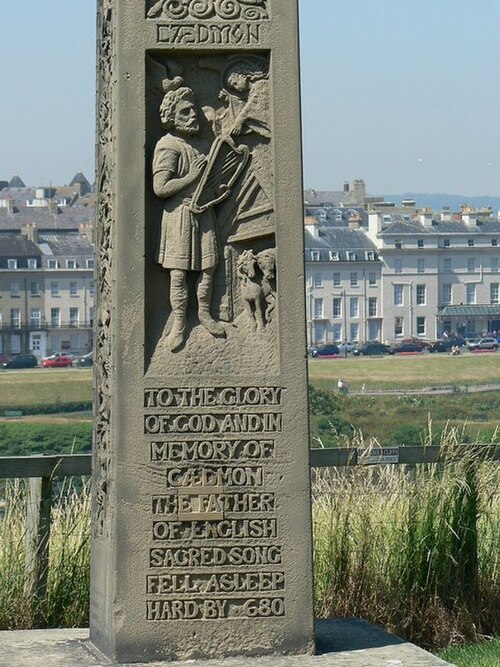
The only surviving work attributed to him with certainty is Caedmon's Hymn, a poem of nine lines in Old English praising God. It is one of the earliest attested poems in Old English. Other biblical poems, preserved in the Junius manuscript, were once attributed to him, but scholars no longer believe they are his. His story shows how the poetry of a people was set in the service of the Gospel. In 1898 a cross was raised in his memory in the churchyard of Saint Mary's at Whitby.
Commemorated the same day February 11
 Gregory II of RomeSaint · Bishop of RomeFeb 11
 Paschal I of RomeSaint · Bishop of RomeFeb 11
 Blaise of SebasteHieromartyr · Bishop of SebasteFeb 11
 TheodoraRight-Believing · Byzantine EmpressFeb 11
 Vsevolod of PskovRight-Believing · Prince of PskovFeb 11
 George the New of SofiaNew Martyr · Silversmith of KratovoFeb 11
 GobnaitVenerable · Saint of BallyvourneyFeb 11
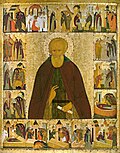 Demetrius of PrilutskVenerable · Founder of the Saviour MonasteryFeb 11
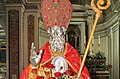 Castrensis of SessaSaint · Bishop of SessaFeb 11
 ArdanVenerableFeb 11
 Berthevin of ParignyMartyrFeb 11
- Cassian the BarefootVenerable · Venerable of VolokolamskFeb 11