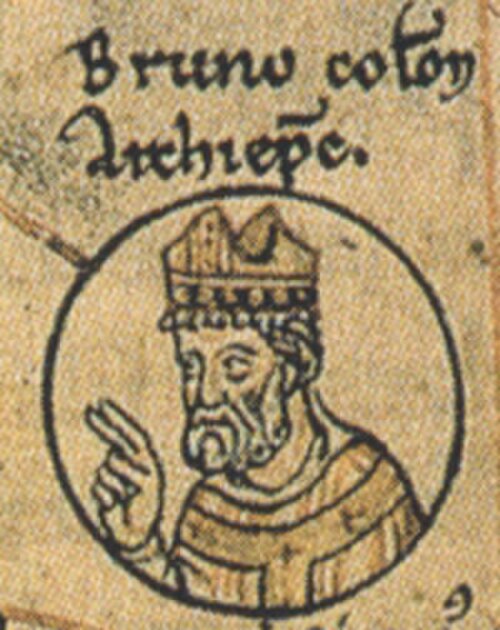
Saint
Bruno the Great
Archbishop of Cologne
Archbishop of Cologne from 953 and duke of Lotharingia, the youngest brother of Emperor Otto I.
- Feast
- October 11old style October 24
- Reposed
- 96510th century
- Place
- Reims
- Order
- Hierarchs
Life
Saint Bruno the Great, hierarch, was archbishop of Cologne from 953 until his death in 965, and duke of Lotharingia from 954. He was the youngest brother of the emperor Otto I. He is commemorated on 11 October.
His life
Bruno was the youngest son of King Henry the Fowler and of Matilda, who is remembered as a saint. While still a child, it was decided that he should follow a church career. He studied at the cathedral school of Utrecht, then, in the early 940s, at Trier, under the scholar Israel the Grammarian. He was his brother’s chancellor, and in 951 Otto named him archchaplain. In 953 the see of Cologne fell vacant just when Duke Conrad the Red of Lotharingia, Otto’s son-in-law, had joined a rebellion against him. By naming Bruno, Otto secured a powerful ally. The next year the revolt collapsed, Otto removed Conrad and gave the duchy of Lotharingia to Bruno, who thus became both archbishop and duke, called by his biographer, Ruotger, archduke. After the death of King Louis IV of France, in 954, and of Hugh the Great, in 956, Bruno, uncle of their heirs, King Lothair and Hugh Capet, in effect ruled as regent of the western kingdom. From 962 he was also Otto’s regent in Germany, while Otto was away in Italy. He died at Reims, in 965, and was buried in the monastery of Saint Pantaleon, near Cologne, which he had founded.
His work
His position in Cologne was almost that of a king: Otto gave him and his successors the right to build fortifications, to strike coins and to collect taxes and tolls on the Rhine. His court at Cologne was the chief center of learning and art in Germany at that time, and many of the church leaders of the next generation were trained there. He built a palace, enlarged the cathedral until it was held to rival Saint Peter’s in Rome, brought within the walls the area between the Roman wall and the Rhine and built churches, among them those of Saint Martin of Tours and of Saint Andrew, and the Benedictine monastery of Saint Pantaleon. He brought from Troyes the relics of Saint Patroclus and set them in 964 at Soest.
Veneration
He was venerated at Saint Pantaleon throughout the Middle Ages. His biographer shows him as an example of life, not as a wonderworker. He was beatified in 1870 and numbered among the saints in 1895.
Commemorated the same day October 11
 Philip the DeaconApostle · One of the Seven DeaconsOct 11
 Philotheus KokkinosSaint · Patriarch of ConstantinopleOct 11
- Arsacius of TarsusSaintOct 11
 Leo of OptinaVenerable · Elder of Optina MonasteryOct 11
 Theodore and Theophanes the BrandedHoly Confessors · Brothers from JerusalemOct 11
 Firminus of UzèsSaint · Bishop of UzèsOct 11
- Sisinnius ISaint · Patriarch of ConstantinopleOct 11
 Sanctinus of MeauxSaint · Bishop of Meaux and VerdunOct 11
 Zenaida and PhilonellaHoly Unmercenary Healers · Unmercenary physicians of TarsusOct 11
 Nicasius of RouenHieromartyr · Apostle of the VexinOct 11
 Theophanes the BrandedConfessor · Metropolitan of NicaeaOct 11
 John the God-pleasingVenerable · Monk of the Kiev CavesOct 11