Saint
Philotheus Kokkinos
Patriarch of Constantinople
Twice Ecumenical Patriarch, a leader of the Byzantine monastic revival, who died in 1379.
- Feast
- October 11old style October 24
- Reposed
- 137914th century
- Place
- Constantinople
- Order
- Hierarchs
Life
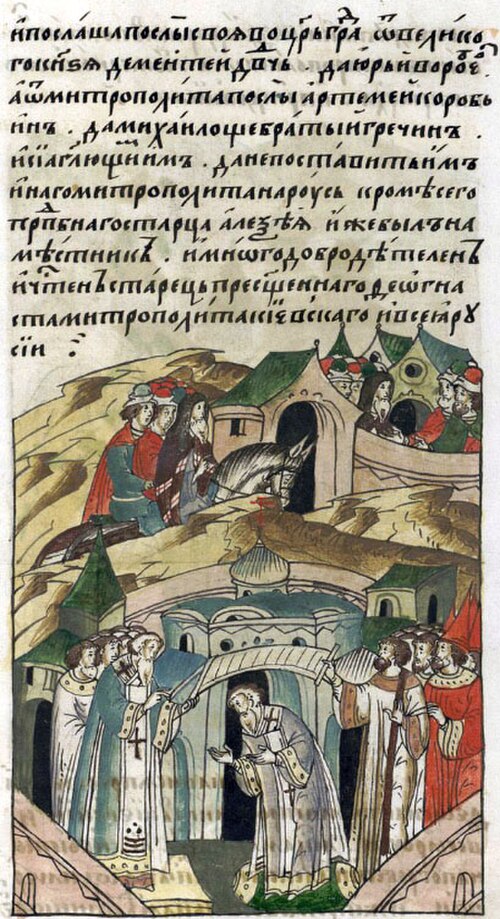
Saint Philotheus Kokkinos, hierarch, was twice Ecumenical Patriarch of Constantinople, from 1353 to 1354 and from 1364 to 1376, and one of the leaders of the monastic and hesychast revival in fourteenth century Byzantium. He was born about the year 1300 at Thessalonica and fell asleep in 1379 at Constantinople. His theological, liturgical and canonical writings spread not only in Byzantium but also in the Slavic Orthodox world, and the Church honours him as a defender of Orthodoxy, together with Saints Photius, Mark of Ephesus and Gregory Palamas.
Beginnings Little is known of his childhood. He is believed to have been born about 1300 at Thessalonica, in a poor family. Some sources, coming above all from polemical writings of his opponents, say that his mother was a Jewish convert to Orthodoxy, but historians warn that this is not certain. He studied at Thessalonica under Thomas Magister, one of the most learned men of the time, and showed great talent for both secular and theological studies. His works show a good knowledge of ancient literature.
He chose the monastic life early, according to some research at the monastery of Chortaitou near Thessalonica, and then on the Holy Mountain. Church tradition also remembers a stay on Mount Sinai. On Athos he first lived at Vatopedi as a disciple of Saint Savvas the Younger, then near the Great Lavra under the guidance of the ascetic Germanos Maroulis. He wrote the lives of Saint Savvas and of Saint Gregory Palamas, whom he knew at the Lavra.
Defender of hesychasm Philotheus firmly held the hesychast teaching on prayer and on uncreated grace and wrote about the uncreated energies of God, refuting the scholastic philosophy of the West. His best known work, from 1339, is the Hagioritic Tome, the manifesto of the Athonite monks on how the saints partake of the divine uncreated light that the disciples saw at the Transfiguration.
In 1340 he was appointed abbot of the Philokalou monastery at Thessalonica, and in 1344 he was called to Athos to lead the Great Lavra. In recognition of his service in the time of the hesychast disputes, Patriarch Isidore made him Metropolitan of Heraclea in Thrace in 1347. He stayed mostly in Constantinople, however, as a trusted man of the emperor John VI Kantakouzenos. When the Genoese sacked his see, in 1351 or 1352, he obtained the release of many inhabitants taken prisoner, but he kept a lifelong opposition to them. In 1351 he took part in the hesychast council at Constantinople and wrote its Acts.
Patriarch In August 1353 the emperor made him patriarch, regarding him as a learned man and unshaken in Orthodoxy. In 1354 he crowned Matthew Kantakouzenos as emperor and confirmed the transfer of the metropolitan see from Kiev to Vladimir, appointing Alexis metropolitan of Kiev and all Rus, with his residence at Moscow. Also in 1354, at the request of Grand Prince Algirdas of Lithuania, he agreed to the founding of a Lithuanian metropolis. When John V Palaiologos came to power, in December 1354, he removed him from the throne, and Philotheus withdrew to a monastery and was again Metropolitan of Heraclea from 1357 to 1364.
On the death of Patriarch Callistus, in 1364, he was called back to the throne. In 1368 he presided over the synod that recognised Gregory Palamas as a saint. When the emperor John V, who had converted to Catholicism in Rome in 1369, sought union of the Churches in order to obtain help against the Turks, Philotheus rejected union on political grounds. He asked instead for a genuine ecumenical council, which he proposed in 1367, but Pope Urban V rejected the idea. Though not a friend of the Latins, he did allow the Genoese, Venetians and Catalans a place in Hagia Sophia for their services.
In 1372 he sent to Saint Sergius of Radonezh a cross with relics, the schema, the paramand and a letter, kept in the lavra to this day. In 1375, after the plea of an Athonite delegation, Constantinople was reconciled with the Serbian Church, the anathema on Stefan Dušan being lifted. In the same year he made Cyprian, a Bulgarian, metropolitan for Little Rus, which led to a church crisis that he regarded as only temporary.
Writings and repose Philotheus left many works: lives of saints, dogmatic and polemical writings, homilies, hymns and prayers. He drew up the order of the Divine Liturgy and of the vigil, and his arrangements remained in use. His encomium of Gregory Palamas is also a valuable historical source.
In 1376, when Andronikos IV seized power, Philotheus was removed from the throne. He withdrew to the monastery of Christ Akataleptos and fell asleep in 1379. He was buried there with imperial honours and was venerated early as a saint. The Church commemorates him in October, on the 11th according to the Greek sources.
Commemorated the same day October 11
 Philip the DeaconApostle · One of the Seven DeaconsOct 11
 Bruno the GreatSaint · Archbishop of CologneOct 11
- Arsacius of TarsusSaintOct 11
 Leo of OptinaVenerable · Elder of Optina MonasteryOct 11
 Theodore and Theophanes the BrandedHoly Confessors · Brothers from JerusalemOct 11
 Firminus of UzèsSaint · Bishop of UzèsOct 11
- Sisinnius ISaint · Patriarch of ConstantinopleOct 11
 Sanctinus of MeauxSaint · Bishop of Meaux and VerdunOct 11
 Zenaida and PhilonellaHoly Unmercenary Healers · Unmercenary physicians of TarsusOct 11
 Nicasius of RouenHieromartyr · Apostle of the VexinOct 11
 Theophanes the BrandedConfessor · Metropolitan of NicaeaOct 11
 John the God-pleasingVenerable · Monk of the Kiev CavesOct 11