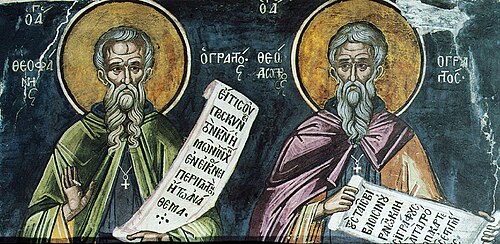
Holy Confessors
Theodore and Theophanes the Branded
Brothers from Jerusalem
Monk brothers from Jerusalem, defenders of the veneration of icons in the second iconoclast period, called the Branded.
- Feast
- October 11old style October 24
- Era
- unknown
- Order
- Confessors
Life
Saints Theodore and Theophanes the Branded were two monk brothers from Jerusalem, confessors of the veneration of holy icons in the second period of the struggle against icons, in the ninth century. They are called the Branded (in Greek Graptoi, "the written upon") because the iconoclast emperor Theophilos had mocking verses inscribed on their faces. Theodore died in prison, while Theophanes became bishop of Nicaea and a great hymnographer of the Church. Theophanes is commemorated on 11 October and Theodore on 27 December.
Youth and monastic life
According to their life, Theodore and Theophanes were born of pious parents in Palestine at the end of the eighth century. The sources say their father was Saint Jonah the Presbyter, and their birthplace was Jerusalem or Arabia. Theodore was the elder brother. They received a fine education and grew up in Jerusalem. While still young they entered the lavra of Saint Sabbas the Sanctified near Bethlehem, where they received the monastic tonsure and became disciples of Saint Michael the Synkellos. Theodore was ordained priest. Of Theodore it is said that from childhood he loved the Church and spent much time in places of worship. Later he studied ancient and Christian philosophy under a learned man, and then returned to the lavra and became a monk.
Confession in Constantinople
In 813 Leo V the Armenian became emperor; in 815 he deposed Patriarch Nikephoros, called a local council that annulled the decisions of the Seventh Ecumenical Council of Nicaea in 787, and renewed the persecution of icons. The Patriarch of Jerusalem, Thomas, sent Theodore and Theophanes to Constantinople to urge the emperor to renounce the heresy. Other sources say that around 812 Michael the Synkellos and his two disciples left Jerusalem for Rome, sent to support the pope in the dispute over the Filioque, but landed at Constantinople, where they vigorously defended the icons.
The brothers' talks with the emperor led to their condemnation as heretics. They were thrown into prison and endured beatings, insults, wounds, chains, hunger and thirst. For nearly thirty years, from 815 or 817 until 842, they were tormented and persecuted by the iconoclast emperors: Leo the Armenian, Michael the Stammerer and, above all, Theophilos (829-842), a fierce enemy of the icons.
The inscription on their faces
Under Michael II the brothers were brought to the monastery of Sosthenion on the Bosphorus. Patriarch John the Grammarian ordered them confined again. After Michael's death Theophilos came to the throne and exiled them to the island of Aphousia, and in 836 recalled them to Constantinople. The emperor beat them with his own hand and ordered twelve iambic verses to be written on their faces with red-hot needles, calling the confessors "vessels of superstitious error". The ordeal lasted two days, and their faces remained disfigured. From this they received the name the Branded.
Before the torture the city prefect asked Theodore to commune just once with the iconoclasts, in return for freedom. The martyr answered that it was as if he said, "We will only cut your throat, and then you may go where you like." After this the brothers were imprisoned at Apamea in Bithynia, where Theodore died around 840 or 841 of his wounds.
After the triumph of the icons
Theodore's relics were carried to Chalcedon, where healings took place. Theophanes lived to see the restoration of the veneration of icons and took part in the council of Constantinople in 843. In prison he corresponded with the future patriarch Methodios the Confessor. Patriarch Methodios wished to make him metropolitan of Nicaea, but some objected that Theophanes was a Syrian and had no guarantors. The patriarch answered, pointing to Theophanes' disfigured face, that after such an inscription there was no need of a better witness to his Orthodox confession. Theophanes governed Nicaea until his death around 845.
Theophanes wrote many hymns, among them a solemn canon for the veneration of the holy icons, four books against the Jews, the letter of the confessors on icons and verses on the persecution of the icons. He is known above all as a composer of canons, said to number as many as 145. Together with Joseph the Hymnographer, he is among the chief authors of the Parakletike, with canons in all eight tones for the angels and for the departed. He belongs among the hymnographers of the tradition of the lavra of Saint Sabbas, with Andrew of Crete, Kosmas of Maiouma and John of Damascus.
The Roman Church commemorates both brothers on 27 December.
Commemorated the same day October 11
 Philip the DeaconApostle · One of the Seven DeaconsOct 11
 Bruno the GreatSaint · Archbishop of CologneOct 11
 Philotheus KokkinosSaint · Patriarch of ConstantinopleOct 11
- Arsacius of TarsusSaintOct 11
 Leo of OptinaVenerable · Elder of Optina MonasteryOct 11
 Firminus of UzèsSaint · Bishop of UzèsOct 11
- Sisinnius ISaint · Patriarch of ConstantinopleOct 11
 Sanctinus of MeauxSaint · Bishop of Meaux and VerdunOct 11
 Zenaida and PhilonellaHoly Unmercenary Healers · Unmercenary physicians of TarsusOct 11
 Nicasius of RouenHieromartyr · Apostle of the VexinOct 11
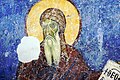 Theophanes the BrandedConfessor · Metropolitan of NicaeaOct 11
 John the God-pleasingVenerable · Monk of the Kiev CavesOct 11