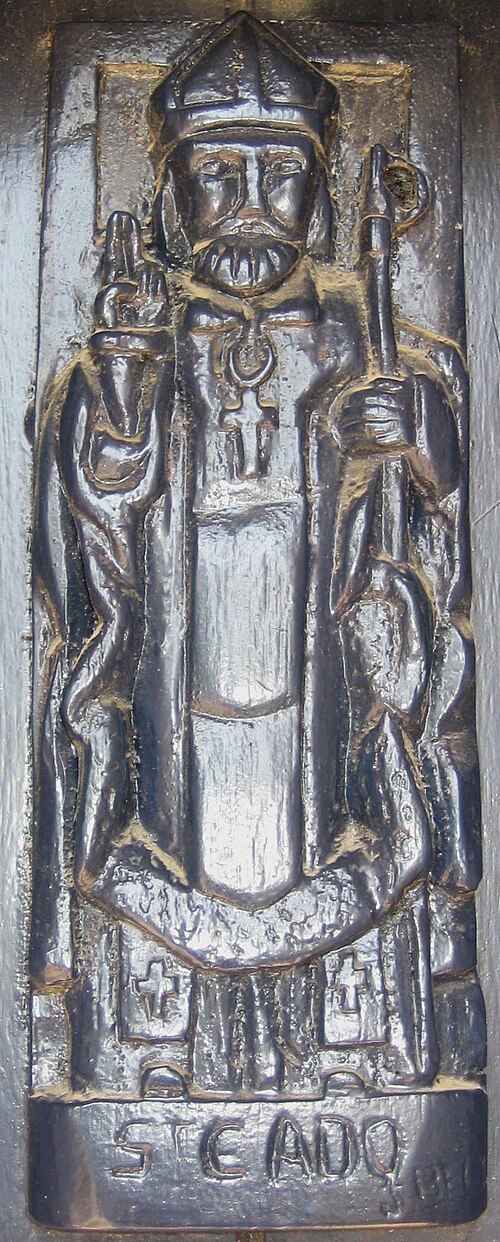
Venerable
Cadoc of Llancarfan
Abbot of Llancarfan
Welsh abbot of the fifth and sixth centuries at Llancarfan in Glamorgan, a monastery famed for learning.
- Feast
- January 24old style February 6
- Reposed
- 5806th century
- Place
- Benevento
- Order
- Venerables
Life
Saint Cadoc was abbot of Llancarfan near Cowbridge in Glamorgan, Wales, in the fifth and sixth centuries, of a monastery famous as a centre of learning of the Celtic Church, where Illtud spent the first part of his monastic life. He is credited with founding many churches in Cornwall, Brittany, Dyfed and Scotland. He was called Cattwg the Wise, and a large collection of his maxims and moral sayings was included in the Myvyrian Archaiology. The Church remembers him on 24 January, in other places on 21 September.
His Life was written shortly before 1086 by Lifris of Llancarfan to honour the house and confirm its endowments, so it has limited historical merit. His father, Gwynllyw the Bearded, was one of the lesser kings of Wales, a brother of Saint Petroc. According to the story he carried off Princess Gwladys, daughter of King Brychan, in a raid in which two hundred of his three hundred followers perished. It is said Cadoc worked miracles even before his birth: strange lights shone in his parents' house and the cellars were filled with food. He was born around 497 in Monmouthshire. An angel announced his birth and summoned the hermit Meuthi to baptize and teach him. A holy well sprang up at his baptism and afterwards flowed with wine and milk. His father sent him to be educated at the monastery of Tathyw at Caerwent. Cadoc learned Latin and came to love the life of a monk and priest.
One day, chased by an armed swineherd, he came upon a wild boar white with age, which made three fierce bounds toward him but vanished. Cadoc took it as a heavenly sign and marked the spot with three branches. The valley belonged to his uncle, King Pawl of Penychen, who gave it to him, and there the great school and monastery of Llancarfan was afterward built. As an adult he refused to take charge of his father's army, "preferring to fight for Christ". He founded the monastery at Llancarfan, studied three years in Ireland, then with Bachan, a teacher of rhetoric from Italy, and founded a monastery at Cambuslang in Scotland. On his return Llancarfan grew into one of the chief monasteries of South Wales. It is told that in a famine he saved his companions by watching a mouse that had found a hoard of grain. More certain is that he spent time in Brittany, on an island in the Etel river, now L'Île de Cado, where he built an oratory and founded a monastery. Chapels are dedicated to him at Belz, Locoal-Mendon and Gouesnac'h, where he is called on to cure deafness. His name is the basis of some thirty Breton place names.
The sources say he died, by some accounts killed, in 577 or 580, by tradition at Benevento in Italy. According to another tradition he made a pilgrimage to Rome. His Life is one of the seven saints' lives that mention King Arthur independently of Geoffrey of Monmouth, and so is important in the discussion of Arthur's historicity. Llancarfan did not survive the arrival of the Normans in South Wales and was dissolved around 1086.
Commemorated the same day January 24
 Xenia of St. PetersburgFool-for-Christ · Patron of St. PetersburgJan 24
 Xenia of RomeVenerableJan 24
 Neophytos the RecluseVenerable · Monk and priest of CyprusJan 24
 Felician of FolignoHieromartyr · Bishop of FolignoJan 24
 Savinianus of TroyesMartyr · Martyr of TroyesJan 24
 Exuperantius of CingoliSaint · Bishop of CingoliJan 24
 Macedonius the Barley-EaterVenerable · Hermit of SyriaJan 24
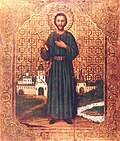 John of KazanMartyr · Martyr of KazanJan 24
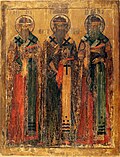 Gerasim of PermSaint · Bishop of PermJan 24
- Babylas of SicilyHieromartyr · Hermit in SicilyJan 24
- Alexander TelemakovHieromartyr · PriestJan 24
- Demetrius of TsilibinoVenerable · Founder of a hermitageJan 24