Fool-for-Christ
Xenia of St. Petersburg
Patron of St. Petersburg
She gave away her possessions to the poor and lived as a fool for Christ in St. Petersburg; died around 1803.
- Feast
- January 24old style February 6
- Reposed
- 180319th century
- Place
- Saint Petersburg
- Order
- Fools-for-Christ
Life
Saint Xenia of Saint Petersburg the Blessed (born Xenia Grigoryevna Petrova) was a fool for Christ who lived in St Petersburg in the eighteenth century and at the start of the nineteenth. She is the patron of the city. No written records of her life survive from her own time, and the first printing of popular traditions about her dates from the 1840s.
Life
According to these accounts she was born in the first half of the eighteenth century, probably between 1719 and 1730. Her father was named Gregory. Of marriageable age, she married Andrey Fyodorovich Petrov, a singer at the imperial court and later a colonel. She lived with him in St Petersburg.
At twenty-six she was widowed by the sudden death of her husband. She then chose the hard way of foolishness for Christ. She gave her house to an acquaintance, put on her husband's clothes, answered only to his name, and said that he was alive and Xenia was dead. When her husband's clothes wore out, she dressed in a red jacket and a green skirt, or the other way round, and wore torn shoes on bare feet. Many offered her warm clothing and footwear, but she accepted nothing. Nor would she take alms, only a few kopecks, which she gave away again.
By day she wandered the streets of Petersburg, sometimes calling on acquaintances, eating with them and talking with them. For a long time it was not known where she spent her nights. Then it was found that in every season and in all weather she spent them in the fields, kneeling in prayer until dawn, making prostrations to the four directions. At night she also carried bricks for the church being built at the Smolensky cemetery. She is said to have foretold the death of Empress Elizabeth Petrovna and of Ivan Antonovich. By her gift of foresight she helped people in ordering their lives and saving their souls, and it was said that those to whom she gave anything prospered.
Death and veneration
Xenia spent forty-five years in foolishness for Christ and fell asleep at the start of the nineteenth century, in 1803 or 1802 according to some sources; she was no longer alive after 1806. She was buried at the Smolensky Orthodox cemetery in St Petersburg. A stone chapel was raised over her grave in 1902, closed twice in the Soviet period and returned to the Church in 1983. It is today one of the great places of pilgrimage in the city. People pray to her for employment, for marriage, for the homeless, for missing children and for spouses.
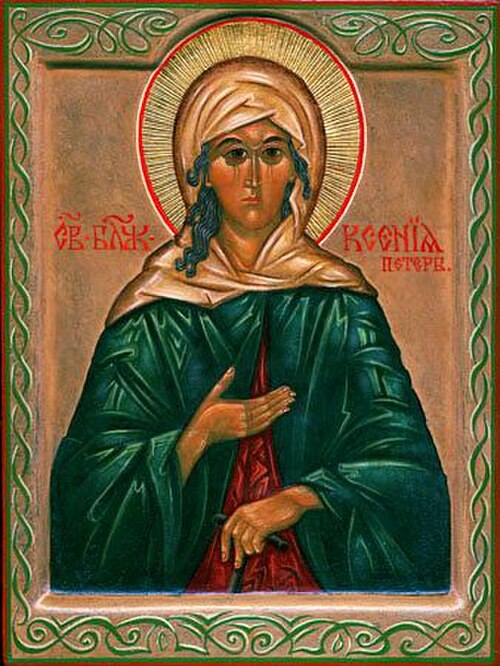
The Russian Church Outside of Russia canonized her on 24 September 1978, and the Russian Church numbered her among the saints at its Local Council on 6 June 1988. In July 2020 the Holy Synod of the Romanian Orthodox Church resolved to include her in its calendar on 24 January, her feast day. On icons she is shown in red and green clothing, leaning on a staff. About forty churches and chapels are dedicated to her.
Commemorated the same day January 24
 Xenia of RomeVenerableJan 24
 Cadoc of LlancarfanVenerable · Abbot of LlancarfanJan 24
 Neophytos the RecluseVenerable · Monk and priest of CyprusJan 24
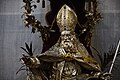 Felician of FolignoHieromartyr · Bishop of FolignoJan 24
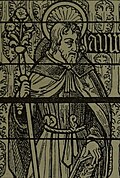 Savinianus of TroyesMartyr · Martyr of TroyesJan 24
 Exuperantius of CingoliSaint · Bishop of CingoliJan 24
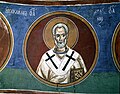 Macedonius the Barley-EaterVenerable · Hermit of SyriaJan 24
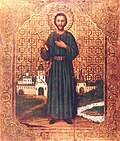 John of KazanMartyr · Martyr of KazanJan 24
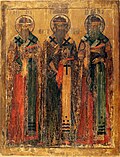 Gerasim of PermSaint · Bishop of PermJan 24
- Babylas of SicilyHieromartyr · Hermit in SicilyJan 24
- Alexander TelemakovHieromartyr · PriestJan 24
- Demetrius of TsilibinoVenerable · Founder of a hermitageJan 24