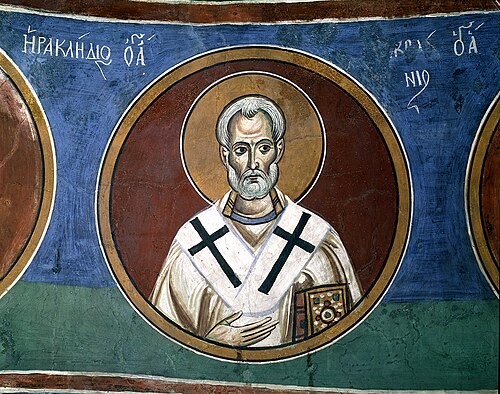
Venerable
Macedonius the Barley-Eater
Hermit of Syria
Hermit of Byzantine Syria at the turn of the 4th and 5th centuries, commemorated on January 24.
- Feast
- January 24old style February 6
- Era
- unknown
- Order
- Venerables
Life
Venerable Macedonius Kritophagos (the Barley-Eater) was a Syrian hermit and priest of the end of the fourth and beginning of the fifth century. Theodoret of Cyrrhus, who knew him personally, writes of him in the thirteenth chapter of his History of the Lovers of God. He is commemorated on 24 January (6 February by the new calendar).
Life
Macedonius was a Syrian and spoke Syriac. The nickname Kritophagos means barley-eater. He ate neither bread nor beans, only barley moistened with water, which for a long time was brought to him by the mother of Theodoret, who knew him. According to Theodoret, he began his ascetic life as a wandering pilgrim through Syria, Phoenicia and Cilicia. He chose the tops of mountains as the place of his labours and passed from one to another, not because he disliked the places but to escape the crowd that gathered about him. For forty-five years he lived thus, without hut or tent, in a deep cave, so that some called him Guvvan, which in Syriac means a lake in a cave. In deep old age, at the request of many, he built himself a dwelling and lived another twenty-five years, in his dwelling and in the little houses of others. His ascetic life lasted seventy years. He regarded food as a kind of medicine that keeps death away, since it is not lawful to shorten one's life to flee labours.
Ordination and trials
Archbishop Flavian of Antioch heard of his virtues and summoned him from the mountain under the pretext of a complaint. When Macedonius came, Flavian led him before the Liturgy to the altar and ordained him priest. After the Liturgy someone explained what had happened. The old man grew angry, scolded those present with harsh words, took his staff and ran after Flavian, thinking that the ordination had deprived him of monastic life. His friends calmed him with difficulty. After a week Flavian summoned him again, but he asked whether what had happened was not enough and they wished to make him a priest again, and he did not come. Later, after many explanations, he was reconciled.
In February 387, at the beginning of Great Lent, riots broke out at Antioch because of heavy taxes, and the statues of Emperor Theodosius the Great and his family were overturned and smashed. Two officials of the emperor, Caesarius and Ellebichus, were coming with troops to carry out the sentence of destroying the city. Macedonius came down from the mountain and stopped them in the square. Learning that he was a great ascetic, they leaped from their horses, touched his hands and knees and promised him mercy. He asked them to tell the emperor that he too is a man and has the same nature as those who angered him, and that for his images he had ordered the images of God destroyed, and for bronze statues had condemned bodies to death; statues are easily remade, but not even the emperor can give life back to bodies that were killed. They heard the words through an interpreter, were amazed and promised to repeat them exactly.
Miracles and end
Theodoret tells of miracles: he healed a woman sick with gluttony, who swallowed thirty birds a day, by blessing water with the sign of the Cross; he drove a spirit from a maiden and persuaded the judge to spare the sorcerer who had sent it; he healed the madwoman Asteria; he foretold the future to the general Lupicinus; and he healed Theodoret's mother of barrenness, then kept her by prayer from losing the pregnancy, the child being Theodoret himself. He told Theodoret that he had been born with great labours and must live worthy of them, being dedicated to God even before birth. He fell asleep around 420 (or 418, according to one source), after about seventy years of ascetic labour, and was buried in a cave with the bodies of Julian, Aphraates and Theodosius.
Commemorated the same day January 24
 Xenia of St. PetersburgFool-for-Christ · Patron of St. PetersburgJan 24
 Xenia of RomeVenerableJan 24
 Cadoc of LlancarfanVenerable · Abbot of LlancarfanJan 24
 Neophytos the RecluseVenerable · Monk and priest of CyprusJan 24
 Felician of FolignoHieromartyr · Bishop of FolignoJan 24
 Savinianus of TroyesMartyr · Martyr of TroyesJan 24
 Exuperantius of CingoliSaint · Bishop of CingoliJan 24
 John of KazanMartyr · Martyr of KazanJan 24
 Gerasim of PermSaint · Bishop of PermJan 24
- Babylas of SicilyHieromartyr · Hermit in SicilyJan 24
- Alexander TelemakovHieromartyr · PriestJan 24
- Demetrius of TsilibinoVenerable · Founder of a hermitageJan 24