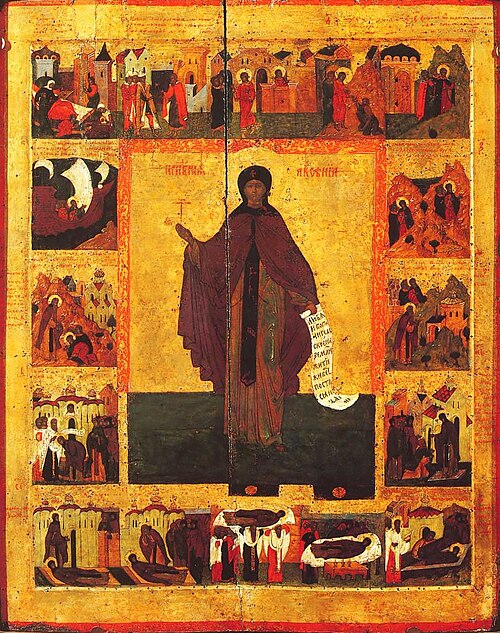
Venerable
Xenia of Rome
Only daughter of a wealthy Roman senator, who became a nun in Asia Minor in the fifth century.
- Feast
- January 24old style February 6
- Reposed
- 4505th century
- Place
- Milas
- Order
- Venerables
Life
The Holy Venerable Xenia of Rome (Xenia of Mylasa), in the world Eusebia, was a deaconess in the convent at Mylasa, in Caria, in the fifth century (according to some sources she fell asleep in 450, according to others no later than 457). Her feast is on 24 January.
Flight from Rome
She was born in a noble family of Rome, the only daughter of a wealthy senator, and was named Eusebia. From youth she was very pious and wished to devote her life to God. Her parents, however, had prepared another future for her: they had found a bridegroom and planned a splendid wedding. To avoid marriage, the girl fled secretly from her parents' house with two devoted maidservants (according to some sources, dressed in men's clothes). They arrived by ship on the island of Kos, near Halicarnassus, and stopped at the edge of the settlement. Then Eusebia changed her name to Xenia, which means "stranger," "traveller." She wished to hide in a deserted place so that her parents would not discover her. According to the Lives of the Saints of Saint Demetrius of Rostov, she said to her maids: "I ask you, for the Lord's sake, my sisters, let us keep our secret, let us tell no one of our country and our intentions, why we left home and what we are called, that my parents may not find me, searching by my name and by the country whence we came. If anyone asks my name, say that I am called Xenia, that is, stranger. For, as you see, I travel, leaving home and parents for God. And from now do not call me Eusebia, but Xenia, for I have no place of abiding here, but travel in this life together with you, caring for what is to come."
At Mylasa
On the island they met the presbyter Paul, abbot of the monastery of the Holy Apostle Andrew in the city of Mylasa, who became the spiritual father of Xenia and the two maids. From Kos they went to Mylasa, where Xenia, with means taken from her home, bought a plot of land and built a church in the name of the first martyr Stephen (in another source, she bought a small house and made it a convent). Soon a community of women who wished to lead the monastic life gathered around her. Paul tonsured her a nun, and when her spiritual father was made bishop of Mylasa, he ordained her deaconess. It is written of her that she "helped everyone: for the destitute she was a benefactress, for the grief-stricken a comforter, for sinners a guide to repentance," and she had deep humility, counting herself the worst and most sinful of all.
According to the account of the Life, she led a severe life, restraining herself in everything. It is said that the demons feared her self-restraint and fled, overcome by her fasting and struggles, not daring to approach. She ate once in two or three days, and many times remained a whole week without food; when the time came to eat she took neither greens, nor beans, nor wine, nor oil, nor garden vegetables, nor any other nourishing food, but only a little bread moistened with her tears. She took ashes from the censer and sprinkled them on her bread; this she did all the years of her life. Though a weak woman, she had a man's endurance in fasting, prayer and vigil; often she stood all night in prayer, and was dressed more poorly than all the sisters. It is said that she foresaw her own death. When her end came, she took leave of the sisters and remained a long time alone in the church, praying before the crucifix.
Her repose
Xenia fell asleep in the second half of the fifth century and was buried at the entrance of the city, in a place chosen by herself. Her noble origin was revealed by one of her maids before her death. It is told that at her funeral a wonderful sign appeared over the monastery: a luminous wreath of stars around a radiant cross, brighter than the sun, which accompanied the funeral procession to the place of burial. From her relics many sick received healing; beside her tomb many wonderful healings took place. Her maids followed their abbess's example in everything and, when they died, were buried, as they wished, at the feet of the blessed Xenia.
Veneration
Xenia of Rome was the heavenly patroness of Princess Xenia Godunova, hence her veneration in Russia at the turn of the sixteenth and seventeenth centuries. A wonderworking mosaic icon of the Venerable Xenia of Mylasa adorns the altar wall of the chapel of Saint Xenia the Blessed in Saint Petersburg.
Troparion, Tone 3: Living the life of a stranger in the world, you estranged yourself from every sin; you abandoned comforts and fleeting honors and betrothed yourself to your Immortal Bridegroom. Glorious Xenia, entreat Christ our God to grant us His great mercy.
Kontakion, Tone 2: We celebrate the memory of the life you lived as a stranger in the world, and as we honor you with love, O Xenia, we praise Christ, who gave you power to grant healing to all; ever pray to Him on our behalf.
Commemorated the same day January 24
 Xenia of St. PetersburgFool-for-Christ · Patron of St. PetersburgJan 24
 Cadoc of LlancarfanVenerable · Abbot of LlancarfanJan 24
 Neophytos the RecluseVenerable · Monk and priest of CyprusJan 24
 Felician of FolignoHieromartyr · Bishop of FolignoJan 24
 Savinianus of TroyesMartyr · Martyr of TroyesJan 24
 Exuperantius of CingoliSaint · Bishop of CingoliJan 24
 Macedonius the Barley-EaterVenerable · Hermit of SyriaJan 24
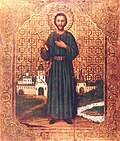 John of KazanMartyr · Martyr of KazanJan 24
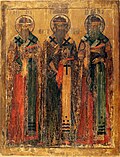 Gerasim of PermSaint · Bishop of PermJan 24
- Babylas of SicilyHieromartyr · Hermit in SicilyJan 24
- Alexander TelemakovHieromartyr · PriestJan 24
- Demetrius of TsilibinoVenerable · Founder of a hermitageJan 24