
Martyr
John of Kazan
Martyr of Kazan
Russian from Nizhny Novgorod, martyred at Kazan in 1529; commemorated on January 24.
- Feast
- January 24old style February 6
- Reposed
- 152916th century
- Place
- Kazan
- Order
- Martyrs
Life
Saint John of Kazan, Martyr, was a Russian Christian from Nizhny Novgorod, taken captive by the Tatars in his youth and put to death for his faith in Christ at Kazan, in the Kazan Khanate, on 24 January 1529. His commemoration is on 24 January (6 February in the new calendar), the day of his passing to the Lord, and in the Synaxis of the saints of Kazan. His life, a text of the sixteenth century written at the latest in the 1550s, is the main source about him. He remains in the memory of the Church of Kazan as one of the first martyrs of the city.
Captivity at Kazan
Of John of Kazan it is known that he came from Nizhny Novgorod. In the reign of Grand Prince of Moscow Vasily Ivanovich (the year 1505 is often given), the Kazan Tatars attacked Nizhny Novgorod. Many inhabitants were taken prisoner and led to Kazan. Among them was a God-fearing and pious young man named John. In the division of the prisoners he fell to a relative of the khan (the "tsar's uncle"), a "prince" named Aley-Shpur (in other sources Aley-Shnur or Aley-Shkur). The scholar R. P. Dmitrieva pointed out that from the Russian chronicles the name of "Prince Ali-Shukur" is known, whose son was killed at Kazan in 1531. His appearance is preserved from his life: "young, reddish, with a small beard".
Being young, he had been well taught in the Christian faith and had received a fine upbringing at home. He was accustomed to keep strictly the requirements of the Christian faith, fasted, disliked idleness and spent all his time in work and prayer. For this industry Aley-Shpur made him his personal servant. John fulfilled his duties diligently and bore captivity patiently, despite the mockery of the Muslims. Hoping in God's mercy, he spent his nights in prayer.
Martyrdom
Valuing him as a servant, Aley-Shpur wanted to make him turn to Islam. But John, meek, obedient in everything and diligent, said firmly that he confessed Jesus Christ as Lord and God. Neither caresses nor threats shook him. He told Aley-Shpur boldly that he was a Christian and that nothing would make him change his convictions. Even the torments to which he was subjected to make him renounce Christ did not achieve their aim. He not only defended the Christian faith with strength but also condemned the false teaching of Muhammad. Seeing, on the one hand, the futility of his attempts to turn John to Islam and, on the other, the firmness with which the martyr openly confessed Christ and called Muhammad a liar, Aley-Shpur, in anger, ordered in 1529 that John, who had served him faithfully, be put to death.
John's hands were bound with a strap and he was led out of the town, onto a hill nearby, where his head was to be cut off. Torturing him, the executioners inflicted many wounds and pierced his belly through with a sword. Finally they decided to cut off his head, but the blow was badly struck: they cut only his neck, and he fell unconscious, streaming with blood. The tormentors, thinking him dead, returned to the town. The lives testify that on that day there was a hard frost. For many hours John lay senseless and only late in the evening came to himself.
God, wishing to glorify His martyr, gave him strength enough to rise: his hands were loosed of themselves, and, making the sign of the cross and supporting his head with his hands, he set out for the town, to the boyars of the grand prince of Moscow who lived there. Reaching the boyars late at night, John told them of the torments he had endured from the Muslims. The wounds were mortal. Feeling the end near, he asked the priest who was with the boyars to give him communion of the Holy Mysteries of Christ. After communion he spent the rest of the night without sleep, in prayer, and in the morning at sunrise gave his soul into the hands of God. The martyr's body was buried secretly "in the old Russian cemetery" near Kazan, probably on the site where the Zilant Dormition monastery now stands.
Veneration
In 1592 the first metropolitan of Kazan, Hermogenes (later patriarch of Moscow), wrote to Patriarch Job that at Kazan there was no special commemoration of the Orthodox soldiers who gave their lives for the faith and fatherland near Kazan, and asked that a day of commemoration be set. At the same time he reported three martyrs who had suffered at Kazan for faith in Christ: one Russian, John ("Ivan the New"), from Nizhny Novgorod, taken captive by the Tatars, and two, Stephen and Peter, recently baptized Tatars, who died for their faith at the hands of their former co-religionists. The hierarch expressed regret that these martyrs were not entered in the synodikon read on the Sunday of Orthodoxy and that "eternal memory" was not sung for them.
In reply, Patriarch Job sent a decree that ordered "for all the Orthodox soldiers killed near Kazan and within the Kazan borders, a memorial service to be held at Kazan and in the whole metropolis of Kazan on the Saturday after the Protection of the Mother of God, and that they be entered in the great synodikon read on the Sunday of Orthodoxy". The same synodikon was to include the three Kazan martyrs, and the day of their commemoration was left to Metropolitan Hermogenes. He announced the patriarchal decree in his diocese, adding that in all churches and monasteries Liturgies and memorial services be served for the three martyrs of Kazan and that they be commemorated at litiyas and Liturgies on 24 January, the day of John of Kazan's martyr's death. So, through Metropolitan Hermogenes's petition, the glorification throughout the Church of the first martyrs of Kazan began, among whom was John.
Saint John the Martyr was honoured in the Zilant Dormition monastery throughout its existence. The sisters of the monastery honour him with devotion and begin no important work without prayer to him. Until the destruction of the monastery, a venerated icon of the saint, full length, stood in the Dormition church, which vanished when the monastery was looted. In 2005 the sisters restored a copy of that icon, which is kept to this day in the monastery's great church. In 2006 the diocese of Kazan and Tatarstan printed, on the sisters' initiative, the booklet "Holy Martyr John of Kazan", with his life and an akathist.
Commemorated the same day January 24
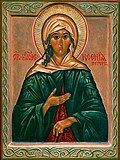 Xenia of St. PetersburgFool-for-Christ · Patron of St. PetersburgJan 24
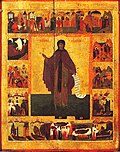 Xenia of RomeVenerableJan 24
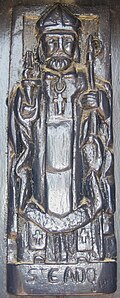 Cadoc of LlancarfanVenerable · Abbot of LlancarfanJan 24
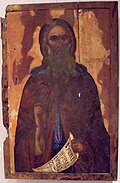 Neophytos the RecluseVenerable · Monk and priest of CyprusJan 24
 Felician of FolignoHieromartyr · Bishop of FolignoJan 24
 Savinianus of TroyesMartyr · Martyr of TroyesJan 24
 Exuperantius of CingoliSaint · Bishop of CingoliJan 24
 Macedonius the Barley-EaterVenerable · Hermit of SyriaJan 24
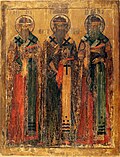 Gerasim of PermSaint · Bishop of PermJan 24
- Babylas of SicilyHieromartyr · Hermit in SicilyJan 24
- Alexander TelemakovHieromartyr · PriestJan 24
- Demetrius of TsilibinoVenerable · Founder of a hermitageJan 24